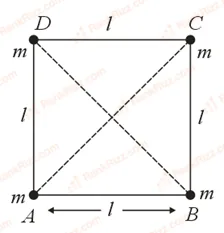
Four equal masses, each are placed at the corners of a square of length as shown in the figure. The moment of inertia of the system about an axis passing through and parallel to would be:
- A
- B
- C
- D
Moment of inertia of standard bodies and composite systems has been asked 73 times in JEE Main, in 15 different years between 2004 and 2026, and in all of the last five exam years (2022–2026), 31 questions in all. That is 26% of Rotational Motion, its most-asked topic. Last asked in JEE Main 04 Apr 2026, Shift 1. 45 are multiple choice and 28 numerical-value; 21 easy, 47 medium and 1 hard by our difficulty labels. All of them are below, newest first, free to read.
Questions
73
Years asked
15
Since
2004
Of the chapter
26%
41–60 OF 73 · NEWEST FIRST
Four equal masses, each are placed at the corners of a square of length as shown in the figure. The moment of inertia of the system about an axis passing through and parallel to would be:

Moment of inertia M.I. of four bodies, having same mass and radius, are reported as;
= M.I. of thin circular ring about its diameter,
= M.I. of circular disc about an axis perpendicular to disc and going through the centre,
= M.I. of solid cylinder about its axis and
= M.I. of solid sphere about its diameter.
Then:
A uniform thin bar of mass 6 kg and length 2.4 meter is bent to make an equilateral hexagon. The moment of inertia about an axis passing through the centre of mass and perpendicular to the plane of hexagon is ______ kg m.
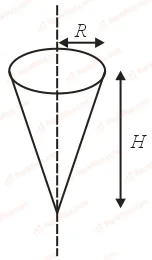
Shown in the figure is a hollow ice-cream cone (it is open at top). If its mass is M, radius of its top is R and height, H, then its moment of inertia about its axis is:

The linear mass density of a thin rod AB of length L varies from A to B as , where is the distance from A. If M is the mass of the rod then its moment of inertia about an axis passing through A and perpendicular to the rod is:
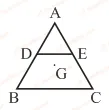
ABC is a plane lamina of the shape of an equilateral triangle. D, E are mid-points of AB, AC and G is the centroid of the lamina. Moment of inertia of the lamina about an axis passing through G and perpendicular to the plane ABC is . If part ADE is removed, the moment of inertia of the remaining part about the same axis is where N is an integer. Value of N is:

Consider two uniform discs of the same thickness and different radii and made of the same material. If the ratio of their moments of inertia and , respectively, about their axes is then the value of is:
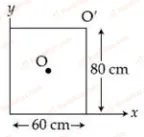
For a uniform rectangular sheet shown in the figure, the ratio of moments of inertia about the axes perpendicular to the sheet and passing through O (the centre of mass) and O' (corner point) is:

2/3
1/4
1/8
1/2
Moment of inertia of a cylinder of mass , length and radius about an axis passing through its centre and perpendicular to the axis of the cylinder is . If such a cylinder is to be made for a given mass of a material, the ratio for it to have minimum possible is:
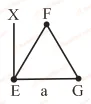
An massless equilateral triangle EFG of side 'a' (As shown in figure) has three particles of mass m situated at its vertices. The moment of inertia of the system about the line EX perpendicular to EG in the plane of EFG is where N is an integer. The value of N is __________.

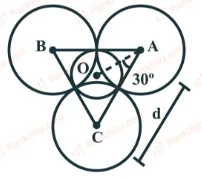
Three solid spheres each of mass and diameter are stuck together such that the lines connecting the centres form an equilateral triangle of side of length . The ratio of moment of inertia of the system about an axis passing the centroid and about center of any of the spheres and perpendicular to the plane of the triangle is:

The radius of gyration of a uniform rod of length , about an axis passing through a point away from the centre of the rod, and perpendicular to it, is:
Mass per unit area of a circular disc of radius a depends on the distance r from its centre as . The moment of inertia of the disc about the axis, perpendicular to the plane and passing through its centre is:
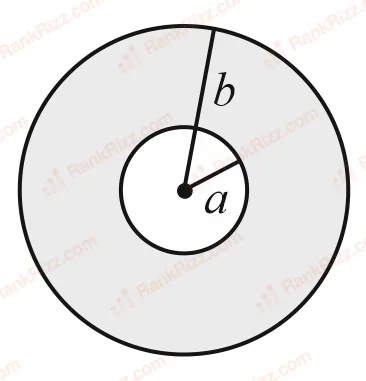
A circular disc of radius b has a hole of radius a at its centre (see figure). If the mass per unit area of the disc varies as , then the radius of gyration of the disc about its axis passing through the center is

A thin disc of mass M and radius R has mass per unit area where r is the distance from its centre. Its moment of inertia about an axis going through its centre of mass and perpendicular to its plane is:
A solid sphere of mass M and radius R is divided into two unequal parts. The first part has a mass of and is converted into uniform disc of radius 2R. The second part is converted into a uniform solid sphere. Let I be the moment of inertia of the disc about its axis and I be the moment of inertia of the new sphere about its axis. The ratio I/I is given by:
140
185
65
285
Moment of inertia of a body about a given axis is 1.5 kg m. Initially the body is at rest. In order to produce a rotational kinetic energy of 1200 J, the angular acceleration of 20 rad/s must be applied about the axis for a duration of:
3 s
2 s
2.5 s
5 s
A thin circular plate of mass and radius has its density varying as with as constant and is the distance from its centre. The moment of Inertia of the circular plate about an axis perpendicular to the plate and passing through its edge is . The value of the coefficient is:
Let the moment of inertia of a hollow cylinder of length 30 cm (inner radius 10 cm and outer radius 20 cm), about its axis be I. The radius of a thin cylinder of the same mass such that its moment of inertia about its axis is also I, is:
16 cm
14 cm
12 cm
18 cm
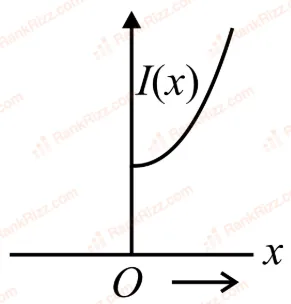
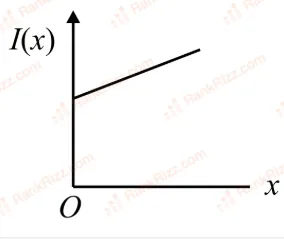
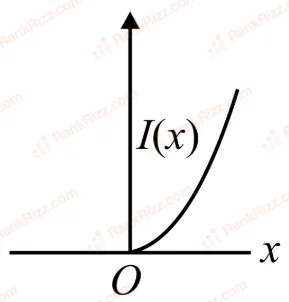
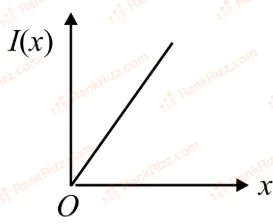
The moment of inertia of a solid sphere, about an axis parallel to its diameter and at a distance of x from it, is . Which one of the graphs represents the variation of with x correctly?


RELATED ROTATIONAL MOTION TOPICS