RankRizz

Fixed-axis rotation: kinematics, rotational energy and pulleys — JEE Main Previous Year Questions

Fixed-axis rotation: kinematics, rotational energy and pulleys has been asked 26 times in JEE Main, in 9 different years between 2009 and 2026, and in 4 of the last five exam years (2022–2026), 19 questions in all. That is 9% of Rotational Motion. Last asked in JEE Main 06 Apr 2026, Shift 1. 18 are multiple choice and 8 numerical-value; 8 easy, 14 medium and 2 hard by our difficulty labels. All of them are below, newest first, free to read.

Questions

26

Years asked

9

Since

2009

Of the chapter

9%

Every Fixed-axis rotation: kinematics, rotational energy and pulleys question

21–26 OF 26 · NEWEST FIRST

JEE MAIN 2021 · 17 MAR S1Fixed-axis rotation: kinematics, rotational energy and pulleys

The angular speed of truck wheel is increased from 900 rpm to 2460 rpm in 26 seconds. The number of revolutions by the truck engine during this time is ________. (Assuming the acceleration to be uniform).
JEE MAIN 2020 · 09 JAN S1Fixed-axis rotation: kinematics, rotational energy and pulleys

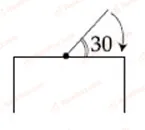
One end of a straight uniform 1  m1 \; m long bar is pivoted on horizontal table. It is released from rest when it makes an angle 30°30° from the horizontal (see figure). Its angular speed when it hits the table is given as n\sqrt{n} rad s−1s^{-1}, where nn is an integer. The value of nn is ___________.

Figure for JEE Main 2020 Physics question on Fixed-axis rotation: kinematics, rotational energy and pulleys
JEE MAIN 2019 · 09 APR S1Fixed-axis rotation: kinematics, rotational energy and pulleys

A stationary horizontal disc is free to rotate about its axis. When a torque is applied on it, its kinetic energy as a function of θ\theta, where θ\theta is the angle by which it has rotated, is given as kθ2k\theta^2. If its moment of inertia is I then the angular acceleration of the disc is:

  1. A

    2kIθ\frac{2k}{I}\theta

  2. B

    k2Iθ\frac{k}{2I}\theta

  3. C

    k4Iθ\frac{k}{4I}\theta

  4. D

    kIθ\frac{k}{I}\theta

JEE MAIN 2019 · 09 JAN S1Fixed-axis rotation: kinematics, rotational energy and pulleys

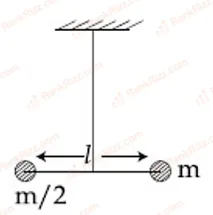
Two masses mm and m2\frac{m}{2} are connected at the two ends of a massless rigid rod of length ll. The rod is suspended by a thin wire of torsional constant kk at the centre of mass of the rod-mass system (see figure). Because of torsional constant kk, the restoring torque is τ=kθ\tau = k\theta for angular displacement θ\theta. If the rod is rotated by θ0\theta_0 and released, the tension in it when it passes through its mean position will be:

Figure for JEE Main 2019 Physics question on Fixed-axis rotation: kinematics, rotational energy and pulleys
  1. A

    kθ02k\theta_0^2

  2. B

    3kθ02l\frac{3k\theta_0^2}{l}

  3. C

    2kθ02l\frac{2k\theta_0^2}{l}

  4. D

    kθ02l\frac{k\theta_0^2}{l}

JEE MAIN 2011Fixed-axis rotation: kinematics, rotational energy and pulleys

A mass mm hangs with the help of a string wrapped around a pulley on a frictionless bearing. The pulley has mass mm and radius RR. Assuming pulley to be a perfect uniform circular disc, the acceleration of the mass mm, if the string does not slip on the pulley, is:

  1. A

    gg

  2. B

    23g\dfrac{2}{3}g

  3. C

    g3\dfrac{g}{3}

  4. D

    32g\dfrac{3}{2}g

JEE MAIN 2009Fixed-axis rotation: kinematics, rotational energy and pulleys

A thin uniform rod of length ℓ\ell and mass mm is swinging freely about a horizontal axis passing through its end. Its maximum angular speed is ω\omega. Its centre of mass rises to a maximum height of

  1. A

    13ℓ2ω2g\frac{1}{3}\frac{\ell^2\omega^2}{g}

  2. B

    16ℓωg\frac{1}{6}\frac{\ell\omega}{g}

  3. C

    12ℓ2ω2g\frac{1}{2}\frac{\ell^2\omega^2}{g}

  4. D

    16ℓ2ω2g\frac{1}{6}\frac{\ell^2\omega^2}{g}