RankRizz

Angular momentum of particles and rigid bodies — JEE Main Previous Year Questions

Angular momentum of particles and rigid bodies has been asked 48 times in JEE Main, in 15 different years between 2007 and 2026, and in all of the last five exam years (2022–2026), 18 questions in all. That is 17% of Rotational Motion, one of its three most-asked topics. Last asked in JEE Main 28 Jan 2026, Shift 2. 34 are multiple choice and 14 numerical-value; 7 easy, 37 medium and 2 hard by our difficulty labels. All of them are below, newest first, free to read.

Questions

48

Years asked

15

Since

2007

Of the chapter

17%

Every Angular momentum of particles and rigid bodies question

21–40 OF 48 · NEWEST FIRST

JEE MAIN 2021 · 27 AUG S2Angular momentum of particles and rigid bodies

Two discs have moments of inertia I1I_1 and I2I_2 about their respective axes perpendicular to the plane and passing through the centre. They are rotating with angular speeds, ω1\omega_1 and ω2\omega_2 respectively and are brought into contact face to face with their axes of rotation coaxial. The loss in kinetic energy of the system in the process is given by:

  1. A

    I1I2(I1+I2)(ω1−ω2)2\frac{I_1 I_2}{(I_1+I_2)}(\omega_1 - \omega_2)^2

  2. B

    (ω1−ω2)22(I1+I2)\frac{(\omega_1-\omega_2)^2}{2(I_1+I_2)}

  3. C

    I1I22(I1+I2)(ω1−ω2)2\frac{I_1 I_2}{2(I_1+I_2)}(\omega_1 - \omega_2)^2

  4. D

    (I1−I2)2ω1ω22(I1+I2)\frac{(I_1-I_2)^2 \omega_1 \omega_2}{2(I_1+I_2)}

JEE MAIN 2021 · 25 JUL S1Angular momentum of particles and rigid bodies

A particle of mass mm is moving in time tt on a trajectory given by,
r⃗=10αt2i^+5β(t−5)j^\vec{r} = 10\alpha t^2 \hat{i} + 5\beta (t - 5)\hat{j}
where α\alpha and β\beta are dimensional constants. The angular momentum of the particle becomes the same as it was for t=0t = 0 at time t=t = ___ seconds.

JEE MAIN 2021 · 17 MAR S1Angular momentum of particles and rigid bodies

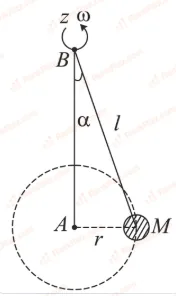
A mass MM hangs on a massless rod of length ll which rotates at a constant angular frequency. The mass MM moves with steady speed in a circular path of constant radius. Assume that the system is in steady circular motion with constant angular velocity ω\omega. The angular momentum of MM about point AA is LAL_A which lies in the positive zz direction and the angular momentum of MM about BB is LBL_B. The correct statement for this system is:

Figure for JEE Main 2021 Physics question on Angular momentum of particles and rigid bodies
  1. A

    LAL_A and LBL_B are both constant in magnitude and direction

  2. B

    LBL_B is constant in direction with varying magnitude

  3. C

    LBL_B is constant, both in magnitude and direction

  4. D

    LAL_A is constant, both in magnitude and direction

JEE MAIN 2021 · 26 FEB S2Angular momentum of particles and rigid bodies

A cord is wound round the circumference of wheel of radius rr. The axis of the wheel is horizontal and the moment of inertia about it is II. A weight mgmg is attached to the cord at the end. The weight falls from rest. After falling through a distance h, the square of angular velocity of wheel will be

  1. A

    2mghI+mr2\frac{2mgh}{I + mr^2}

  2. B

    2mghI+2mr2\frac{2mgh}{I + 2mr^2}

  3. C

    2gh2gh

  4. D

    2ghI+mr2\frac{2gh}{I + mr^2}

JEE MAIN 2020 · 06 SEP S1Angular momentum of particles and rigid bodies

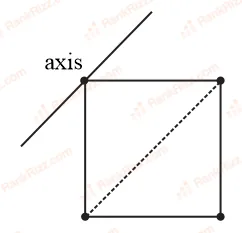
Four point masses, each of mass mm, are fixed at the corners of a square of side ll. The square is rotating with angular frequency ω\omega, about an axis passing through one of the corners of the square and parallel to its diagonal, as shown in the figure. The angular momentum of the square about the axis is:

Figure for JEE Main 2020 Physics question on Angular momentum of particles and rigid bodies
  1. A

    ml2ωml^2\omega

  2. B

    4ml2ω4ml^2\omega

  3. C

    3ml2ω3ml^2\omega

  4. D

    2ml2ω2ml^2\omega

JEE MAIN 2020 · 05 SEP S1Angular momentum of particles and rigid bodies

A wheel is rotating freely with an angular speed ω\omega on a shaft. The moment of inertia of the wheel is II and the moment of inertia of the shaft is negligible. Another wheel of moment of inertia 3I3I initially at rest is suddenly coupled to the same shaft. The resultant fractional loss in the kinetic energy of the system is:

  1. A

    56\frac{5}{6}

  2. B

    14\frac{1}{4}

  3. C

    0

  4. D

    34\frac{3}{4}

JEE MAIN 2020 · 05 SEP S2Angular momentum of particles and rigid bodies

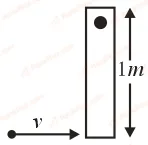
A thin rod of mass 0.9 kg0.9\,\text{kg} and length 1 m1\,\text{m} is suspended, at rest, from one end so that it can freely oscillate in the vertical plane. A particle of mass 0.1 kg0.1\,\text{kg} moving in a straight line with velocity 80 m s−180\,\text{m s}^{-1} hits the rod at its bottom most point and sticks to it (see figure). The angular speed (in rad s−1\text{rad s}^{-1}) of the rod immediately after the collision will be...........

Figure for JEE Main 2020 Physics question on Angular momentum of particles and rigid bodies
JEE MAIN 2020 · 04 SEP S1Angular momentum of particles and rigid bodies

A circular disc of mass M and radius R is rotating about its axis with angular speed ω1\omega_1. If another stationary disc having radius R2\frac{R}{2} and same mass M is dropped co-axially on to the rotating disc. Gradually both discs attain constant angular speed ω2\omega_2. The energy lost in the process is p% of the initial energy. Value of p is

JEE MAIN 2020 · 03 SEP S1Angular momentum of particles and rigid bodies

A person of 80 kg mass is standing on the rim of a circular platform of mass 200 kg rotating about its axis at 5 revolutions per minute (rpm). The person now starts moving towards the centre of the platform. What will be the rotational speed (in rpm) of the platform when the person reaches its centre....

JEE MAIN 2020 · 02 SEP S2Angular momentum of particles and rigid bodies

Two uniform circular discs are rotating independently in the same direction around their common axis passing through their centres. The moment of inertia and angular velocity of the first disc are 0.1 kg - m2^2 and 10 rad s−1^{-1} respectively while those for the second one are 0.2 kg - m2^2 and 5 rad s−1^{-1} respectively. At some instant they get stuck together and start rotating as a single system about their common axis with some angular speed. The kinetic energy of the combined system is:

  1. A

    103\frac{10}{3} J

  2. B

    203\frac{20}{3} J

  3. C

    53\frac{5}{3} J

  4. D

    23\frac{2}{3} J

JEE MAIN 2020 · 09 JAN S2Angular momentum of particles and rigid bodies

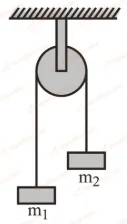
A uniformly thick wheel with moment of inertia II and radius RR is free to rotate about its centre of mass (see fig). A massless string is wrapped over its rim and two blocks of masses m1m_1 and m2m_2 (m1>m2)(m_1 > m_2) are attached to the ends of the string. The system is released from rest. The angular speed of the wheel when m1m_1 descends by a distance hh is:

Figure for JEE Main 2020 Physics question on Angular momentum of particles and rigid bodies
  1. A

    [2(m1−m2)gh(m1+m2)R2+I]12\left[\dfrac{2(m_1-m_2)gh}{(m_1+m_2)R^2+I}\right]^{\dfrac{1}{2}}

  2. B

    [2(m1+m2)gh(m1+m2)R2+I]12\left[\dfrac{2(m_1+m_2)gh}{(m_1+m_2)R^2+I}\right]^{\dfrac{1}{2}}

  3. C

    [(m1−m2)(m1+m2)R2+1]12gh\left[\dfrac{(m_1-m_2)}{(m_1+m_2)R^2+1}\right]^{\dfrac{1}{2}}gh

  4. D

    [m1+m2(m1+m2)R2+I]12gh\left[\dfrac{m_1+m_2}{(m_1+m_2)R^2+I}\right]^{\dfrac{1}{2}}gh

JEE MAIN 2020 · 08 JAN S1Angular momentum of particles and rigid bodies

Consider a uniform rod of mass M=4M = 4 m and length ll pivoted about its centre. A mass mm moving with velocity vv making angle θ=π4\theta = \frac{\pi}{4} to the rod's long axis collides with one end of the rod and sticks to it. The angular speed of the rod-mass system just after the collision is:

  1. A

    372vl\frac{3}{7\sqrt{2}} \frac{v}{l}

  2. B

    37vl\frac{3}{7} \frac{v}{l}

  3. C

    327vl\frac{3\sqrt{2}}{7} \frac{v}{l}

  4. D

    47vl\frac{4}{7} \frac{v}{l}

JEE MAIN 2019 · 12 APR S1Angular momentum of particles and rigid bodies

A person of mass M is sitting on a swing of length L and swinging with an angular amplitude θ0\theta_0. If the person stands up when the swing passes through its lowest point, the work done by him, assuming that his centre of mass moves by a distance ll (l<<Ll << L), is close to:

  1. A

    Mgl(1−θ02)Mgl(1 - \theta_0^2)

  2. B

    Mgl(1+θ022)Mgl\left(1 + \frac{\theta_0^2}{2}\right)

  3. C

    MglMgl

  4. D

    Mgl(1+θ02)Mgl(1 + \theta_0^2)

JEE MAIN 2019 · 10 APR S2Angular momentum of particles and rigid bodies

The time dependence of the position of a particle of mass m = 2 is given by r⃗(t)=2ti^−3t2j^\vec{r}(t) = 2t\hat{i} - 3t^2\hat{j}. Its angular momentum, with respect to the origin, at time t = 2 is:

  1. A

    36k^36\hat{k}

  2. B

    48i^+j^48\hat{i} + \hat{j}

  3. C

    −48k^-48\hat{k}

  4. D

    −34k^−i^-34\hat{k} - \hat{i}

JEE MAIN 2019 · 09 APR S2Angular momentum of particles and rigid bodies

A thin smooth rod of length L and mass M is rotating freely with angular speed ω0\omega_0 about an axis perpendicular to the rod and passing through center. Two beads of mass m and negligible size are at the center of the rod initially.The beads of mass mm and negligible size are at the center of the rod initially. The beads are free to slide along the rod. The angular speed of the system, when the beads reach the opposite ends of the rod, will be:

  1. A

    Mω0M+3m\frac{M\omega_0}{M + 3m}

  2. B

    Mω0M+2m\frac{M\omega_0}{M + 2m}

  3. C

    Mω0M+6m\frac{M\omega_0}{M + 6m}

  4. D

    Mω0M+m\frac{M\omega_0}{M + m}

JEE MAIN 2019 · 08 APR S2Angular momentum of particles and rigid bodies

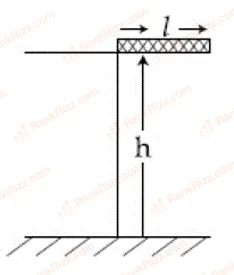
A rectangular solid box of length 0.3 m is held horizontally, with one of its sides on the edge of a platform of height 5 m. When released, it slips off the table in a very short time τ=0.01\tau = 0.01 s, remaining essentially horizontal. The angle by which it would rotate when it hits the ground will be (in radians) close to:

Figure for JEE Main 2019 Physics question on Angular momentum of particles and rigid bodies
  1. A

    0.5

  2. B

    0.3

  3. C

    0.02

  4. D

    0.28

JEE MAIN 2019 · 12 JAN S2Angular momentum of particles and rigid bodies

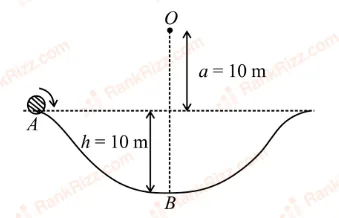
A particle of mass 20 g is released with an initial velocity 5 m s−1^{-1} along the curve from the point A, as shown in the figure. The point A is at height h from point B. The particle slides along the frictionless surface. When the particle reaches point B, its angular momentum about O will be: (Take g=10g = 10 m s−2^{-2})

Figure for JEE Main 2019 Physics question on Angular momentum of particles and rigid bodies
  1. A

    3 kg m2^2 s−1^{-1}

  2. B

    2 kg m2^2 s−1^{-1}

  3. C

    6 kg m2^2 s−1^{-1}

  4. D

    8 kg m2^2 s−1^{-1}

JEE MAIN 2018 · 15 APR S2Angular momentum of particles and rigid bodies

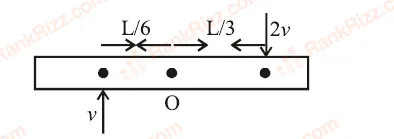
A thin uniform bar of length L and mass 8 m lies on a smooth horizontal table. Two point masses m and 2 m moving in the same horizontal plane from opposite sides of the bar with speeds 2v and v respectively. The masses stick to the bar after collision at a distance L3\frac{L}{3} and L6\frac{L}{6} respectively from the centre of the bar. If the bar starts rotating about its center of mass as a result of collision, the angular speed of the bar will be:

Figure for JEE Main 2018 Physics question on Angular momentum of particles and rigid bodies
  1. A

    v6L\frac{v}{6L}

  2. B

    6v5L\frac{6v}{5L}

  3. C

    3v5L\frac{3v}{5L}

  4. D

    v5L\frac{v}{5L}

JEE MAIN 2016 · 09 APR ONLINEAngular momentum of particles and rigid bodies

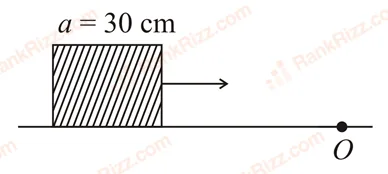
A cubical block of side 30 cm is moving with velocity 2 m s−1^{-1} on a smooth horizontal surface. The surface has a bump at a point O as shown in the figure. The angular velocity (in rad/s) of the block immediately after it hits the bump, is:

Figure for JEE Main 2016 Physics question on Angular momentum of particles and rigid bodies
  1. A

    13.3

  2. B

    5.0

  3. C

    9.4

  4. D

    6.7

JEE MAIN 2016 · 03 APR OFFLINEAngular momentum of particles and rigid bodies

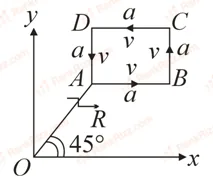
A particle of mass m is moving along the side of a square of side 'a', with a uniform speed v in the x-y plane as shown in the figure:

Figure for JEE Main 2016 Physics question on Angular momentum of particles and rigid bodies


Which of the following statements is false for the angular momentum L⃗\vec{L} about the origin?

  1. A

    L⃗=mv[R2+a]k^\vec{L} = mv\left[\frac{R}{\sqrt{2}} + a\right]\hat{k} when the particle is moving from B to C.

  2. B

    L⃗=mv2Rk^\vec{L} = \frac{mv}{\sqrt{2}}R\hat{k} when the particle is moving from D to A.

  3. C

    L⃗=−mv2Rk^\vec{L} = -\frac{mv}{\sqrt{2}}R\hat{k} when the particle is moving from A to B.

  4. D

    L⃗=mv[R2+a]k^\vec{L} = mv\left[\frac{R}{\sqrt{2}} + a\right]\hat{k} when the particle is moving from C to D.