RankRizz

Newton's laws, free-body diagrams and equilibrium of a particle — JEE Main Previous Year Questions

Newton's laws, free-body diagrams and equilibrium of a particle has been asked 53 times in JEE Main, in 14 different years between 2007 and 2026, and in all of the last five exam years (2022–2026), 33 questions in all. That is 35% of Laws of Motion & Friction, its most-asked topic. Last asked in JEE Main 04 Apr 2026, Shift 2. 48 are multiple choice and 5 numerical-value; 28 easy, 19 medium and 2 hard by our difficulty labels. All of them are below, newest first, free to read.

Questions

53

Years asked

14

Since

2007

Of the chapter

35%

Every Newton's laws, free-body diagrams and equilibrium of a particle question

21–40 OF 53 · NEWEST FIRST

JEE MAIN 2023 · 08 APR S1Newton's laws, free-body diagrams and equilibrium of a particle

At any instant the velocity of a particle of mass 500 g is (2ti^+3t2j^)(2t\hat{i} + 3t^2\hat{j}) m s−1^{-1}. If the force acting on the particle at t=1t = 1 s is (i^+xj^)(\hat{i} + x\hat{j}) N. Then the value of xx will be:

  1. A

    3

  2. B

    4

  3. C

    2

  4. D

    6

JEE MAIN 2023 · 31 JAN S1Newton's laws, free-body diagrams and equilibrium of a particle

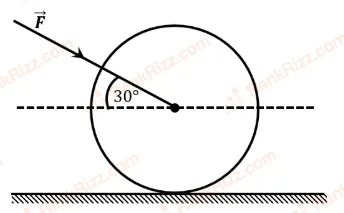
As shown in figure, a 70 kg garden roller is pushed with a force of F⃗=200\vec{F} = 200 N at an angle of 30° with horizontal. The normal reaction on the roller is (Given g=10g = 10 m s−2^{-2})

Figure for JEE Main 2023 Physics question on Newton's laws, free-body diagrams and equilibrium of a particle
  1. A

    8002800\sqrt{2} N

  2. B

    600 N

  3. C

    800 N

  4. D

    2003200\sqrt{3} N

JEE MAIN 2023 · 30 JAN S2Newton's laws, free-body diagrams and equilibrium of a particle

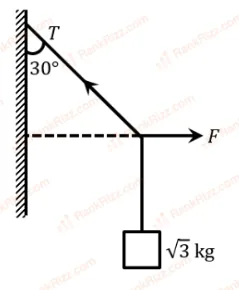
A block of 3\sqrt{3} kg is attached to a string whose other end is attached to the wall. An unknown force FF is applied so that the string makes an angle of 30°30° with the wall. The tension TT is: (Given g=10g = 10 m s−2^{-2})

Figure for JEE Main 2023 Physics question on Newton's laws, free-body diagrams and equilibrium of a particle
  1. A

    2020 N

  2. B

    2525 N

  3. C

    1010 N

  4. D

    1515 N

JEE MAIN 2023 · 29 JAN S2Newton's laws, free-body diagrams and equilibrium of a particle

Force acts for 2020 s on a body of mass 2020 kg, starting from rest, after which the force ceases and then body describes 5050 m in the next 1010 s. The value of force will be:

  1. A

    4040 N

  2. B

    55 N

  3. C

    2020 N

  4. D

    1010 N

JEE MAIN 2022 · 28 JUL S1Newton's laws, free-body diagrams and equilibrium of a particle

A balloon has mass of 10 g in air. The air escapes from the balloon at a uniform rate with velocity 4.5 cm s−1^{-1}. If the balloon shrinks in 5 s completely. Then, the average force acting on that balloon will be (in dyne).

  1. A

    3

  2. B

    9

  3. C

    12

  4. D

    18

JEE MAIN 2022 · 26 JUL S1Newton's laws, free-body diagrams and equilibrium of a particle

A monkey of mass 50 kg50 \text{ kg} climbs on a rope which can withstand the tension (TT) of 350 N350 \text{ N}. If monkey initially climbs down with an acceleration of 4 m s−24 \text{ m s}^{-2} and then climbs up with an acceleration of 5 m s−25 \text{ m s}^{-2}. Choose the correct option (g=10 m s−2g = 10 \text{ m s}^{-2})

  1. A

    T=700 NT = 700 \text{ N} while climbing upward

  2. B

    T=350 NT = 350 \text{ N} while going downward

  3. C

    Rope will break while climbing upward

  4. D

    Rope will break while going downward

JEE MAIN 2022 · 25 JUL S1Newton's laws, free-body diagrams and equilibrium of a particle

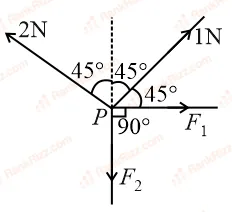
Four forces are acting at a point PP in equilibrium as shown in figure. The ratio of force F1F_1 to F2F_2 is 1:x1:x where x=x = ______.

Figure for JEE Main 2022 Physics question on Newton's laws, free-body diagrams and equilibrium of a particle
JEE MAIN 2022 · 25 JUL S2Newton's laws, free-body diagrams and equilibrium of a particle

For a free body diagram shown in the figure, the four forces are applied in the 'xx' and 'yy' directions. What additional force must be applied and at what angle with positive xx-axis so that the net acceleration of body is zero?
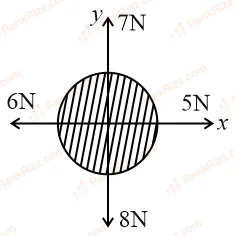
Figure for JEE Main 2022 Physics question on Newton's laws, free-body diagrams and equilibrium of a particle
  1. A

    2 N,45°\sqrt{2} \text{ N}, 45°

  2. B

    2 N,135°\sqrt{2} \text{ N}, 135°

  3. C

    23 N,30°\dfrac{2}{\sqrt{3}} \text{ N}, 30°

  4. D

    2 N,45°2 \text{ N}, 45°

JEE MAIN 2022 · 29 JUN S1Newton's laws, free-body diagrams and equilibrium of a particle

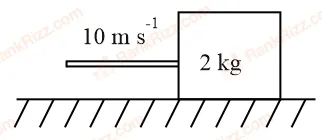
A block of metal weighing 2 kg is resting on a frictionless plane (as shown in figure). It is struck by a jet releasing water at a rate of 1 kg s−1^{-1} and at a speed of 10 m s−1^{-1}. Then, the initial acceleration of the block, in m s−2^{-2}, will be
Figure for JEE Main 2022 Physics question on Newton's laws, free-body diagrams and equilibrium of a particle

  1. A

    3

  2. B

    6

  3. C

    5

  4. D

    4

JEE MAIN 2022 · 27 JUN S2Newton's laws, free-body diagrams and equilibrium of a particle

A mass of 1010 kg is suspended vertically by a rope of length 55 m from the roof. A force of 3030 N is applied at the middle point of rope in horizontal direction. The angle made by upper half of the rope with vertical is α=tan⁡−1(x×10−1)\alpha = \tan^{-1}(x \times 10^{-1}). The value of xx is ______.
(Given, g=10g = 10 m s−2^{-2})

JEE MAIN 2022 · 25 JUN S1Newton's laws, free-body diagrams and equilibrium of a particle

A force on an object of mass 100100 g is (10i^+5j^)(10\hat{i} + 5\hat{j}) N. The position of that object at t=2t = 2 s is ai^+bj^a\hat{i} + b\hat{j} m after starting from rest. The value of ab\frac{a}{b} will be ______.

JEE MAIN 2022 · 25 JUN S2Newton's laws, free-body diagrams and equilibrium of a particle

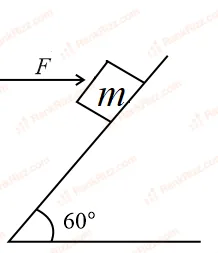
A block of mass 200200 g is kept stationary on a smooth inclined plane by applying a minimum horizontal force F=xF = \sqrt{x} N as shown in figure. The value of xx = ______.

Figure for JEE Main 2022 Physics question on Newton's laws, free-body diagrams and equilibrium of a particle
JEE MAIN 2022 · 24 JUN S2Newton's laws, free-body diagrams and equilibrium of a particle

An object of mass 55 kg is thrown vertically upwards from the ground. The air resistance produces a constant retarding force of 1010 N throughout the motion. The ratio of time of ascent to the time of descent will be equal to : [Use g=10g = 10 m s−2^{-2}]

  1. A

    1:11 : 1

  2. B

    2:3\sqrt{2} : \sqrt{3}

  3. C

    3:2\sqrt{3} : \sqrt{2}

  4. D

    2:32 : 3

JEE MAIN 2021 · 31 AUG S2Newton's laws, free-body diagrams and equilibrium of a particle

Statement I: If three forces F⃗1\vec{F}_1, F⃗2\vec{F}_2 and F⃗3\vec{F}_3 are represented by three sides of a triangle and F⃗1+F⃗2=−F⃗3\vec{F}_1 + \vec{F}_2 = -\vec{F}_3, then these three forces are concurrent forces and satisfy the condition for equilibrium.
Statement II: A triangle made up of three forces F⃗1\vec{F}_1, F⃗2\vec{F}_2 and F⃗3\vec{F}_3 as its sides were taken in the same order, satisfies the condition for translatory equilibrium.
In the light of the above statements, choose the most appropriate answer from the options given below:

  1. A

    Both Statement I and Statement II are true.

  2. B

    Statement I is true but Statement II is false.

  3. C

    Both Statement I and Statement II are false.

  4. D

    Statement I is false but Statement II is true.

JEE MAIN 2021 · 27 JUL S2Newton's laws, free-body diagrams and equilibrium of a particle

A particle of mass MM originally at rest is subjected to a force whose direction is constant but magnitude varies with time according to the relation F=F0[1−(t−TT)2]F = F_0\left[1 - \left(\frac{t-T}{T}\right)^2\right] where F0F_0 and TT are constants. The force acts only for the time interval 2T2T. The velocity vv of the particle after time 2T2T is:

  1. A

    2F0TM\frac{2F_0 T}{M}

  2. B

    F0T2M\frac{F_0 T}{2M}

  3. C

    4F0T3M\frac{4F_0 T}{3M}

  4. D

    F0T3M\frac{F_0 T}{3M}

JEE MAIN 2021 · 25 JUL S2Newton's laws, free-body diagrams and equilibrium of a particle

A force F⃗=(40i^+10j^)\vec{F} = \left(40\hat{i} + 10\hat{j}\right) N acts on a body of mass 5 kg. If the body starts from rest, its position vector r⃗\vec{r} at time t=10t = 10 s will be

  1. A

    (100i^+400j^)\left(100\hat{i} + 400\hat{j}\right) m

  2. B

    (100i^+100j^)\left(100\hat{i} + 100\hat{j}\right) m

  3. C

    (400i^+100j^)\left(400\hat{i} + 100\hat{j}\right) m

  4. D

    (400i^+400j^)\left(400\hat{i} + 400\hat{j}\right) m

JEE MAIN 2021 · 16 MAR S2Newton's laws, free-body diagrams and equilibrium of a particle

A body of mass 2 kg moves under a force of (2i^+3j^+5k^)\left(2\hat{i} + 3\hat{j} + 5\hat{k}\right) N. It starts from rest and was at the origin initially. After 4 s, its new coordinates are (8,b,20)(8, b, 20). The value of bb is ________. (Round off to the Nearest Integer)

JEE MAIN 2021 · 24 FEB S2Newton's laws, free-body diagrams and equilibrium of a particle

A particle is projected with velocity v0v_0 along xx-axis. A damping force is acting on the particle which is proportional to the square of the distance from the origin i.e. ma=−αx2ma = -\alpha x^2. The distance at which the particle stops:

  1. A

    (2v03α)13\left(\frac{2v_0}{3\alpha}\right)^{\frac{1}{3}}

  2. B

    (3mv022α)13\left(\frac{3mv_0^2}{2\alpha}\right)^{\frac{1}{3}}

  3. C

    (3v022α)12\left(\frac{3v_0^2}{2\alpha}\right)^{\frac{1}{2}}

  4. D

    (2v023α)12\left(\frac{2v_0^2}{3\alpha}\right)^{\frac{1}{2}}

JEE MAIN 2020 · 06 SEP S2Newton's laws, free-body diagrams and equilibrium of a particle

A particle moving in the xy-plane experiences a velocity dependent force F⃗=k(vyi^+vxj^)\vec{F} = k(v_y\hat{i} + v_x\hat{j}), where vxv_x and vyv_y are the x and y components of its velocity v⃗\vec{v}. If a⃗\vec{a} is the acceleration of the particle, then which of the following statements is true for the particle?

  1. A

    quantity v⃗×a⃗\vec{v} \times \vec{a} is constant in time

  2. B

    F⃗\vec{F} arises due to a magnetic field

  3. C

    kinetic energy of particle is constant in time

  4. D

    quantity v⃗⋅a⃗\vec{v} \cdot \vec{a} is constant in time

JEE MAIN 2020 · 04 SEP S2Newton's laws, free-body diagrams and equilibrium of a particle

A small ball of mass mm is thrown upward with velocity uu from the ground. The ball experiences a resistive force mkv2mkv^2 where vv is its speed. The maximum height attained by the ball is:

  1. A

    12ktan⁡−1ku2g\frac{1}{2k}\tan^{-1}\frac{ku^2}{g}

  2. B

    1kln⁡(1+ku22g)\frac{1}{k}\ln\left(1 + \frac{ku^2}{2g}\right)

  3. C

    1ktan⁡−1ku22g\frac{1}{k}\tan^{-1}\frac{ku^2}{2g}

  4. D

    12kln⁡(1+ku2g)\frac{1}{2k}\ln\left(1 + \frac{ku^2}{g}\right)