When 5 V potential difference is applied across a wire of length 0.1 m, the drift speed of electrons is m s. If the electron density in the wire is m, the resistivity of the material is close to:
- A
m
- B
m
- C
m
- D
m
Ohm's law, resistance, resistivity and colour code has been asked 51 times in JEE Main, in 18 different years between 2004 and 2025, and in 4 of the last five exam years (2022–2026), 25 questions in all. That is 13% of Current Electricity, one of its three most-asked topics. Last asked in JEE Main 03 Apr 2025, Shift 1. 40 are multiple choice and 11 numerical-value; 29 easy and 13 medium by our difficulty labels. All of them are below, newest first, free to read.
Questions
51
Years asked
18
Since
2004
Of the chapter
13%
41–51 OF 51 · NEWEST FIRST
When 5 V potential difference is applied across a wire of length 0.1 m, the drift speed of electrons is m s. If the electron density in the wire is m, the resistivity of the material is close to:
m
m
m
m
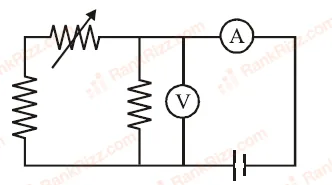
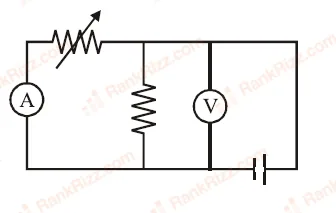
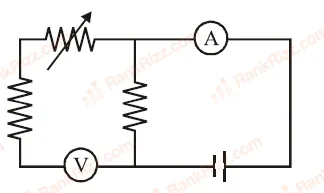
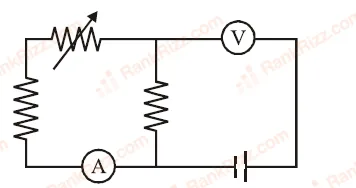
Correct set up to verify Ohm's law is :


The resistance of a wire is . It is bent at the middle by and both the ends are twisted together to make a shorter wire. The resistance of the new wire is
If a wire is stretched to make it longer, its resistance will:
increase by
decrease by
decrease by
increase by
Two conductors have the same resistance at C but their temperature coefficients of resistance are and . The respective temperature coefficients of their series and parallel combinations are nearly
This question contains Statement-1 and Statement-2. Of the four choices given after the statements, choose the one that best describes the two statements.
Statement-1: The temperature dependence of resistance is usually given as . The resistance of a wire changes from to when its temperature is increased from to . This implies that .
Statement 2: is valid only when the change in the temperature is small and .
Statement-1 is true, Statement-2 is false
Statement-1 is true, Statement-2 is true; Statement-2 is the correct explanation of Statement-1.
Statement-1 is true, Statement-2 is true; Statement-2 is not the correct explanation of Statement-1.
Statement-1 is false, Statement-2 is true
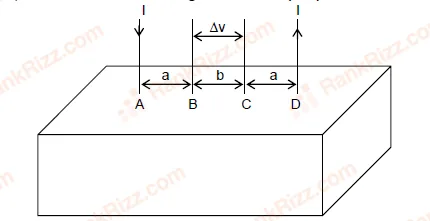
Paragraph: Consider a block of conducting material of resistivity '' shown in the figure. Current '' enters at '' and leaves from ''. We apply superposition principle to find voltage '' developed between '' and ''. The calculation is done in the following steps: (i) Take current '' entering from '' and assume it to spread over a hemispherical surface in the block. (ii) Calculate field at distance '' from by using Ohm's law , where is the current per unit area at ''. (iii) From the '' dependence of , obtain the potential at . (iv) Repeat (i), (ii) and (iii) for current '' leaving '' and superpose results for '' and ''.
Question: measured between and is
The resistance of a wire is 5 ohm at and 6 ohm at . The resistance of the wire at will be
2 ohm
1 ohm
4 ohm
3 ohm
A material '' has twice the specific resistance of ''. A circular wire made of '' has twice the diameter of a wire made of ''. Then for the two wires to have the same resistance, the ratio of their respective lengths must be
2
1
The resistance of a bulb filament is at a temperature of . If its temperature coefficient of resistance be per , its resistance will become at a temperature of
An electric current is passed through a circuit containing two wires of the same material, connected in parallel. If the length and radii of the wires are in the ratio of and , then the ratio of the currents passing through the wire will be
RELATED CURRENT ELECTRICITY TOPICS