JEE MAIN 2021 · 27 JUL S1+4 / −1MEDIUM
JEE Main 2021 Physics question — Electric current, current density and drift velocity
In the given figure, a battery of emf is connected across a conductor of length and different area of cross-sections having radii and ().
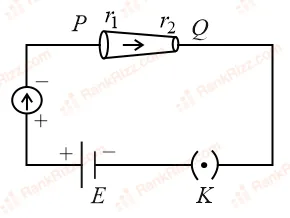
Choose the correct option as one moves from to .
SOLUTION
We need to determine how physical properties like drift velocity, electric field, and electron current change as we move from point to point along a non-uniform conductor.
1. Analyze the Geometry of the Conductor
From the problem details :
- The conductor has a tapering cross-section.
- The radius at is , and the radius at is , given that .
- As you move from to , the radius decreases, which means the cross-sectional area () decreases.
2. Analyze individual Physical Quantities
-
Electron Current ():
The conductor is connected in a single series loop with a battery. Due to the conservation of charge, the steady-state electric current must remain constant at every cross-section along the conductor.Therefore, the statement "Electron current decreases" is incorrect.
-
Drift Velocity ():
The relationship between electric current and drift velocity is given by the formula:Where is the free electron density and is the elementary charge (both constant for a given material). Since current is constant and the area decreases as we approach , the drift velocity must increase:
-
Electric Field ():
According to the microscopic form of Ohm's Law, current density () is related to the electric field by , where is the electrical conductivity. Since :As area decreases from to , the electric field strength must increase. Therefore, the statement "Electric field decreases" is incorrect.
Conclusion
As one moves from to , the narrowing area causes the drift velocity of the electrons to increase.