RankRizz

Kinematics of uniform circular motion — JEE Main Previous Year Questions

Kinematics of uniform circular motion has been asked 35 times in JEE Main, in 12 different years between 2004 and 2026, and in all of the last five exam years (2022–2026), 22 questions in all. That is 47% of Circular Motion, its most-asked topic. Last asked in JEE Main 08 Apr 2026, Shift 2. 31 are multiple choice and 4 numerical-value; 15 easy and 17 medium by our difficulty labels. All of them are below, newest first, free to read.

Questions

35

Years asked

12

Since

2004

Of the chapter

47%

Every Kinematics of uniform circular motion question

21–35 OF 35 · NEWEST FIRST

JEE MAIN 2022 · 24 JUN S1Kinematics of uniform circular motion

A boy ties a stone of mass 100100 g to the end of a 22 m long string and whirls it around in a horizontal plane. The string can withstand the maximum tension of 8080 N. If the maximum speed with which the stone can revolve is Kπ\frac{K}{\pi} rev min−1^{-1}. The value of KK is : (Assume the string is massless and un-stretchable)

  1. A

    400

  2. B

    300

  3. C

    600

  4. D

    800

JEE MAIN 2022 · 24 JUN S2Kinematics of uniform circular motion

A stone of mass mm, tied to a string is being whirled in a vertical circle with a uniform speed. The tension in the string is

  1. A

    the same throughout the motion.

  2. B

    minimum when the rope is in the horizontal position.

  3. C

    minimum at the highest position of the circular path.

  4. D

    minimum at the lowest position of the circular path.

JEE MAIN 2021 · 27 AUG S1Kinematics of uniform circular motion

A huge circular arc of length 4.4 ly subtends an angle 4s at the centre of the circle. How long it would take for a body to complete 4 revolution if its speed is 8 AU per second?
Given : 1 ly = 9.46×10159.46 \times 10^{15} m
1 AU = 1.5×10111.5 \times 10^{11} m

  1. A

    3.5×1063.5 \times 10^6 s

  2. B

    4.5×10104.5 \times 10^{10} s

  3. C

    4.1×1084.1 \times 10^8 s

  4. D

    7.2×1087.2 \times 10^8

JEE MAIN 2021 · 26 AUG S2Kinematics of uniform circular motion

A particle of mass mm is suspended from a ceiling through a string of length LL. The particle moves in a horizontal circle of radius rr such that r=L2r = \frac{L}{\sqrt{2}}. The speed of particle will be:

  1. A

    rg\sqrt{rg}

  2. B

    2rg\sqrt{2rg}

  3. C

    rg2\sqrt{\frac{rg}{2}}

  4. D

    2rg2\sqrt{rg}

JEE MAIN 2021 · 18 MAR S2Kinematics of uniform circular motion

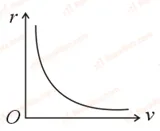
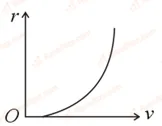
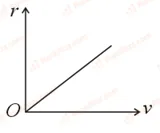
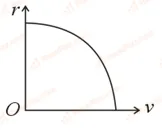
A particle of mass mm moves in a circular orbit under the central potential field, U(r)=CrU(r) = \frac{C}{r}, where CC is a positive constant. The correct radius - velocity graph of the particle's motion is :

  1. A
    Figure for JEE Main 2021 Physics question on Kinematics of uniform circular motion
  2. B
    Figure for JEE Main 2021 Physics question on Kinematics of uniform circular motion
  3. C
    Figure for JEE Main 2021 Physics question on Kinematics of uniform circular motion
  4. D
    Figure for JEE Main 2021 Physics question on Kinematics of uniform circular motion
JEE MAIN 2021 · 17 MAR S1Kinematics of uniform circular motion

A modern grand-prix racing car of mass mm is travelling on a flat track in a circular arc of radius RR with a speed vv. If the coefficient of static friction between the tyres and the track is μs\mu_s, then the magnitude of negative lift FLF_L acting downwards on the car is:

Figure for JEE Main 2021 Physics question on Kinematics of uniform circular motion
  1. A

    m(v2μsR+g)m\left(\frac{v^2}{\mu_s R} + g\right)

  2. B

    m(v2μsR−g)m\left(\frac{v^2}{\mu_s R} - g\right)

  3. C

    m(g−v2μsR)m\left(g - \frac{v^2}{\mu_s R}\right)

  4. D

    −m(g+v2μsR)-m\left(g + \frac{v^2}{\mu_s R}\right)

JEE MAIN 2021 · 16 MAR S1Kinematics of uniform circular motion

A block of 200 g mass moves with a uniform speed in a horizontal circular groove, with vertical side walls of radius 20 cm. If the block takes 40 s to complete one round, the normal force by the side walls of the groove is:

  1. A

    0.0314 N

  2. B

    9.859×10−29.859 \times 10^{-2} N

  3. C

    6.28×10−36.28 \times 10^{-3} N

  4. D

    9.859×10−49.859 \times 10^{-4} N

JEE MAIN 2021 · 16 MAR S2Kinematics of uniform circular motion

Statement I: A cyclist is moving on an unbanked road with a speed of 7 km h−1^{-1} and takes a sharp circular turn along a path of the radius of 2 m without reducing the speed. The static friction coefficient is 0.2. The cyclist will not slip and pass the curve (g=9.8g = 9.8 m s−2^{-2}).
Statement II: If the road is banked at an angle of 45°, cyclist can cross the curve of 2 m radius with the speed of 18.5 km h−1^{-1} without slipping. In the light of the above statements, choose the correct answer from the options given below.

  1. A

    Statement I is incorrect and Statement II is correct

  2. B

    Statement I is correct and Statement II is incorrect

  3. C

    Both statement I and statement II are false

  4. D

    Both statement I and statement II are true

JEE MAIN 2020 · 06 SEP S1Kinematics of uniform circular motion

A clock has a continuously moving second's hand of 0.1 m0.1\,\text{m} length. The average acceleration of the tip of the hand (in units of ms−2\text{ms}^{-2}) is of the order of:

  1. A

    10−310^{-3}

  2. B

    10−410^{-4}

  3. C

    10−210^{-2}

  4. D

    10−110^{-1}

JEE MAIN 2020 · 08 JAN S1Kinematics of uniform circular motion

A particle of mass mm is fixed to one end of a light spring having force constant kk and unstretched length ll. The other end is fixed. The system is given an angular speed ω\omega about the fixed end of the spring such that it rotates in a circle in gravity free space. Then the stretch in the spring is:

  1. A

    mlω2k−ωm\frac{ml\omega^2}{k - \omega m}

  2. B

    mlω2k−mω2\frac{ml\omega^2}{k - m\omega^2}

  3. C

    mlω2k+mω2\frac{ml\omega^2}{k + m\omega^2}

  4. D

    mlω2k+mω\frac{ml\omega^2}{k + m\omega}

JEE MAIN 2019 · 11 JAN S1Kinematics of uniform circular motion

A particle is moving along a circular path with a constant speed of 10 ms−110 \text{ ms}^{-1}. What is the magnitude of the change in velocity of the particle, when it moves through an angle of 60°60° around the centre of the circle?

  1. A

    10310\sqrt{3} m/s

  2. B

    zero

  3. C

    10210\sqrt{2} m/s

  4. D

    1010 m/s

JEE MAIN 2015 · 10 APR ONLINEKinematics of uniform circular motion

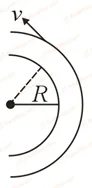
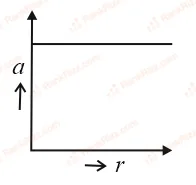
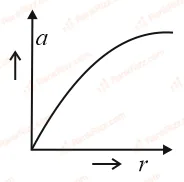
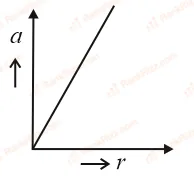
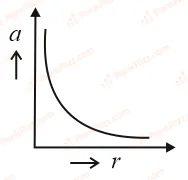
If a body moving in a circular path maintains constant speed of 10 m s−1^{-1}, then which of the following correctly describes the relation between acceleration and radius?

  1. A
    Figure for JEE Main 2015 Physics question on Kinematics of uniform circular motion
  2. B
    Figure for JEE Main 2015 Physics question on Kinematics of uniform circular motion
  3. C
    Figure for JEE Main 2015 Physics question on Kinematics of uniform circular motion
  4. D
    Figure for JEE Main 2015 Physics question on Kinematics of uniform circular motion
JEE MAIN 2012Kinematics of uniform circular motion

Two cars of masses m1m_1 and m2m_2 are moving in circles of radii r1r_1 and r2r_2, respectively. Their speeds are such that they make complete circles in the same time tt. The ratio of their centripetal acceleration is

  1. A

    m1r1:m2r2m_1 r_1 : m_2 r_2

  2. B

    m1:m2m_1 : m_2

  3. C

    r1:r2r_1 : r_2

  4. D

    1:11 : 1

JEE MAIN 2010Kinematics of uniform circular motion

For a particle in uniform circular motion the acceleration a⃗\vec{a} at a point P(R,θ)P(R, \theta) on the circle of radius R is (here θ\theta is measured from the xx-axis)

  1. A

    −v2Rcos⁡θ i^+v2Rsin⁡θ j^-\frac{v^2}{R} \cos\theta \, \hat{i} + \frac{v^2}{R} \sin\theta \, \hat{j}

  2. B

    −v2Rsin⁡θ i^+v2Rcos⁡θ j^-\frac{v^2}{R} \sin\theta \, \hat{i} + \frac{v^2}{R} \cos\theta \, \hat{j}

  3. C

    −v2Rcos⁡θ i^−v2Rsin⁡θ j^-\frac{v^2}{R} \cos\theta \, \hat{i} - \frac{v^2}{R} \sin\theta \, \hat{j}

  4. D

    v2Ri^+v2Rj^\frac{v^2}{R} \hat{i} + \frac{v^2}{R} \hat{j}

JEE MAIN 2004Kinematics of uniform circular motion

Which of the following statements is false for a particle moving in a circle with a constant angular speed?

  1. A

    The velocity vector is tangent to the circle.

  2. B

    The acceleration vector is tangent to the circle.

  3. C

    The acceleration vector points to the centre of the circle.

  4. D

    The velocity and acceleration vectors are perpendicular to each other.