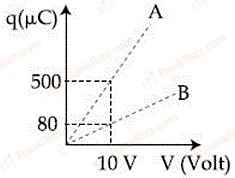
Figure shows charge (q) versus voltage (V) graph for series and parallel combination of two given capacitors. The capacitances are:
- A
60 μF and 40 μF
- B
50 μF and 30 μF
- C
20 μF and 30 μF
- D
40 μF and 10 μF
Series and parallel combinations of capacitors has been asked 29 times in JEE Main, in 13 different years between 2005 and 2026, and in all of the last five exam years (2022–2026), 15 questions in all. That is 17% of Capacitance, one of its three most-asked topics. Last asked in JEE Main 04 Apr 2026, Shift 2. 19 are multiple choice and 10 numerical-value; 12 easy and 16 medium by our difficulty labels. All of them are below, newest first, free to read.
Questions
29
Years asked
13
Since
2005
Of the chapter
17%
21–29 OF 29 · NEWEST FIRST
Figure shows charge (q) versus voltage (V) graph for series and parallel combination of two given capacitors. The capacitances are:

60 μF and 40 μF
50 μF and 30 μF
20 μF and 30 μF
40 μF and 10 μF
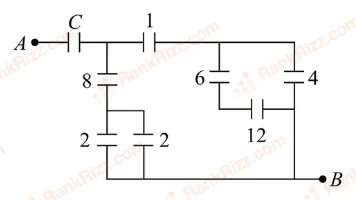
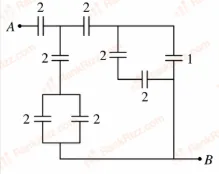
In the circuit shown, find C if the effective capacitance of the whole circuit is to be 0.5 . All values in the circuit are in .

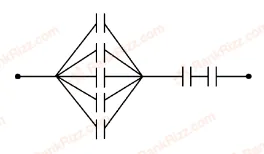
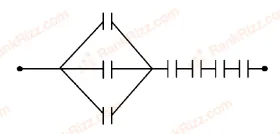
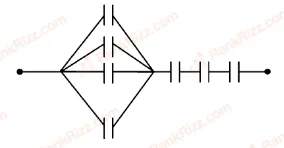
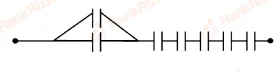
Seven capacitors, each of capacitance , are to be connected in a configuration to obtain an effective capacitance of . Which of the combinations, shown in figures below, will achieve the desired value?


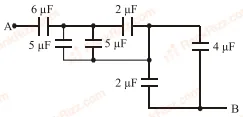
The equivalent capacitance between A and B in the circuit given below is:

4.9 F
3.6 F
5.4 F
2.4 F
The figure shows a network of capacitors where the number indicates capacitances in micro Farad. The value of capacitance C if the equivalent capacitance between point A and B is to be 1 is:

Three capacitors each of 4 F are to be connected in such a way that the effective capacitance is 6 F. This can be done by connecting them
all in series
all in parallel
two in parallel and one in series
two in series and one in parallel
Three capacitances, each of 3 F, are provided. These cannot be combined to provide the resultant capacitance of:
2 F
6 F
4.5 F
1 F
Two capacitors and are charged to 120 V and 200 V respectively. It is found that by connecting them together the potential on each one can be made zero. Then:
A parallel plate capacitor is made by stacking equally spaced plates connected alternatively. If the capacitance between any two adjacent plates is then the resultant capacitance is
RELATED CAPACITANCE TOPICS