RankRizz

Probability — JEE Main Previous Year Questions

Every Probability question JEE Main has set from 2004–2026, grouped by the idea it tests rather than the order of the syllabus. 251 questions across 9 distinct ideas. Free to read, answer key on every one.

DATA UPDATED

Questions

251

Distinct ideas

9

Share of marks

4%

Difficulty

MEDIUM

The ideas inside Probability

A chapter is not one subject — it is a handful of procedures the examiner reuses. These are the ones Probability questions actually test.

Every Probability question

161–180 OF 251 · NEWEST FIRST

JEE MAIN 2021 · 25 FEB S2Probability using permutations and combinations

Let AA be a set of all 4-digit natural numbers whose exactly one digit is 7. Then the probability that a randomly chosen element of AA leaves remainder 2 when divided by 5 is:

  1. A

    15\frac{1}{5}

  2. B

    122297\frac{122}{297}

  3. C

    97297\frac{97}{297}

  4. D

    29\frac{2}{9}

JEE MAIN 2021 · 24 FEB S1Binomial distribution

An ordinary dice is rolled for a certain number of times. If the probability of getting an odd number 2 times is equal to the probability of getting an even number 3 times, then the probability of getting an odd number for odd number of times is:

  1. A

    132\frac{1}{32}

  2. B

    516\frac{5}{16}

  3. C

    316\frac{3}{16}

  4. D

    12\frac{1}{2}

JEE MAIN 2021 · 24 FEB S1Classical probability and sample spaces

Let BiB_i (i=1,2,3i = 1, 2, 3) be three independent events in a sample space. The probability that only B1B_1 occur is α\alpha, only B2B_2 occurs is β\beta and only B3B_3 occurs is γ\gamma. Let pp be the probability that none of the events BiB_i occurs and these 4 probabilities satisfy the equations (α−2β)p=αβ(\alpha - 2\beta)p = \alpha\beta and (β−3γ)p=2βγ(\beta - 3\gamma)p = 2\beta\gamma (All the probabilities are assumed to lie in the interval (0, 1)). Then P(B1)P(B3)\frac{P(B_1)}{P(B_3)} is equal to ______.

JEE MAIN 2021 · 24 FEB S2Probability using permutations and combinations

The probability that two randomly selected subsets of the set {1,2,3,4,5}\{1, 2, 3, 4, 5\} have exactly two elements in their intersection, is:

  1. A

    6528\frac{65}{2^8}

  2. B

    6527\frac{65}{2^7}

  3. C

    3527\frac{35}{2^7}

  4. D

    13529\frac{135}{2^9}

JEE MAIN 2020 · 06 SEP S1Probability using permutations and combinations

Out of 11 consecutive natural numbers if three numbers are selected at random (without repetition), then the probability that they are in A.P. with positive common difference is:

  1. A

    15101\frac{15}{101}

  2. B

    5101\frac{5}{101}

  3. C

    533\frac{5}{33}

  4. D

    1099\frac{10}{99}

JEE MAIN 2020 · 06 SEP S2Addition theorem and algebra of events

The probabilities of three events A, B and C are given P(A)=0.6P(A) = 0.6, P(B)=0.4P(B) = 0.4 and P(C)=0.5P(C) = 0.5. If P(A∪B)=0.8P(A \cup B) = 0.8, P(A∩C)=0.3P(A \cap C) = 0.3, P(A∩B∩C)=0.2P(A \cap B \cap C) = 0.2, P(B∩C)=βP(B \cap C) = \beta and P(A∪B∪C)=αP(A \cup B \cup C) = \alpha, where 0.85≤α≤0.950.85 \leq \alpha \leq 0.95, then β\beta lies in the interval:

  1. A

    [0.35,0.36][0.35, 0.36]

  2. B

    [0.25,0.35][0.25, 0.35]

  3. C

    [0.20,0.25][0.20, 0.25]

  4. D

    [0.36,0.40][0.36, 0.40]

JEE MAIN 2020 · 05 SEP S1Binomial distribution

Four fair dice are thrown independently 27 times. Then the expected number of times, at least two dice show up a three or a five, is

JEE MAIN 2020 · 05 SEP S2Binomial distribution

In a bombing attack, there is 50% chance that a bomb will hit the target. At least two independent hits are required to destroy the target completely. Then the minimum number of bombs, that must be dropped to ensure that there is at least 99% chance of completely destroying the target, is.....

JEE MAIN 2020 · 04 SEP S1Classical probability and sample spaces

The probability of a man hitting a target is 110\frac{1}{10}. The least number of shots required, so that the probability of his hitting the target at least once is greater than 14\frac{1}{4}, is ____

JEE MAIN 2020 · 04 SEP S2Conditional probability and multiplication theorem

In a game two players A and B take turns in throwing a pair of fair dice starting with player A and total of scores on the two dice, in each throw is noted. A wins the game if he throws a total of 6 before B throws a total of 7 and B wins the game if he throws a total of 7 before A throws a total of six. The game stops as soon as either of the players wins. The probability of A winning the game is:

  1. A

    531\frac{5}{31}

  2. B

    3161\frac{31}{61}

  3. C

    56\frac{5}{6}

  4. D

    3061\frac{30}{61}

JEE MAIN 2020 · 03 SEP S1Conditional probability and multiplication theorem

A die is thrown two times and the sum of the scores appearing on the die is observed to be a multiple of 4. Then the conditional probability that the score 4 has appeared at least once is

  1. A

    14\frac{1}{4}

  2. B

    13\frac{1}{3}

  3. C

    18\frac{1}{8}

  4. D

    19\frac{1}{9}

JEE MAIN 2020 · 03 SEP S2Probability using permutations and combinations

The probability that a randomly chosen 5-digit number is made from exactly two digits is:

  1. A

    135104\frac{135}{10^4}

  2. B

    150104\frac{150}{10^4}

  3. C

    134104\frac{134}{10^4}

  4. D

    121104\frac{121}{10^4}

JEE MAIN 2020 · 02 SEP S1Bayes' theorem

Box 1 contains 30 cards numbered 1 to 30 and Box 2 contains 20 cards numbered 31 to 50. A box is selected at random and a card is drawn from it. The number on the card is found to be a non-prime number. The probability that the card was drawn from Box 1 is:

  1. A

    23\frac{2}{3}

  2. B

    817\frac{8}{17}

  3. C

    417\frac{4}{17}

  4. D

    25\frac{2}{5}

JEE MAIN 2020 · 02 SEP S2Conditional probability and multiplication theorem

Let ECE^C denote the complement of an event EE. Let E1E_1, E2E_2 and E3E_3 be any pairwise independent events with P(E1)>0P(E_1) > 0 and P(E1∩E2∩E3)=0P(E_1 \cap E_2 \cap E_3) = 0 then P((E2C∩E3C)/E1)P\left((E_2^C \cap E_3^C)/E_1\right) is equal to:

  1. A

    P(E2C)+P(E3)P(E_2^C) + P(E_3)

  2. B

    P(E3C)−P(E2C)P(E_3^C) - P(E_2^C)

  3. C

    P(E3)−P(E2C)P(E_3) - P(E_2^C)

  4. D

    P(E3C)−P(E2)P(E_3^C) - P(E_2)

JEE MAIN 2020 · 09 JAN S1Classical probability and sample spaces

In a box, there are 20 cards, out of which 10 are labelled as AA and the remaining 10 are labelled as BB. Cards are drawn at random, one after the other and with replacement, till a second AA card is obtained. The probability that the second AA card appears before the third BB card is:

  1. A

    916\frac{9}{16}

  2. B

    1116\frac{11}{16}

  3. C

    1316\frac{13}{16}

  4. D

    1516\frac{15}{16}

JEE MAIN 2020 · 09 JAN S2Probability using permutations and combinations

If 10 different balls are to be placed in 4 distinct boxes at random, then the probability that two of these boxes contain exactly 2 and 3 balls is:

  1. A

    965211\frac{965}{2^{11}}

  2. B

    965210\frac{965}{2^{10}}

  3. C

    945210\frac{945}{2^{10}}

  4. D

    945211\frac{945}{2^{11}}

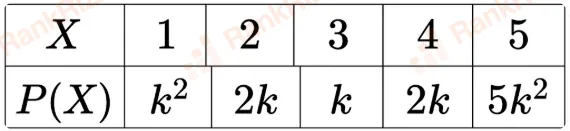
JEE MAIN 2020 · 09 JAN S2Random variables, mean and variance

A random variable XX has the following probability distribution:

Figure for JEE Main 2020 Mathematics question on Random variables, mean and variance

Then, P(X>2)P(X > 2) is equal to:

  1. A

    712\frac{7}{12}

  2. B

    136\frac{1}{36}

  3. C

    16\frac{1}{6}

  4. D

    2336\frac{23}{36}

JEE MAIN 2020 · 08 JAN S1Conditional probability and multiplication theorem

Let A and B be two independent events such that P(A)=13P(A) = \frac{1}{3} and P(B)=16P(B) = \frac{1}{6}. Then, which of the following is true?

  1. A

    P(AB)=23P\left(\frac{A}{B}\right) = \frac{2}{3}

  2. B

    P(AB′)=13P\left(\frac{A}{B'}\right) = \frac{1}{3}

  3. C

    P(A′B′)=13P\left(\frac{A'}{B'}\right) = \frac{1}{3}

  4. D

    P(AA∪B)=14P\left(\frac{A}{A \cup B}\right) = \frac{1}{4}

JEE MAIN 2020 · 08 JAN S2Addition theorem and algebra of events

Let AA and BB, be two events such that the probability that exactly one of them occurs is 25\frac{2}{5}, and the probability that AA or BB, occurs is 12\frac{1}{2}, then the probability of both of them occur together is.

  1. A

    0.02

  2. B

    0.20

  3. C

    0.01

  4. D

    0.10

JEE MAIN 2020 · 07 JAN S1Random variables, mean and variance

An unbiased coin is tossed 5 times. Suppose that a variable X is assigned the value k when k consecutive heads are obtained for k=3,4,5k = 3, 4, 5, otherwise X takes the value −1-1. Then the expected value of X, is

  1. A

    316\frac{3}{16}

  2. B

    18\frac{1}{8}

  3. C

    −316-\frac{3}{16}

  4. D

    −18-\frac{1}{8}