RankRizz

Probability — JEE Main Previous Year Questions

Every Probability question JEE Main has set from 2004–2026, grouped by the idea it tests rather than the order of the syllabus. 251 questions across 9 distinct ideas. Free to read, answer key on every one.

DATA UPDATED

Questions

251

Distinct ideas

9

Share of marks

4%

Difficulty

MEDIUM

The ideas inside Probability

A chapter is not one subject — it is a handful of procedures the examiner reuses. These are the ones Probability questions actually test.

Every Probability question

121–140 OF 251 · NEWEST FIRST

JEE MAIN 2022 · 27 JUN S1Binomial distribution

Let XX be a random variable having binomial distribution B(7,p)B(7, p). If P(X=3)=5P(X=4)P(X = 3) = 5P(X = 4), then the sum of the mean and the variance of XX is

  1. A

    10516\frac{105}{16}

  2. B

    7736\frac{77}{36}

  3. C

    3136\frac{31}{36}

  4. D

    3536\frac{35}{36}

JEE MAIN 2022 · 27 JUN S2Classical probability and sample spaces

If a point A(x,y)A(x, y) lies in the region bounded by the y-axis, straight lines 2y+x=62y + x = 6 and 5x−6y=305x - 6y = 30, then the probability that y<1y < 1 is

  1. A

    16\frac{1}{6}

  2. B

    56\frac{5}{6}

  3. C

    23\frac{2}{3}

  4. D

    67\frac{6}{7}

JEE MAIN 2022 · 27 JUN S2Classical probability and sample spaces

Let S={E,E2…E8}S = \{E, E_2 \ldots E_8\} be a sample space of a random experiment such that P(En)=n36P(E_n) = \frac{n}{36} for every n=1,2…8n = 1, 2 \ldots 8. Then the number of elements in the set {A⊂S:P(A)≥45}\{A \subset S : P(A) \geq \frac{4}{5}\} is ______

JEE MAIN 2022 · 26 JUN S1Binomial distribution

Let a biased coin be tossed 5 times. If the probability of getting 4 heads is equal to the probability of getting 5 heads, then the probability of getting atmost two heads is

  1. A

    4664\frac{46}{6^4}

  2. B

    27565\frac{275}{6^5}

  3. C

    4155\frac{41}{5^5}

  4. D

    3654\frac{36}{5^4}

JEE MAIN 2022 · 26 JUN S2Probability using permutations and combinations

If the probability that a randomly chosen 6-digit number formed by using digits 1 and 8 only is a multiple of 21 is pp, then 96p96p is equal to ______

JEE MAIN 2022 · 25 JUN S1Conditional probability and multiplication theorem

Let E1E_1 and E2E_2 be two events such that the conditional probabilities P(E1∣E2)=12P(E_1 | E_2) = \frac{1}{2}, P(E2∣E1)=34P(E_2 | E_1) = \frac{3}{4} and P(E1∩E2)=18P(E_1 \cap E_2) = \frac{1}{8}. Then

  1. A

    P(E1∩E2)=P(E1)⋅P(E2)P(E_1 \cap E_2) = P(E_1) \cdot P(E_2)

  2. B

    P(E1′∩E2′)=P(E1′)⋅P(E2)P(E_1' \cap E_2') = P(E_1') \cdot P(E_2)

  3. C

    P(E1∩E2′)=P(E1)⋅P(E2)P(E_1 \cap E_2') = P(E_1) \cdot P(E_2)

  4. D

    P(E1∪E2)=P(E1)P(E2)P(E_1 \cup E_2) = P(E_1) P(E_2)

JEE MAIN 2022 · 25 JUN S2Random variables, mean and variance

A biased die is marked with numbers 2,4,8,16,32,322, 4, 8, 16, 32, 32 on its faces and the probability of getting a face with mark nn is 1n\frac{1}{n}. If the die is thrown thrice, then the probability, that the sum of the numbers obtained is 4848, is

  1. A

    7211\frac{7}{2^{11}}

  2. B

    7212\frac{7}{2^{12}}

  3. C

    3210\frac{3}{2^{10}}

  4. D

    13212\frac{13}{2^{12}}

JEE MAIN 2022 · 24 JUN S1Bayes' theorem

Bag AA contains 22 white, 11 black and 33 red balls and bag BB contains 33 black, 22 red and nn white balls. One bag is chosen at random and 22 balls drawn from it at random are found to be 11 red and 11 black. If the probability that both balls come from Bag AA is 611\frac{6}{11}, then nn is equal to

  1. A

    13

  2. B

    6

  3. C

    4

  4. D

    3

JEE MAIN 2022 · 24 JUN S1Binomial distribution

If a random variable XX follows the Binomial distribution B(33,p)B(33, p) such that 3P(X=0)=P(X=1)3P(X = 0) = P(X = 1), then the value of P(X=15)P(X=18)−P(X=16)P(X=17)\frac{P(X = 15)}{P(X = 18)} - \frac{P(X = 16)}{P(X = 17)} is equal to

  1. A

    1320

  2. B

    1088

  3. C

    10881089\frac{1088}{1089}

  4. D

    1201331\frac{120}{1331}

JEE MAIN 2022 · 24 JUN S2Random variables, mean and variance

A random variable XX has the following probability distribution:

XX01234
P(X)P(X)kk2k2k4k4k6k6k8k8k


The value of P(1<x<4x≤2)P\left(\frac{1 < x < 4}{x \leq 2}\right) is equal to

  1. A

    47\frac{4}{7}

  2. B

    23\frac{2}{3}

  3. C

    37\frac{3}{7}

  4. D

    45\frac{4}{5}

JEE MAIN 2022 · 24 JUN S2Binomial distribution

In an examination, there are 1010 true-false type questions. Out of 1010, a student can guess the answer of 44 questions correctly with probability 34\frac{3}{4} and the remaining 66 questions correctly with probability 14\frac{1}{4}. If the probability that the student guesses the answers of exactly 88 questions correctly out of 1010 is 27k410\frac{27k}{4^{10}}, then kk is equal to ______.

JEE MAIN 2021 · 01 SEP S2Probability using permutations and combinations

Two squares are chosen at random on a chessboard (see figure). The probability that they have a side in common is:
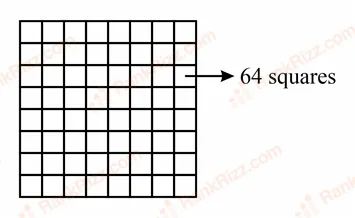
Figure for JEE Main 2021 Mathematics question on Probability using permutations and combinations
  1. A

    19\frac{1}{9}

  2. B

    17\frac{1}{7}

  3. C

    27\frac{2}{7}

  4. D

    118\frac{1}{18}

JEE MAIN 2021 · 01 SEP S2Random variables, mean and variance

Let XX be a random variable with distribution.

Figure for JEE Main 2021 Mathematics question on Random variables, mean and variance

If the mean of XX is 2.3 and variance of XX is σ2\sigma^2, then 100σ2100\sigma^2 is equal to _________.

JEE MAIN 2021 · 31 AUG S1Conditional probability and multiplication theorem

An electric instrument consists of two units. Each unit must function independently for the instrument to operate. The probability that the first unit functions is 0.9 and that of the second unit is 0.8. The instrument is switched on and it fails to operate. If the probability that only the first unit failed and second unit is functioning is pp, then 98p98p is equal to _________.

JEE MAIN 2021 · 31 AUG S2Probability using permutations and combinations

Let S={1,2,3,4,5,6}S = \{1, 2, 3, 4, 5, 6\}. Then the probability that a randomly chosen onto function gg from SS to SS satisfies g(3)=2g(1)g(3) = 2g(1) is:

  1. A

    115\frac{1}{15}

  2. B

    15\frac{1}{5}

  3. C

    130\frac{1}{30}

  4. D

    110\frac{1}{10}

JEE MAIN 2021 · 27 AUG S1Conditional probability and multiplication theorem

When a certain biased die is rolled, a particular face occurs with probability 16−x\frac{1}{6} - x and its opposite face occurs with probability 16+x\frac{1}{6} + x. All other faces occur with probability 16\frac{1}{6}. Note that opposite faces sum to 7 in any die. If 0<x<160 < x < \frac{1}{6}, and the probability of obtaining total sum = 7, when such a die is rolled twice, is 1396\frac{13}{96}, then the value of xx is

  1. A

    116\frac{1}{16}

  2. B

    112\frac{1}{12}

  3. C

    18\frac{1}{8}

  4. D

    19\frac{1}{9}

JEE MAIN 2021 · 27 AUG S2Binomial distribution

Each of the persons AA and BB independently tosses three fair coins. The probability that both of them get the same number of heads is:

  1. A

    58\frac{5}{8}

  2. B

    18\frac{1}{8}

  3. C

    516\frac{5}{16}

  4. D

    1

JEE MAIN 2021 · 27 AUG S2Random variables, mean and variance

The probability distribution of random variable XX is given by

Figure for JEE Main 2021 Mathematics question on Random variables, mean and variance

Let p=P(1<X<4∣X<3)p = P(1 < X < 4 | X < 3). If 5p=λK5p = \lambda K, then λ\lambda is equal to _________.

JEE MAIN 2021 · 26 AUG S1Conditional probability and multiplication theorem

Let A and B be independent events such that P(A) = p, P(B) = 2p. The largest value of p, for which P(exactly one of A, B occurs) = 59\frac{5}{9}, is:

  1. A

    49\frac{4}{9}

  2. B

    15\frac{1}{5}

  3. C

    512\frac{5}{12}

  4. D

    29\frac{2}{9}

JEE MAIN 2021 · 26 AUG S2Classical probability and sample spaces

Two fair dice are thrown. The numbers on them are taken as λ\lambda and μ\mu, and a system of linear equations
x+y+z=5x + y + z = 5
x+2y+3z=μx + 2y + 3z = \mu
x+3y+λz=1x + 3y + \lambda z = 1
is constructed. If pp is the probability that the system has a unique solution and qq is the probability that the system has no solution, then:

  1. A

    p=16p = \frac{1}{6} and q=536q = \frac{5}{36}

  2. B

    p=56p = \frac{5}{6} and q=136q = \frac{1}{36}

  3. C

    p=16p = \frac{1}{6} and q=136q = \frac{1}{36}

  4. D

    p=56p = \frac{5}{6} and q=536q = \frac{5}{36}
