RankRizz

JEE Main 29 Jan 2025, Shift 2 Question Paper

All 75 questions of JEE Main 29 Jan 2025, Shift 2, in the order they were asked, one subject to a page. Pick an answer on any question to check it against the key. Free to read, nothing to download.

Questions

75

Physics · Chemistry · Maths

Answer key

75

questions with a checked key

Price

Free

no sign-up

Physics

Q1Head-on collisions and coefficient of restitution

Given below are two statements. One is labelled as Assertion (A) and the other is labelled as Reason (R).
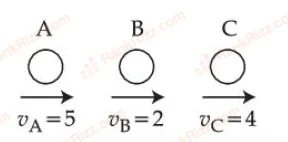
page3_img1


Assertion (A) :
Three identical spheres of same mass undergo one dimensional motion as shown in figure with initial velocities vA=5 m/s,  vB=2 m/s,  vC=4 m/sv_A = 5\,\text{m/s},\; v_B = 2\,\text{m/s},\; v_C = 4\,\text{m/s}. If we wait sufficiently long for elastic collision to happen, then vA=4 m/s,  vB=2 m/s,  vC=5 m/sv_A = 4\,\text{m/s},\; v_B = 2\,\text{m/s},\; v_C = 5\,\text{m/s}, will be the final velocities.
Reason (R): In an elastic collision between identical masses, two objects exchange their velocities. In the light of the above statements, choose the correct answer from the options given below :

  1. A

    (A) is false but (R) is true

  2. B

    Both (A) and (R) are true but (R) is NOT the correct explanation of (A)

  3. C

    Both (A) and (R) are true and (R) is the correct explanation of (A)

  4. D

    (A) is true but (R) is false
Q2Thin lenses: lens formula, lens maker's formula and power

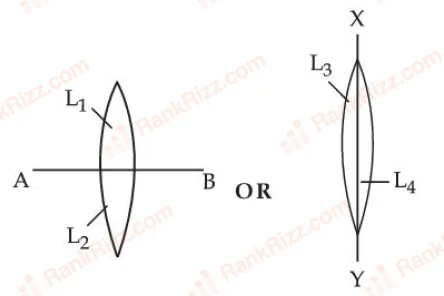
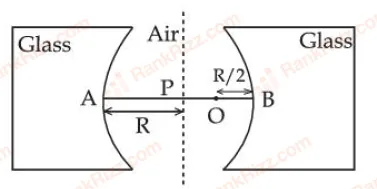
Two identical symmetric double convex lenses of focal length f are cut into two equal parts L1,L2L_{1}, L_{2} by AB plane and L3,L4L_{3}, L_{4} by XY plane as shown in figure respectively. The ratio of focal lengths of lenses L1L_{1} and L3L_{3} is

page4_img1
  1. A

    1:1

  2. B

    1:2

  3. C

    1:4

  4. D

    2:1

Q3SHM: equation, phase, velocity and acceleration

Two bodies A and B of equal mass are suspended from two massless springs of spring constant k1k_{1} and k2k_{2}, respectively. If the bodies oscillate vertically such that their amplitudes are equal, the ratio of the maximum velocity of A to the maximum velocity of B is

  1. A

    k3k2\frac{k_{3}}{k_{2}}

  2. B

    k1k2\sqrt{\frac{k_{1}}{k_{2}}}

  3. C

    k3k1\sqrt{\frac{k_{3}}{k_{1}}}

  4. D

    k1k2\frac{k_{1}}{k_{2}}

Q4Isothermal and adiabatic processes

Given below are two statements. One is labelled as Assertion (A) and the other is labelled as Reason (R).
Assertion (A) : With the increase in the pressure of an ideal gas, the volume falls off more rapidly in an isothermal process in comparison to the adiabatic process.
Reason (R) : In isothermal process, PV = constant, while in adiabatic process PVγPV^{\gamma} = constant. Here γ\gamma is the ratio of specific heats, P is the pressure and V is the volume of the ideal gas. In the light of the above statements, choose the correct answer from the options given below :

  1. A

    Both (A) and (R) are true and (R) is the correct explanation of (A)

  2. B

    Both (A) and (R) are true but (R) is NOT the correct explanation of (A)

  3. C

    (A) is true but (R) is false
  4. D

    (A) is false but (R) is true

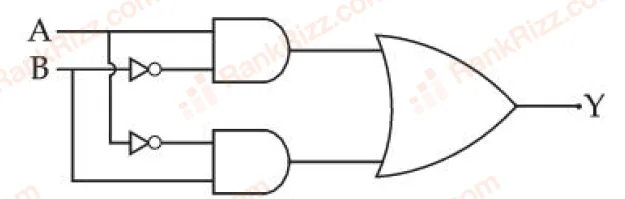
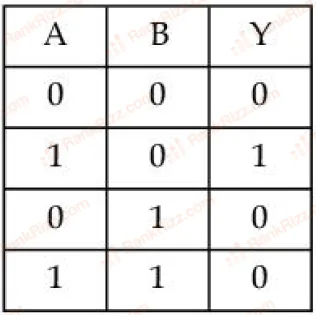
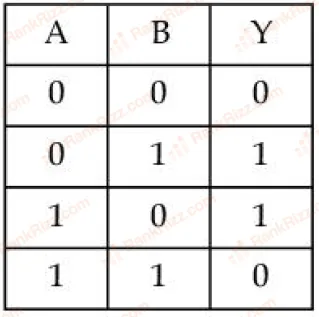
Q5Logic gates and digital circuits
page5_img1


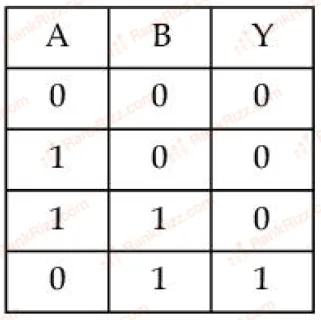
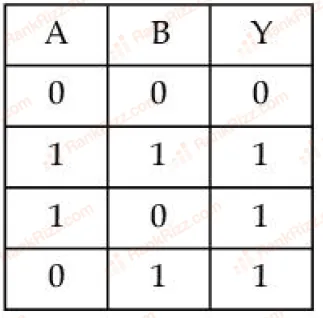
The truth table for the circuit given below is :

  1. A
    page5_img2
  2. B
    page5_img3
  3. C
    page5_img4
  4. D
    page5_img5
Q6Heat conduction and thermal resistance

The difference of temperature in a material can convert heat energy into electrical energy. To harvest the heat energy, the material should have

  1. A

    high thermal conductivity and high electrical conductivity

  2. B

    low thermal conductivity and low electrical conductivity

  3. C

    high thermal conductivity and low electrical conductivity

  4. D

    low thermal conductivity and high electrical conductivity

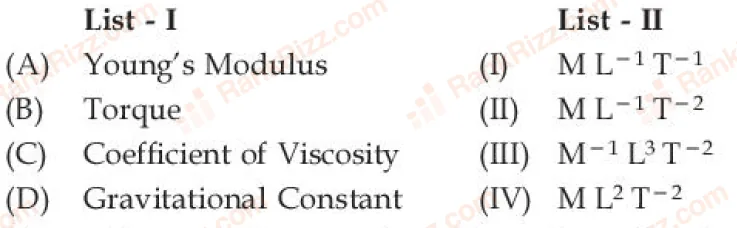
Q7Dimensional analysis: deriving and checking relations

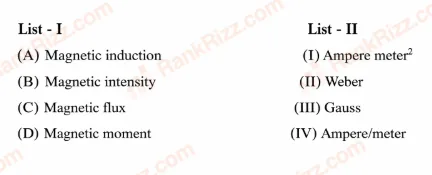
Match List - I with List - II.

page5_img6


Choose the correct answer from the options given below :

  1. A

    (A)-(I), (B)-(III), (C)-(II), (D)-(IV)

  2. B

    (A)-(IV), (B)-(II), (C)-(III), (D)-(I)

  3. C

    (A)-(II), (B)-(IV), (C)-(I), (D)-(III)

  4. D

    (A)-(II), (B)-(I), (C)-(IV), (D)-(III)

Q8Power

A sand dropper drops sand of mass m(t) on a conveyer belt at a rate proportional to the square root of speed (v)of the belt, i.e. dmdt∝v\frac{dm}{dt} \propto \sqrt{v}. If P is the power delivered to run the belt at constant speed then which of the following relationship is true?

  1. A

    P∝vP \propto \sqrt{v}

  2. B

    P∝vP \propto v

  3. C

    P2∝v5P^{2} \propto v^{5}

  4. D

    P2∝v3P^{2} \propto v^{3}

Q9Conservation of angular momentum
page6_img1


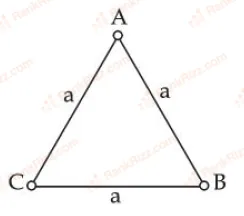
Three equal masses m are kept at vertices (A, B, C) of an equilateral triangle of side a in free space. At t=0, they are given an initial velocity V⃗A=V0AC→\vec{V}_A = V_0 \overrightarrow{AC}, V⃗B=V0BA→\vec{V}_B = V_0 \overrightarrow{BA} and V⃗C=V0CB→\vec{V}_C = V_0 \overrightarrow{CB}. Here AC→\overrightarrow{AC}, CB→\overrightarrow{CB} and BA→\overrightarrow{BA} are unit vectors along the edges of the triangle. If the three masses interact gravitationally, then the magnitude of the net angular momentum of the system at the point of collision is :

  1. A

    3amV03amV_0

  2. B

    32amV0\frac{3}{2}amV_0

  3. C

    32amV0\frac{\sqrt{3}}{2}amV_0

  4. D

    12amV0\frac{1}{2}amV_0

Q10Hydrogen spectrum and spectral series

The number of spectral lines emitted by atomic hydrogen that is in the 4th4^{th} energy level, is

  1. A

    3

  2. B

    1

  3. C

    6

  4. D

    0

Q11Thin lenses: lens formula, lens maker's formula and power

A convex lens made of glass (refractive index = 1.5) has focal length 24 cm in air. When it is totally immersed in water (refractive index 1.33), its focal length changes to

  1. A

    24 cm

  2. B

    96 cm

  3. C

    48 cm

  4. D

    72 cm

Q12Photoelectric effect and Einstein's equation

In an experiment with photoelectric effect, the stopping potential,

  1. A

    increases with increase in the intensity of the incident light

  2. B

    decreases with increase in the intensity of the incident light

  3. C

    increases with increase in the wavelength of the incident light

  4. D

    is 1e\frac{1}{e} times the maximum kinetic energy of the emitted photoelectrons

Q13Series and parallel combinations of capacitors

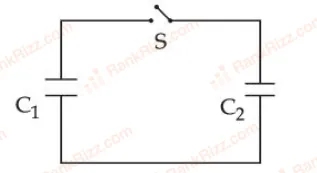
A capacitor C1=6 μFC_1 = 6\,\mu\text{F}, is charged to a potential difference of V0=5VV_{0} = 5 V using a  battery. The battery is removed and another capacitor, C2=12 μFC_2 = 12\,\mu\text{F} is inserted in place of the battery. When the switch 'S' is closed, the charge flows between the capacitors for some time until equilibrium condition is reached. What are the charges (q1q_{1} and q2q_{2} on the capacitors C1C_{1} and C2C_{2} when equilibrium condition is reached.

page7_img1
  1. A

    q1=10 μC,  q2=20 μCq_1 = 10\,\mu C,\; q_2 = 20\,\mu C

  2. B

    q1=30 μC,  q2=15 μCq_1 = 30\,\mu C,\; q_2 = 15\,\mu C

  3. C

    q1=20 μC,  q2=10 μCq_1 = 20\,\mu C,\; q_2 = 10\,\mu C

  4. D

    q1=15 μC,  q2=30 μCq_1 = 15\,\mu C,\; q_2 = 30\,\mu C

Q14Properties of EM waves: fields, energy, intensity and momentum

A plane electromagnetic wave propagates along the +x direction in free space. The components of the electric field, E⃗\vec{E} and magnetic field, B⃗\vec{B}
vectors associated with the wave in Cartesian frame are

  1. A

    Ex, ByE_x,\, B_y

  2. B

    Ey, BzE_y,\, B_z

  3. C

    Ez, ByE_z,\, B_y

  4. D

    Ey, BxE_y,\, B_x

Q15Newton's law of cooling

A cup of coffee cools from 90∘90^{\circ} to 80∘80^{\circ} in t minutes when the room temperature is 20∘20^{\circ}. The time taken by the similar cup of coffee to cool from 80∘80^{\circ} to 60∘60^{\circ} at the same room temperature is :

  1. A

    1310t\frac{13}{10}t

  2. B

    1013t\frac{10}{13}t

  3. C

    513t\frac{5}{13}t

  4. D

    135t\frac{13}{5}t

Q16Refraction at plane surfaces, Snell's law and apparent depth
page7_img2


Two concave refracting surfaces of equal radii of curvature and refractive index 1.5 face each other in air as shown in figure. A point object O is placed midway, between P and B . The separation between the images of O , formed by each refracting surface is :

  1. A

    0.214 R

  2. B

    0.411 R

  3. C

    0.124 R

  4. D

    0.114 R

Q17Isothermal and adiabatic processes
page7_img3


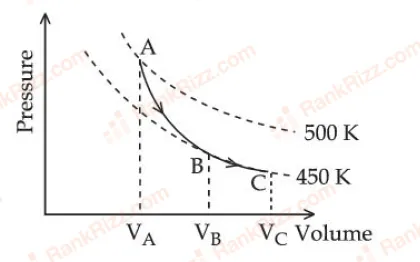
A poly-atomic molecule (CV=3R, CP=4RC_V = 3R,\, C_P = 4R, where R is gas constant) goes from phase space point A (PA=105 Pa, VA=4×10⁻⁶ mA\ (P_A = 10^5\,\text{Pa},\ V_A = 4 \times 10^{-6}\,\text{m} to point B (PB=5×10⁴ Pa, VB=6×10⁻⁶ m3)B\ (P_B = 5 \times 10^4\,\text{Pa},\ V_B = 6 \times 10^{-6}\,\text{m}^3) to point C (PC=104 Pa,  VC=8×10⁻⁶ m3).C\,(P_C = 10^4\,\text{Pa},\; V_C = 8 \times 10^{-6}\,\text{m}^3). A to B is an adiabatic path B and C to is an isothermal path. The net heat absorbed per unit mole by the system is :

  1. A

    500R(ln 3 + ln 4)

  2. B

    450R(ln 4 − ln 3)

  3. C

    500R ln 2

  4. D

    400R ln 4

Q18Dimensional formulae of physical quantities

Match List - I with List - II.

Figure for JEE Main 2025 Physics question on Dimensional formulae of physical quantities
  1. A

    (A)-(I), (B)-(II), (C)-(III), (D)-(IV)

  2. B

    (A)-(III), (B)-(IV), (C)-(I), (D)-(II)

  3. C

    (A)-(III), (B)-(II), (C)-(I), (D)-(IV)

  4. D

    (A)-(III), (B)-(IV), (C)-(II), (D)-(I)

Q19Electric flux and Gauss's law

A point charge causes an electric flux of −2×10⁴ N m2C−1-2 \times 10^{4}\,\text{N m}^2 \text{C}^{-1} to pass through a spherical Gaussian surface of 8.0 cm radius, centred on the charge. The value of the point charge is : (Given ε0=8.85×10⁻¹² C2N−1m−2\varepsilon_0 = 8.85 \times 10^{-12}\,\text{C}^2 \text{N}^{-1} \text{m}^{-2} )

  1. A

    15.7×10⁻⁸ C15.7 \times 10^{-8}\,\text{C}

  2. B

    17.7×10⁻⁸ C17.7 \times 10^{-8}\,\text{C}

  3. C

    −15.7×10⁻⁸ C-15.7 \times 10^{-8}\,\text{C}

  4. D

    −17.7×10⁻⁸ C-17.7 \times 10^{-8}\,\text{C}

Q20Electric dipole and dipole in external field

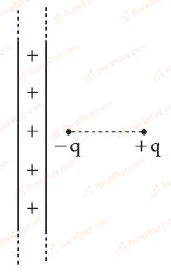
An electric dipole is placed at a distance of 2 cm from an infinite plane sheet having positive charge density σ0\sigma_{0}.

page8_img1


Choose the correct option from the following.

  1. A

    Potential energy and torque both are maximum.

  2. B

    Torque on dipole is zero and net force is directed away from the sheet.

  3. C

    Torque on dipole is zero and net force acts towards the sheet.

  4. D

    Potential energy of dipole is minimum and torque is zero.

Q21Ampere's circuital law: cylinders, solenoids and toroids

The magnetic field inside a 200 turns solenoid of radius 10 cm is 2.9 ×\times 10−410^{-4} Tesla . If the solenoid carries a current of 0.29 A , then the length of the solenoid is ________ π\pi cm.

Q22Parallel plate capacitor

A parallel plate capacitor consisting of two circular plates of radius 10 cm is being charged by a constant current of 0.15 A . If the rate of change of potential difference between the plates is 7×10⁸ V/s7 \times 10^{8}\,\text{V/s} then the integer value of the distance between the parallel plates is (Take ε0=9×10⁻¹² Fm, π=227\varepsilon_0 = 9 \times 10^{-12}\,\frac{F}{m},\ \pi = \frac{22}{7}), ________ μm\mu\text{m}.

Q23Satellites: orbital speed, period, energy and geostationary orbits

Two planets, A and B are orbiting a common star in circular orbits of radii RAR_{A} and RBR_{B}, respectively, with RB=2RAR_{B} = 2R_{A}. The planet B is 424\sqrt{2} times more massive than planet A. The ratio (LBLA)\left(\frac{L_{B}}{L_{A}}\right) of angular momentum (LB)(L_{B}) of planet B to that of planet A(LA)A(L_{A}) is closest to integer ________.

Q24Relative motion in one dimension

Two cars P and Q are moving on a road in the same direction. Acceleration of car P increases linearly with time whereas car Q moves with a constant acceleration. Both cars cross each other at time t=0, for the first time. The maximum possible number of crossing(s) (including the crossing at t=0) is ________.

Q25Errors in measurement and significant figures

A physical quantity Q is related to four observables a,b,c,d as follows : Q=ab4cdQ = \frac{ab^{4}}{cd} where, a=(60±3) Paa = (60 \pm 3)\,\text{Pa}; b=(20±0.1) mb = (20 \pm 0.1)\,\text{m}; c=(40±0.2) Nsm−2c = (40 \pm 0.2)\,\text{Nsm}^{-2}; and d=(50±0.1) md = (50 \pm 0.1)\,\text{m} , then the percentage error in Q is x1000\frac{x}{1000} , where x = ________ .

NEXT IN THIS PAPER →Chemistry, Q26 onwards