Q1Young's double slit experiment: fringe width and intensity
A light wave is propagating with plane wave fronts of the type = constant. The angle made by the direction of wave propagation with the x-axis is:
- A
- B
- C
- D
All 75 questions of JEE Main 02 Apr 2025, Shift 1, in the order they were asked, one subject to a page. Pick an answer on any question to check it against the key. Free to read, nothing to download.
Questions
75
Physics · Chemistry · Maths
Answer key
75
questions with a checked key
Price
Free
no sign-up
A light wave is propagating with plane wave fronts of the type = constant. The angle made by the direction of wave propagation with the x-axis is:
The equation for real gas is given by , where P, V, T and R are the pressure, volume, temperature and gas constant, respectively. The dimension of is equivalent to that of:
Planck's constant
Compressibility
Strain
Energy density
A cord of negligible mass is wound around the rim of a wheel supported by spokes with negligible mass. The mass of wheel is 10 kg and radius is 10 cm and it can freely rotate without any friction. Initially the wheel is at rest. If a steady pull of 20 N is applied on the cord, the angular velocity of the wheel, after the cord is unwound by 1 m, would be:
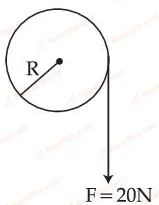
20 rad/s
30 rad/s
10 rad/s
0 rad/s
A slanted object AB is placed on one side of convex lens as shown in the diagram. The image is formed on the opposite side. Angle made by the image with principal axis is:
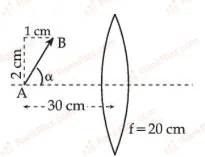
Consider two infinitely large plane parallel conducting plates as shown below. The plates are uniformly charged with a surface charge density and . The force experienced by a point charge placed at the mid point between two plates will be:
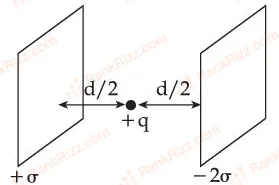
A river is flowing from west to east direction with speed of 9 km h. If a boat capable of moving at a maximum speed of 27 km h in still water, crosses the river in half a minute, while moving with maximum speed at an angle of 150° to direction of river flow, then the width of the river is:
300 m
112.5 m
75 m
m
A point charge is placed at the origin. A second point charge is placed at in Cartesian coordinate system. The point in between them where the electric field vanishes is:
The battery of a mobile phone is rated as 4.2 V, 5800 mAh. How much energy is stored in it when fully charged?
43.8 kJ
48.7 kJ
87.7 kJ
24.4 kJ
A particle is subjected to two simple harmonic motions as:
cm
and cm
where x is displacement and is time in seconds. The maximum acceleration of the particle is ms. The value of x is:
175
125
The relationship between the magnetic susceptibility () and the magnetic permeability () is given by: ( is the permeability of free space and is relative permeability)
A zener diode with 5V zener voltage is used to regulate an unregulated dc voltage input of 25 V. For a 400 resistor connected in series, the zener current is found to be 4 times load current. The load current () and load resistance () are:
= 20 mA; = 250
= 10 A; = 0.5
= 0.02 mA; = 250
= 10 mA; = 500
In an adiabatic process, which of the following statements is true?
The molar heat capacity is infinite
Work done by the gas equals the increase in internal energy
The molar heat capacity is zero
The internal energy of the gas decreases as the temperature increases
A square Lamina OABC of length 10 cm is pivoted at 'O'. Forces act on Lamina as shown in figure. If Lamina remains stationary, then the magnitude of F is:
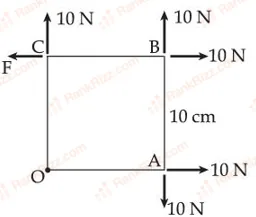
20 N
0 (zero)
10 N
N
Let be the magnitude of magnetic field at center of a circular coil of radius R carrying current I. Let be the magnitude of magnetic field at an axial distance 'x' from the center. For , is:
4 : 5
16 : 25
64 : 125
25 : 16
Considering Bohr's atomic model for hydrogen atom:
(A) the energy of H atom in ground state is same as energy of He ion in its first excited state.
(B) the energy of H atom in ground state is same as that for Li ion in its second excited state.
(C) the energy of H atom in ground state is same as that of He ion for its ground state.
(D) the energy of He ion in its first excited state is same as that for Li ion in its ground state.
Choose the correct answer from the options below:
(B), (D) only
(A), (B) only
(A), (D) only
(A), (C) only
Moment of inertia of a rod of mass 'M' and length 'L' about an axis passing through its center and normal to its length is ''. Now the rod is cut into two equal parts and these parts are joined symmetrically to form a cross shape. Moment of inertia of cross about an axis passing through its center and normal to plane containing cross is:
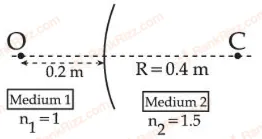
A spherical surface separates two media of refractive indices 1 and 1.5 as shown in figure. Distance of the image of an object 'O', is: (C is the center of curvature of the spherical surface and R is the radius of curvature)
0.24 m right to the spherical surface
0.4 m left to the spherical surface
0.24 m left to the spherical surface
0.4 m right to the spherical surface
Match List-I with List-II.
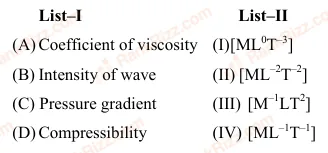
Choose the correct answer from the options below:
(A)-(I), (B)-(IV), (C)-(III), (D)-(II)
(A)-(IV), (B)-(I), (C)-(II), (D)-(III)
(A)-(IV), (B)-(II), (C)-(I), (D)-(III)
(A)-(II), (B)-(III), (C)-(IV), (D)-(I)
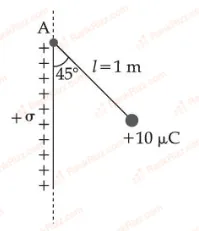
A small bob of mass 100 and charge C is connected to an insulating string of length 1 m. It is brought near to an infinitely long non-conducting sheet of charge density '' as shown in figure. If string subtends an angle of 45° with sheet at equilibrium the charge density of sheet will be:
(Given, F/m and acceleration due to gravity, m/s)
0.885 nC/m
17.7 nC/m
885 nC/m
1.77 nC/m
A monochromatic light is incident on a metallic plate having work function . An electron, emitted normally to the plate from a point A with maximum kinetic energy, enters a constant magnetic field, perpendicular to the initial velocity of electron. The electron passes through a curve and hits back the plate at a point B. The distance between A and B is:
(Given: The magnitude of charge of an electron is e and mass is m, h is Planck's constant and c is velocity of light. Take the magnetic field exists throughout the path of electron)
A vessel with square cross-section and height of 6 m is vertically partitioned. A small window of 100 cm with hinged door is fitted at a depth of 3 m in the partition wall. One part of the vessel is filled completely with water and the other side is filled with the liquid having density kg/m. What force one needs to apply on the hinged door so that it does not get opened?
(Acceleration due to gravity = 10 m/s)
A steel wire of length 2 m and Young's modulus Nm is stretched by a force. If Poisson ratio and transverse strain for the wire are 0.2 and respectively, then the elastic potential energy density of the wire is ______ (in SI units).
If the measured angular separation between the second minimum to the left of the central maximum and the third minimum to the right of the central maximum is 30° in a single slit diffraction pattern recorded using 628 nm light, then the width of the slit is ______ µm.
is the specific heat ratio of monoatomic gas A having 3 translational degrees of freedom. is the specific heat ratio of polyatomic gas B having 3 translational, 3 rotational degrees of freedom and 1 vibrational mode. If , then the value of n is ______.
A person travelling on a straight line moves with a uniform velocity for a distance x and with a uniform velocity for the next distance. The average velocity in this motion is m/s. If is 5 m/s then = ______ m/s.