RankRizz

JEE Main 09 Apr 2024, Shift 2 Question Paper

All 90 questions of JEE Main 09 Apr 2024, Shift 2, in the order they were asked, one subject to a page. Pick an answer on any question to check it against the key. Free to read, nothing to download.

Questions

90

Physics · Chemistry · Maths

Answer key

88

questions with a checked key

Price

Free

no sign-up

Physics

Q1Dimensional analysis: deriving and checking relations

The de-Broglie wavelength associated with a particle of mass mm and energy EE is h/2mEh/\sqrt{2mE}. The dimensional formula for Planck's constant is :

  1. A

    [ML2T−1][ML^2 T^{-1}]

  2. B

    [ML−1T−2][ML^{-1} T^{-2}]

  3. C

    [MLT−2][MLT^{-2}]

  4. D

    [M2L2T−2][M^2 L^2 T^{-2}]

Q2Equations of motion for uniform acceleration

Two cars are travelling towards each other at speed of 20 m s−120 \text{ m s}^{-1} each. When the cars are 300 m300 \text{ m} apart, both the drivers apply brakes and the cars retard at the rate of 2 m s−22 \text{ m s}^{-2}. The distance between them when they come to rest is :

  1. A

    200 m200 \text{ m}

  2. B

    100 m100 \text{ m}

  3. C

    50 m50 \text{ m}

  4. D

    25 m25 \text{ m}

Q3Newton's laws, free-body diagrams and equilibrium of a particle


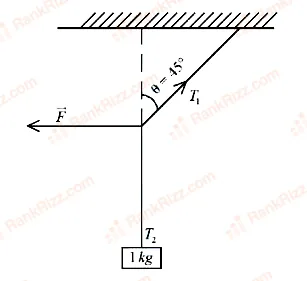
A 1 kg1 \text{ kg} mass is suspended from the ceiling by a rope of length 4 m4 \text{ m}. A horizontal force 'FF' is applied at the mid point of the rope so that the rope makes an angle of 45°45° with respect to the vertical axis as shown in figure.
page1_img1

The magnitude of FF is : (Assume that the system is in equilibrium and g=10 m/s2g = 10 \text{ m/s}^2)

  1. A

    10 N10 \text{ N}

  2. B

    102 N\frac{10}{\sqrt{2}} \text{ N}

  3. C

    1 N1 \text{ N}

  4. D

    1102 N\frac{1}{10\sqrt{2}} \text{ N}

Q4Escape speed

A satellite of 103 kg10^3 \text{ kg} mass is revolving in circular orbit of radius 2R2R. If 104R6 J\frac{10^4 R}{6} \text{ J} energy is supplied to the satellite, it would revolve in a new circular orbit of radius (use g=10 m/s2g = 10 \text{ m/s}^2, RR = radius of earth)

  1. A

    2.5R2.5R

  2. B

    3R3R

  3. C

    4R4R

  4. D

    6R6R

Q5Excess pressure in drops and bubbles

The excess pressure inside a soap bubble is thrice the excess pressure inside a second soap bubble. The ratio between the volume of the first and the second bubble is:

  1. A

    1:91 : 9

  2. B

    1:31 : 3

  3. C

    1:271 : 27

  4. D

    1:811 : 81

Q6Stokes' law and terminal velocity

A spherical ball of radius 1×10⁻⁴ m1 \times 10^{-4} \text{ m} and density 105 kg/m310^5 \text{ kg/m}^3 falls freely under gravity through a distance hh before entering a tank of water. If after entering in water the velocity of the ball does not change, then the value of hh is approximately: (The coefficient of viscosity of water is 9.8×10⁻⁶ N s/m29.8 \times 10^{-6} \text{ N s/m}^2)

  1. A

    2296 m2296 \text{ m}

  2. B

    2518 m2518 \text{ m}

  3. C

    2249 m2249 \text{ m}

  4. D

    2396 m2396 \text{ m}

Q7Work done in thermodynamic processes and P-V diagrams


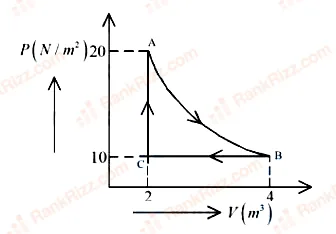
A real gas within a closed chamber at 27°C27°C undergoes the cyclic process as shown in figure. The gas obeys PV3=RTPV^3 = RT equation for the path AA to BB. The net work done in the complete cycle is (assuming R=8 J/molKR = 8 \text{ J/molK}):

page2_img1
  1. A

    20 J20 \text{ J}

  2. B

    205 J205 \text{ J}

  3. C

    −20 J-20 \text{ J}

  4. D

    225 J225 \text{ J}

Q8Kinetic interpretation of pressure and temperature

The temperature of a gas is −78°C-78°C and the average translational kinetic energy of its molecules is KK. The temperature at which the average translational kinetic energy of the molecules of the same gas becomes 2K2K is :

  1. A

    127°C127°C

  2. B

    117°C117°C

  3. C

    −39°C-39°C

  4. D

    −78°C-78°C

Q9Electric flux and Gauss's law


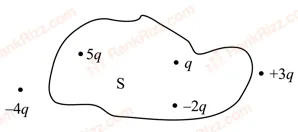
Five charges +q,+5q,−2q,+3q+q, +5q, -2q, +3q and −4q-4q are situated as shown in the figure.

Figure for JEE Main 2024 Physics question on Electric flux and Gauss's law

The electric flux due to this configuration through the surface SS is :

  1. A

    4qϵ0\frac{4q}{\epsilon_0}

  2. B

    5qϵ0\frac{5q}{\epsilon_0}

  3. C

    qϵ0\frac{q}{\epsilon_0}

  4. D

    3qϵ0\frac{3q}{\epsilon_0}

Q10Combination of resistors and equivalent resistance


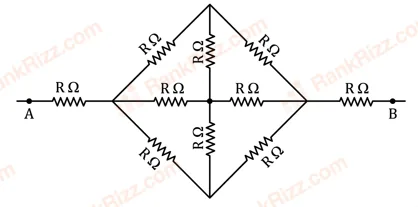
The effective resistance between AA and BB, if resistance of each resistor is RR, will be

Figure for JEE Main 2024 Physics question on Combination of resistors and equivalent resistance
  1. A

    8R3\frac{8R}{3}

  2. B

    5R3\frac{5R}{3}

  3. C

    4R3\frac{4R}{3}

  4. D

    23R\frac{2}{3}R

Q11Motion of charged particles in a magnetic field

A proton and a deutron (q=+e,m=2.0uq = +e, m = 2.0u) having same kinetic energies enter a region of uniform magnetic field B⃗\vec{B}, moving perpendicular to B⃗\vec{B}. The ratio of the radius of deutron path to the radius of the proton path is:

  1. A

    2:1\sqrt{2} : 1

  2. B

    1:11 : 1

  3. C

    1:21 : \sqrt{2}

  4. D

    1:21 : 2

Q12Motional emf in moving rods and loops

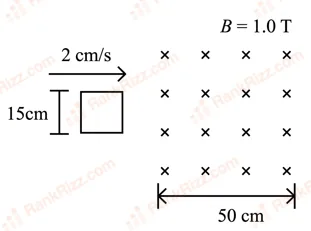
A square loop of side 15 cm15 \text{ cm} being moved towards right at a constant speed of 2 cm/s2 \text{ cm/s} as shown in figure. The front edge enters the 50 cm50 \text{ cm} wide magnetic field at t=0t = 0. The value of induced emf in the loop at t=10 st = 10 \text{ s} will be :

Figure for JEE Main 2024 Physics question on Motional emf in moving rods and loops
  1. A

    0.3 mV0.3 \text{ mV}

  2. B

    zero

  3. C

    4.5 mV4.5 \text{ mV}

  4. D

    3 mV3 \text{ mV}

Q13Properties of EM waves: fields, energy, intensity and momentum

The magnetic field in a plane electromagnetic wave is By=(3.5×10⁻⁷)sin⁡(1.5×10³x+0.5×10¹¹t) TB_y = (3.5 \times 10^{-7}) \sin(1.5 \times 10^3 x + 0.5 \times 10^{11} t) \text{ T}. The corresponding electric field will be :

  1. A

    Ey=10.5sin⁡(1.5×10³x+0.5×10¹¹t) Vm−1E_y = 10.5 \sin(1.5 \times 10^3 x + 0.5 \times 10^{11} t) \text{ Vm}^{-1}

  2. B

    Ez=1.17sin⁡(1.5×10³x+0.5×10¹¹t) Vm−1E_z = 1.17 \sin(1.5 \times 10^3 x + 0.5 \times 10^{11} t) \text{ Vm}^{-1}

  3. C

    Ey=1.17sin⁡(1.5×10³x+0.5×10¹¹t) Vm−1E_y = 1.17 \sin(1.5 \times 10^3 x + 0.5 \times 10^{11} t) \text{ Vm}^{-1}

  4. D

    Ez=105sin⁡(1.5×10³x+0.5×10¹¹t) Vm−1E_z = 105 \sin(1.5 \times 10^3 x + 0.5 \times 10^{11} t) \text{ Vm}^{-1}

Q14Thin lenses: lens formula, lens maker's formula and power

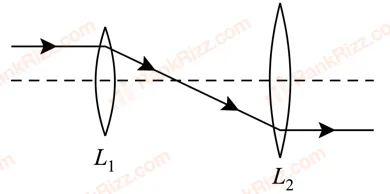
The following figure represents two biconvex lenses L1L_1 and L2L_2 having focal length 10 cm10 \text{ cm} and 15 cm15 \text{ cm} respectively. The distance between L1L_1 & L2L_2 is 

Figure for JEE Main 2024 Physics question on Thin lenses: lens formula, lens maker's formula and power
  1. A

    10 cm10 \text{ cm}

  2. B

    35 cm35 \text{ cm}

  3. C

    25 cm25 \text{ cm}

  4. D

    15 cm15 \text{ cm}

Q15Photoelectric effect and Einstein's equation

UV light of 4.13 eV4.13 \text{ eV} is incident on a photosensitive metal surface having work function 3.13 eV3.13 \text{ eV}. The maximum kinetic energy of ejected photoelectrons will be:

  1. A

    4.13 eV4.13 \text{ eV}

  2. B

    3.13 eV3.13 \text{ eV}

  3. C

    1 eV1 \text{ eV}

  4. D

    7.26 eV7.26 \text{ eV}

Q16Hydrogen spectrum and spectral series

A hydrogen atom in ground state is given an energy of 10.2 eV10.2 \text{ eV}. How many spectral lines will be emitted due to transition of electrons?

  1. A

    6

  2. B

    3

  3. C

    10

  4. D

    1

Q17Nuclear size, mass defect and binding energy

A nucleus at rest disintegrates into two smaller nuclei with their masses in the ratio of 2:12 : 1. After disintegration they will move :

  1. A

    in the same direction with same speed.

  2. B

    in opposite directions with the same speed.

  3. C

    in opposite directions with speed in the ratio of 2:12 : 1 respectively.

  4. D

    in opposite directions with speed in the ratio of 1:21 : 2 respectively.

Q18Nuclear size, mass defect and binding energy

The energy released in the fusion of 2 kg2 \text{ kg} of hydrogen deep in the sun is EHE_H and the energy released in the fission of 2 kg2 \text{ kg} of 235U^{235}U is EUE_U. The ratio EHEU\frac{E_H}{E_U} is approximately: (Consider the fusion reaction as 4∣H+2e−→24He+2ν+6γ+26.7 MeV4 \mid H + 2e^- \to {}^4_2He + 2\nu + 6\gamma + 26.7 \text{ MeV}, energy released in the fission reaction of 235U^{235}U is 200 MeV200 \text{ MeV} per fission nucleus and NA=6.023×10²³N_A = 6.023 \times 10^{23})

  1. A

    7.62

  2. B

    25.6

  3. C

    15.04

  4. D

    9.13

Q19Zener diode, LED, photodiode and solar cell

The I−VI - V characteristics of an electronic device shown in the figure. The device is:
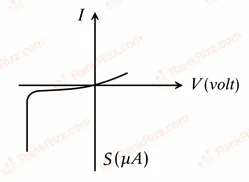
Figure for JEE Main 2024 Physics question on Zener diode, LED, photodiode and solar cell
  1. A

    a diode which can be used as a rectifier

  2. B

    a zener diode which can be used as a voltage regulator

  3. C

    a transistor which can be used as an amplifier

  4. D

    a solar cell

Q20Logic gates and digital circuits
Figure for JEE Main 2024 Physics question on Logic gates and digital circuits

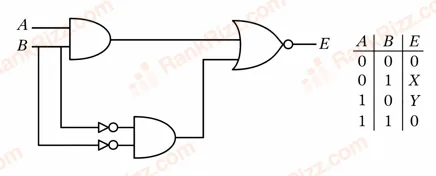
In the truth table of the above circuit the value of XX and YY are :

  1. A

    0, 0

  2. B

    1, 1

  3. C

    1, 0

  4. D

    0, 1

Q21Dot and cross product of vectors

The resultant of two vectors A⃗\vec{A} and B⃗\vec{B} is perpendicular to A⃗\vec{A} and its magnitude is half that of B⃗\vec{B}. The angle between vectors A⃗\vec{A} and B⃗\vec{B} is ______ °.

Q22Work done by constant and variable forces

A force (3x2+2x−5) N(3x^2 + 2x - 5) \text{ N} displaces a body from x=2 mx = 2 \text{ m} to x=4 mx = 4 \text{ m}. Work done by this force is ______ J.

Q23Rolling with friction, slipping and impulsive forces

A circular disc reaches from top to bottom of an inclined plane of length ll. When it slips down the plane, it takes tt s. When it rolls down the plane then it takes (α2)1/2t\left(\frac{\alpha}{2}\right)^{1/2} t s, where α\alpha is ______

Q24Ohm's law, resistance, resistivity and colour code

At room temperature (27°C)(27°C), the resistance of a heating element is 50Ω50\Omega. The temperature coefficient of the material is 2.4×10⁻⁴ °C−12.4 \times 10^{-4} \text{ °C}^{-1}. The temperature of the element, when its resistance is 62Ω62\Omega, is ______ °C.

Q25SHM: equation, phase, velocity and acceleration

A particle of mass 0.50 kg0.50 \text{ kg} executes simple harmonic motion under force F=−50 (Nm−1)xF = -50 \text{ (Nm}^{-1}\text{)}x. The time period of oscillation is πx\frac{\pi}{x} s. The value of xx is ______ (Given π=227\pi = \frac{22}{7})

Q26Electric flux and Gauss's law


An electric field E⃗=(2xi^) NC−1\vec{E} = (2x\hat{i}) \text{ NC}^{-1} exists in space. A cube of side 2 m2 \text{ m} is placed in the space as per figure given below.
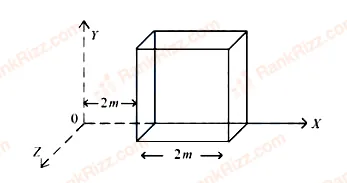
page4_img3

The electric flux through the cube is ______ Nm2/C\text{Nm}^2/\text{C}.

Q27Galvanometer conversion to ammeter and voltmeter


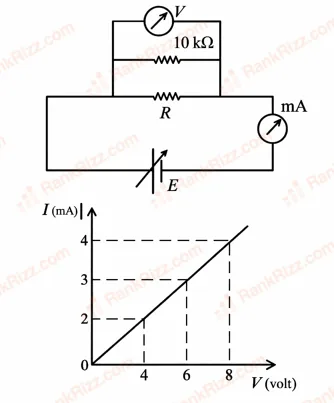
To determine the resistance (R)(R) of a wire, a circuit is designed below. The V−IV - I characteristic curve for this circuit is plotted for the voltmeter and the ammeter readings as shown in figure. The value of RR is ______ Ω\Omega.

Figure for JEE Main 2024 Physics question on Galvanometer conversion to ammeter and voltmeter
Q28Bar magnet as a magnetic dipole

A straight magnetic strip has a magnetic moment of 44 Am244 \text{ Am}^2. If the strip is bent in a semicircular shape, its magnetic moment will be ______ Am2\text{Am}^2. (given π=227\pi = \frac{22}{7})

Q29Series LCR circuits: impedance and phase

A capacitor of reactance 43Ω4\sqrt{3} \Omega and a resistor of resistance 4Ω4\Omega are connected in series with an ac source of peak value 82 V8\sqrt{2} \text{ V}. The power dissipation in the circuit is ______ W.

Q30Wavefronts and Huygens' principle

Monochromatic light of wavelength 500 nm500 \text{ nm} is used in Young's double slit experiment. An interference pattern is obtained on a screen. When one of the slits is covered with a very thin glass plate (refractive index =1.5= 1.5), the central maximum is shifted to a position previously occupied by the 4th4^{th} bright fringe. The thickness of the glass-plate is ______ μm\mu m.

NEXT IN THIS PAPER →Chemistry, Q31 onwards