Q1Dimensional analysis: deriving and checking relations
The dimensional formula of latent heat is :
- A
- B
- C
- D
All 90 questions of JEE Main 09 Apr 2024, Shift 1, in the order they were asked, one subject to a page. Pick an answer on any question to check it against the key. Free to read, nothing to download.
Questions
90
Physics · Chemistry · Maths
Answer key
87
questions with a checked key
Price
Free
no sign-up
The dimensional formula of latent heat is :
A particle moving in a straight line covers half the distance with speed m/s. The other half is covered in two equal time intervals with speeds m/s and m/s respectively. The average speed of the particle during the motion is :
m/s
m/s
m/s
m/s
A light unstretchable string passing over a smooth light pulley connects two blocks of masses and . If the acceleration of the system is , then the ratio of the masses is :
A particle of mass moves on a straight line with its velocity increasing with distance according to the equation , where is a constant. The total work done by all the forces applied on the particle during its displacement from to , will be :
A heavy iron bar, of weight is having its one end on the ground and the other on the shoulder of a person. The bar makes an angle with the horizontal. The weight experienced by the person is :
An astronaut takes a ball of mass from earth to space. He throws the ball into a circular orbit about earth at an altitude of km. From earth's surface to the orbit, the change in total mechanical energy of the ball is . The value of is (take km) :
A sphere of relative density and diameter has concentric cavity of diameter . The ratio of , if it just floats on water in a tank is :
A sample of 1 mole gas at temperature T is adiabatically expanded to double its volume. If adiabatic constant for the gas is , then the work done by the gas in the process is:
The volume of an ideal gas is changed adiabatically from 5 litres to 4 litres. The ratio of initial pressure to final pressure is:
A bulb and a capacitor are connected in series across an ac supply. A dielectric is then placed between the plates of the capacitor. The glow of the bulb:
increases
decreases
remains same
becomes zero
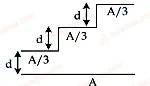
A capacitor is made of a flat plate of area A and a second plate having a stair-like structure as shown in figure. If the area of each stair is and the height is , the capacitance of the arrangement is
A galvanometer has a coil of resistance with a full scale deflection at . The value of resistance to be added to use it as an ammeter of range mA is :
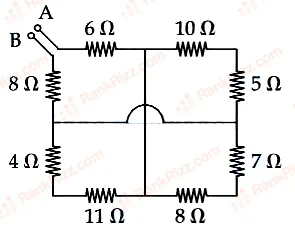
The equivalent resistance between A and B is :
Given below are two statements : Statement (I) : When currents vary with time, Newton's third law is valid only if momentum carried by the electromagnetic field is taken into account. Statement (II) : Ampere's circuital law does not depend on Biot-Savart's law. In the light of the above statements, choose the correct answer from the options given below :
Both Statement I and Statement II are true
Statement I is true but Statement II is false
Both Statement I and Statement II are false
Statement I is false but Statement II is true
A plane EM wave is propagating along direction. It has a wavelength of mm. If electric field is in direction with the maximum magnitude of Vm, the equation for magnetic field is :
T
T
T
T
Given below are two statements :
Statement (I) : When an object is placed at the centre of curvature of a concave lens, image is formed at the centre of curvature of the lens on the other side.
Statement (II) : Concave lens always forms a virtual and erect image.
In the light of the above statements, choose the correct answer from the options given below :
Both Statement I and Statement II are true
Both Statement I and Statement II are false
Statement I is true but Statement II is false
Statement I is false but Statement II is true
A proton, an electron and an alpha particle have the same energies. Their de-Broglie wavelengths will be compared as :
The energy equivalent of g of substance is :
MeV
MeV
MeV
eV
A light emitting diode (LED) is fabricated using GaAs semiconducting material whose band gap is eV. The wavelength of light emitted from the LED is :
nm
nm
nm
nm
One main scale division of a vernier caliper is equal to units. If division of main scale coincides with division of vernier scale, the least count of the vernier caliper is :
If and makes an angle with each other, then for , . The integer value of is ____
A string is wrapped around the rim of a wheel of moment of inertia kg m and radius cm. The wheel is free to rotate about its axis. Initially the wheel is at rest. The string is now pulled by a force of N. The angular velocity of the wheel after s is rad/s, where is _______
Two persons pull a wire towards themselves. Each person exerts a force of N on the wire. Young's modulus of the material of wire is N m. Original length of the wire is m and the area of cross section is cm. The wire will extend in length by ______ m.
The position, velocity and acceleration of a particle executing simple harmonic motion are found to have magnitudes of m, ms and ms at a certain instant. The amplitude of the motion is m, where is ________
At the centre of a half ring of radius cm and linear charge density nCm, the potential is V. The value of is _______
The current flowing through the resistor is A. The value of is ________
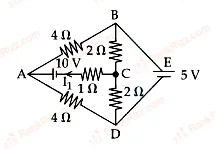
A square loop of edge length m carrying current of A is placed with its edges parallel to the - axis. A magnetic field is passing through the plane and expressed as , where T. The net magnetic force experienced by the loop is _______ N.
When a coil is connected across a V dc supply, it draws a current of A. When it is connected across V, Hz ac supply, it draws a current of A. The self inductance of the coil is ______ mH. (Take )
In a Young's double slit experiment, the intensity at a point is of the maximum intensity, the minimum distance of the point from the central maximum is _______ m. (Given : nm, mm, m)
A star has helium composition. It starts to convert three He into one C via triple alpha process as He He He C . The mass of the star is kg and it generates energy at the rate of W. The rate of converting these He to C is s, where n is ________ [Take, mass of He u, mass of C u]