RankRizz

JEE Main 08 Apr 2024, Shift 2: Maths

The 30 Maths questions of JEE Main 08 Apr 2024, Shift 2, numbered across the whole paper. Pick an answer on any question to check it against the key. Free to read, nothing to download.

Maths

Q61Algebra of complex numbers and square roots

The sum of all possible values of θ∈[−π,2π]\theta \in [-\pi, 2\pi], for which 1+icos⁡θ1−2icos⁡θ\frac{1 + i\cos\theta}{1 - 2i\cos\theta} is purely imaginary, is equal to :

  1. A

    3π3\pi

  2. B

    2π2\pi

  3. C

    5π5\pi

  4. D

    4π4\pi

Q62Combinations and selections with conditions

The number of ways five alphabets can be chosen from the alphabets of the word MATHEMATICS, where the chosen alphabets are not necessarily distinct, is equal to :

  1. A

    179

  2. B

    177

  3. C

    181

  4. D

    175

Q63Geometric progression and infinite GP

In an increasing geometric progression of positive terms, the sum of the second and sixth terms is 703\frac{70}{3} and the product of the third and fifth terms is 49. Then the sum of the 4th4^{th}, 6th6^{th} and 8th8^{th} terms is equal to :

  1. A

    96

  2. B

    91

  3. C

    84

  4. D

    78

Q64General term and specific coefficients

If the term independent of xx in the expansion of (ax2+12x3)10\left(\sqrt{a}x^2 + \frac{1}{2x^3}\right)^{10} is 105, then a2a^2 is equal to :

  1. A

    2

  2. B

    4

  3. C

    6

  4. D

    9

Q65Trigonometric ratios, allied and standard angles

If the value of 3cos⁡36°+5sin⁡18°5cos⁡36°−3sin⁡18°\frac{3\cos 36° + 5\sin 18°}{5\cos 36° - 3\sin 18°} is a5−bc\frac{a\sqrt{5} - b}{c}, where a,b,ca, b, c are natural numbers and gcd⁡(a,c)=1\gcd(a, c) = 1, then a+b+ca + b + c is equal to :

  1. A

    40

  2. B

    52

  3. C

    50

  4. D

    54

Q66Equation of a circle in various forms

If the image of the point (−4,5)(-4, 5) in the line x+2y=2x + 2y = 2 lies on the circle (x+4)2+(y−3)2=r2(x + 4)^2 + (y - 3)^2 = r^2, then rr is equal to :

  1. A

    2

  2. B

    3

  3. C

    1

  4. D

    4

Q67Angle between lines, parallel and perpendicular lines

If the line segment joining the points (5,2)(5, 2) and (2,a)(2, a) subtends an angle π4\frac{\pi}{4} at the origin, then the absolute value of the product of all possible values of aa is :

  1. A

    6

  2. B

    8

  3. C

    2

  4. D

    -4

Q68Reflexive, symmetric and transitive relations

Let A={2,3,6,8,9,11}A = \{2, 3, 6, 8, 9, 11\} and B={1,4,5,10,15}B = \{1, 4, 5, 10, 15\}. Let RR be a relation on A×BA \times B defined by (a,b)R(c,d)(a, b)R(c, d) if and only if 3ad−7bc3ad - 7bc is an even integer. Then the relation RR is :

  1. A

    an equivalence relation

  2. B

    reflexive and symmetric but not transitive

  3. C

    transitive but not symmetric

  4. D

    reflexive but not symmetric

Q69Properties of determinants

If α≠a,β≠b,γ≠c\alpha \neq a, \beta \neq b, \gamma \neq c and ∣αbcaβcabγ∣=0\begin{vmatrix} \alpha & b & c \\ a & \beta & c \\ a & b & \gamma \end{vmatrix} = 0, then aα−a+bβ−b+γγ−c\frac{a}{\alpha - a} + \frac{b}{\beta - b} + \frac{\gamma}{\gamma - c} is equal to :

  1. A

    3

  2. B

    0

  3. C

    1

  4. D

    2

Q70Systems of linear equations

If the system of equations x+4y−z=λx + 4y - z = \lambda, 7x+9y+μz=−37x + 9y + \mu z = -3, 5x+y+2z=−15x + y + 2z = -1 has infinitely many solutions, then (2μ+3λ)(2\mu + 3\lambda) is equal to :

  1. A

    3

  2. B

    -3

  3. C

    -2

  4. D

    2

Q71One-one, onto functions and counting functions

Let f(x)={−aif −a≤x≤0x+aif 0<x≤af(x) = \begin{cases} -a & \text{if } -a \leq x \leq 0 \\ x + a & \text{if } 0 < x \leq a \end{cases} where a>0a > 0 and g(x)=(f(x)−∣f(x)∣)/2g(x) = (f(x) - |f(x)|)/2. Then the function g:[−a,a]→[−a,a]g : [-a, a] \rightarrow [-a, a] is :

  1. A

    neither one-one nor onto

  2. B

    onto

  3. C

    both one-one and onto

  4. D

    one-one

Q72Continuity at a point

For a,b>0a, b > 0, let f(x)={tan⁡((a+1)x)+btan⁡xx,x<03,x=0ax+b2x2−axbaxx,x>0f(x) = \begin{cases} \frac{\tan((a+1)x) + b\tan x}{x}, & x < 0 \\ 3, & x = 0 \\ \frac{\sqrt{ax + b^2x^2} - \sqrt{ax}}{b\sqrt{ax}\sqrt{x}}, & x > 0 \end{cases} be a continuous function at x=0x = 0. Then ba\frac{b}{a} is equal to :

  1. A

    6

  2. B

    4

  3. C

    5

  4. D

    8

Q73Monotonicity for inequalities and number of roots

If the function f(x)=2x3−9ax2+12a2x+1f(x) = 2x^3 - 9ax^2 + 12a^2x + 1, a>0a > 0 has a local maximum at x=αx = \alpha and a local minimum at x=α2x = \alpha^2, then α\alpha and α2\alpha^2 are the roots of the equation :

  1. A

    x2−6x+8=0x^2 - 6x + 8 = 0

  2. B

    x2+6x+8=0x^2 + 6x + 8 = 0

  3. C

    8x2+6x−1=08x^2 + 6x - 1 = 0

  4. D

    8x2−6x+1=08x^2 - 6x + 1 = 0

Q74Definite integrals: properties and King's rule

Let ∫αlog⁡e4dxex−1=π6\int_{\alpha}^{\log_e 4} \frac{dx}{\sqrt{e^x - 1}} = \frac{\pi}{6}. Then eαe^{\alpha} and e−αe^{-\alpha} are the roots of the equation :

  1. A

    x2+2x−8=0x^2 + 2x - 8 = 0

  2. B

    x2−2x−8=0x^2 - 2x - 8 = 0

  3. C

    2x2−5x+2=02x^2 - 5x + 2 = 0

  4. D

    2x2−5x−2=02x^2 - 5x - 2 = 0

Q75Area between curves

The area of the region in the first quadrant inside the circle x2+y2=8x^2 + y^2 = 8 and outside the parabola y2=2xy^2 = 2x is equal to :

  1. A

    π2−13\frac{\pi}{2} - \frac{1}{3}

  2. B

    π−13\pi - \frac{1}{3}

  3. C

    π2−23\frac{\pi}{2} - \frac{2}{3}

  4. D

    π−23\pi - \frac{2}{3}

Q76Linear first-order differential equations

Let y=y(x)y = y(x) be the solution curve of the differential equation sec⁡ydydx+2xsin⁡y=x3cos⁡y\sec y \frac{dy}{dx} + 2x\sin y = x^3\cos y, y(1)=0y(1) = 0. Then y(3)y(\sqrt{3}) is equal to :

  1. A

    π3\frac{\pi}{3}

  2. B

    π6\frac{\pi}{6}

  3. C

    π12\frac{\pi}{12}

  4. D

    π4\frac{\pi}{4}

Q77Vector (cross) product and area

Let a⃗=4i^−j^+k^\vec{a} = 4\hat{i} - \hat{j} + \hat{k}, b⃗=11i^−j^+k^\vec{b} = 11\hat{i} - \hat{j} + \hat{k} and c⃗\vec{c} be a vector such that (a⃗+b⃗)×c⃗=c⃗×(−2a⃗+3b⃗)(\vec{a} + \vec{b}) \times \vec{c} = \vec{c} \times (-2\vec{a} + 3\vec{b}). If (2a⃗+3b⃗)⋅c⃗=1670(2\vec{a} + 3\vec{b}) \cdot \vec{c} = 1670, then ∣c⃗∣2|\vec{c}|^2 is equal to :

  1. A

    1609

  2. B

    1618

  3. C

    1600

  4. D

    1627

Q78Scalar (dot) product

Let a⃗=i^+2j^+3k^\vec{a} = \hat{i} + 2\hat{j} + 3\hat{k}, b⃗=2i^+3j^−5k^\vec{b} = 2\hat{i} + 3\hat{j} - 5\hat{k} and c⃗=3i^−j^+λk^\vec{c} = 3\hat{i} - \hat{j} + \lambda\hat{k} be three vectors. Let r⃗\vec{r} be a unit vector along b⃗+c⃗\vec{b} + \vec{c}. If r⃗⋅a⃗=3\vec{r} \cdot \vec{a} = 3, then 3λ3\lambda is equal to :

  1. A

    21

  2. B

    30

  3. C

    25

  4. D

    27

Q79Foot of perpendicular, image and distance from a line

If the shortest distance between the lines x−λ2=y−43=z−34\frac{x - \lambda}{2} = \frac{y - 4}{3} = \frac{z - 3}{4} and x−24=y−46=z−78\frac{x - 2}{4} = \frac{y - 4}{6} = \frac{z - 7}{8} is 1329\frac{13}{\sqrt{29}}, then a value of λ\lambda is :

  1. A

    -1

  2. B

    −1325-\frac{13}{25}

  3. C

    1325\frac{13}{25}

  4. D

    1

Q80Bayes' theorem

There are three bags X,YX, Y and ZZ. Bag XX contains 5 one-rupee coins and 4 five-rupee coins; Bag YY contains 4 one-rupee coins and 5 five-rupee coins and Bag ZZ contains 3 one-rupee coins and 6 five-rupee coins. A bag is selected at random and a coin drawn from it at random is found to be a one-rupee coin. Then the probability, that it came from bag Y, is :

  1. A

    14\frac{1}{4}

  2. B

    12\frac{1}{2}

  3. C

    512\frac{5}{12}

  4. D

    13\frac{1}{3}

Q81Equations with modulus and greatest integer

The number of distinct real roots of the equation ∣x+1∣∣x+3∣−4∣x+2∣+5=0|x + 1||x + 3| - 4|x + 2| + 5 = 0, is _____

Q82Arithmetic progression


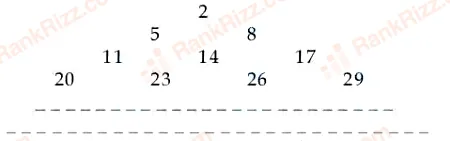
An arithmetic progression is written in the following way:
page12_img1


The sum of all the terms of the 10th10^{th} row is _____

Q83Angle between lines, parallel and perpendicular lines

Let a ray of light passing through the point (3,10)(3, 10) reflects on the line 2x+y=62x + y = 6 and the reflected ray passes through the point (7,2)(7, 2). If the equation of the incident ray is ax+by+1=0ax + by + 1 = 0, then a2+b2+3aba^2 + b^2 + 3ab is equal to _____

Q84Standard hyperbola and basic properties

Let S be the focus of the hyperbola x23−y25=1\frac{x^2}{3} - \frac{y^2}{5} = 1, on the positive x-axis. Let C be the circle with its centre at A(6,5)A(\sqrt{6}, \sqrt{5}) and passing through the point S. If O is the origin and SAB is a diameter of C, then the square of the area of the triangle OSB is equal to _____

Q85Limits of exponential and logarithmic functions

If α=lim⁡x→0+(etan⁡x−extan⁡x−x)\alpha = \lim_{x \to 0^+} \left(\frac{e^{\sqrt{\tan x}} - e^{\sqrt{x}}}{\sqrt{\tan x} - \sqrt{x}}\right) and β=lim⁡x→0(1+sin⁡x)12cot⁡x\beta = \lim_{x \to 0} (1 + \sin x)^{\frac{1}{2}\cot x} are the roots of the quadratic equation ax2+bx−e=0ax^2 + bx - \sqrt{e} = 0, then 12log⁡e(a+b)12\log_e(a + b) is equal to _____

Q86Variance and standard deviation

Let a,b,c∈Na, b, c \in \mathbb{N} and a<b<ca < b < c. Let the mean, the mean deviation about the mean and the variance of the 5 observations 9,25,a,b,c9, 25, a, b, c be 18,418, 4 and 1365\frac{136}{5}, respectively. Then 2a+b−c2a + b - c is equal to _____

Q87Finding parameters from given areas

Let A be the region enclosed by the parabola y2=2xy^2 = 2x and the line x=24x = 24. Then the maximum area of the rectangle inscribed in the region A is _____

Q88Integration by substitution

If ∫1(x−1)4(x+3)65dx=A(αx−1βx+3)B+C\int \frac{1}{\sqrt[5]{(x-1)^4(x+3)^6}} dx = A\left(\frac{\alpha x - 1}{\beta x + 3}\right)^B + C, where C is the constant of integration, then the value of α+β+20AB\alpha + \beta + 20AB is _____

Q89Variable separable equations

Let α∣x∣=∣y∣exy−β\alpha|x| = |y|e^{xy - \beta}, α,β∈N\alpha, \beta \in \mathbb{N} be the solution of the differential equation x dy−y dx+xy(x dy+y dx)=0x\,dy - y\,dx + xy(x\,dy + y\,dx) = 0, y(1)=2y(1) = 2. Then α+β\alpha + \beta is equal to _____

Q90Foot of perpendicular, image and distance from a line

Let P(α,β,γ)P(\alpha, \beta, \gamma) be the image of the point Q(1,6,4)Q(1, 6, 4) in the line x1=y−12=z−23\frac{x}{1} = \frac{y - 1}{2} = \frac{z - 2}{3}. Then 2α+β+γ2\alpha + \beta + \gamma is equal to _____