All 90 questions of JEE Main 01 Feb 2024, Shift 2, in the order they were asked, one subject to a page. Pick an answer on any question to check it against the key. Free to read, nothing to download.
Questions
90
Physics · Chemistry · Maths
Answer key
89
questions with a checked key
Price
Free
no sign-up
Physics
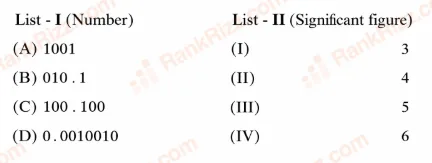
Q1Errors in measurement and significant figures
Match List - I with List - II.
Choose the correct answer from the options given below:
Train A is moving along two parallel rail tracks towards north with 72 km h−1 and train B is moving towards south with speed 108 km h−1. Velocity of train B with respect to A and velocity of ground with respect to B are (in m s−1):
Q3Newton's laws, free-body diagrams and equilibrium of a particle
A cricket player catches a ball of mass 120 g moving with 25 m s−1 speed. If the catching process is completed in 0.1 s then the magnitude of force exerted by the ball on the hand of player will be (in SI unit):
Q5Fixed-axis rotation: kinematics, rotational energy and pulleys
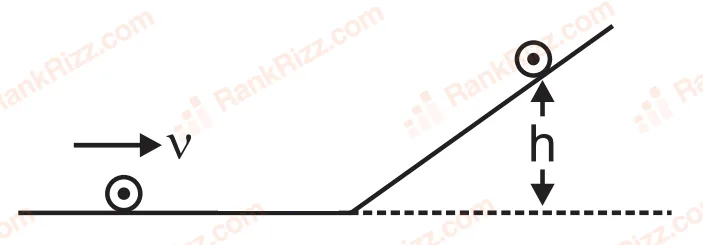
A disc of radius R and mass M is rolling horizontally without slipping with a speed v. It then moves up an inclined smooth surface as shown in the figure. The maximum height that the disc can go up the incline is
A light planet is revolving around a massive star in a circular orbit of radius R with a period of revolution T. If the force of attraction between planet and star is proportional to R−3/2 then choose the correct option:
Q9RMS, average and most probable speeds of gas molecules
If the root mean square velocity of hydrogen molecule at a given temperature and pressure is 2 km s−1, the root mean square velocity of oxygen at the same condition in km s−1 is:
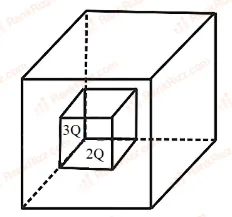
C1 and C2 are two hollow concentric cubes enclosing charges 2Q and 3Q respectively as shown in figure. The ratio of electric flux passing through C1 and C2 is
In a metre-bridge when a resistance in the left gap is 2Ω and unknown resistance in the right gap, the balance length is found to be 40 cm. On shunting the unknown resistance with 2Ω, the balance length changes by:
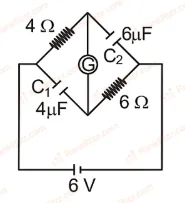
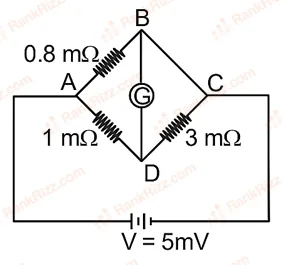
To measure the temperature coefficient of resistivity α of a semiconductor, an electrical arrangement shown in the figure is prepared. The arm BC is made up of the semiconductor. The experiment is being conducted at 25°C and resistance of the semiconductor arm is 3 mΩ. Arm BC is cooled at a constant rate of 2 °C s−1. If the galvanometer G shows no deflection after 10 s, then α is
Q16Properties of EM waves: fields, energy, intensity and momentum
If frequency of electromagnetic wave is 60 MHz and it travels in air along z direction then the corresponding electric and magnetic field vectors will be mutually perpendicular to each other and the wavelength of the wave in m is:
A microwave of wavelength 2.0 cm falls normally on a slit of width 4.0 cm. The angular spread of the central maxima of the diffraction pattern obtained on a screen 1.5 m away from the slit, will be:
Q18Photons: energy, momentum and radiation pressure
Monochromatic light of frequency 6×10¹⁴ Hz is produced by a laser. The power emitted is 2×10⁻³ W. How many photons per second on an average, are emitted by the source? (Given h=6.63×10⁻³⁴ J s)
From the statements given below: (A) The angular momentum of an electron in nth orbit is an integral multiple of 2πh). (B) Nuclear forces do not obey inverse square law. (C) Nuclear forces are spin dependent. (D) Nuclear forces are central and charge independent. (E) Stability of nucleus is inversely proportional to the value of packing fraction. Choose the correct answer from the options given below:
Conductivity of a photodiode starts changing only if the wavelength of incident light is less than 660 nm. The band gap of photodiode is found to be 8X eV. The value of X is: (Given h=6.6×10⁻³⁴ J s, e=1.6×10⁻¹⁹ C)
A particle initially at rest starts moving from reference point x=0 along x-axis, with velocity v that varies as v=4x m s−1. The acceleration of the particle is ______ m s−2.
A uniform rod AB of mass 2 kg and length 30 cm at rest on a smooth horizontal surface. An impulse of force 0.2 N s is applied to end B. The time taken by the rod to turn through at right angles will be xπ s, where x = ______.
Q23Stress, strain, Hooke's law and Young's modulus
One end of a metal wire is fixed to a ceiling and a load of 2 kg hangs from the other end. A similar wire is attached to the bottom of the load and another load of 1 kg hangs from this lower wire. Then the ratio of longitudinal strain of upper wire to that of the lower wire will be [Area of cross section of wire = 0.005 cm2, Y=2×10¹¹ N m−2 and g=10 m s−2]
Q24SHM: equation, phase, velocity and acceleration
A mass m is suspended from a spring of negligible mass and the system oscillates with a frequency f1. The frequency of oscillations if a mass 9m is suspended from the same spring is f2. The value of f2f1 is ______.
Q25Electric field due to point charges and superposition
Suppose a uniformly charged wall provides a uniform electric field of 2×10⁴ N C−1 normally. A charged particle of mass 2 g being suspended through a silk thread of length 20 cm and remain stayed at a distance of 10 cm from the wall. Then the charge on the particle will be x1μC where x = ______ [use g=10 m s−2]
A moving coil galvanometer has 100 turns and each turn has an area of 2.0 cm2. The magnetic field produced by the magnet is 0.01 T and the deflection in the coil is 0.05 radian when a current of 10 mA is passed through it. The torsional constant of the suspension wire is x×10−5 N-m/rad. The value of x is ______.
Q28Emf in rotating rods, discs and coils; eddy currents
A coil of 200 turns and area 0.20 m2 is rotated at half a revolution per second and is placed in uniform magnetic field of 0.01 T perpendicular to axis of rotation of the coil. The maximum voltage generated in the coil is β2π volt. The value of β is ______.
In Young's double slit experiment, monochromatic light of wavelength 5000 Å is used. The slits are 1.0 mm apart and screen is placed at 1.0 m away from slits. The distance from the centre of the screen where intensity becomes half of the maximum intensity for the first time is ______ ×10−6 m.
A particular hydrogen-like ion emits the radiation of frequency 3×10¹⁵ Hz when it makes transition from n=2 to n=1. The frequency of radiation emitted in transition from n=3 to n=1 is 9x×1015 Hz, when x = ______.