Q1Kinematics of uniform circular motion
A body is moving with constant speed, in a circle of radius 10 m. The body completes one revolution in 4 s. At the end of 3rd second, the displacement of body (in m) from its starting point is:
- A
30
- B
- C
- D
All 90 questions of JEE Main 31 Jan 2023, Shift 2, in the order they were asked, one subject to a page. Pick an answer on any question to check it against the key. Free to read, nothing to download.
Questions
90
Physics · Chemistry · Maths
Answer key
88
questions with a checked key
Price
Free
no sign-up
A body is moving with constant speed, in a circle of radius 10 m. The body completes one revolution in 4 s. At the end of 3rd second, the displacement of body (in m) from its starting point is:
30
Match List I with List II
List I List II
A. Angular momentum I. [MLT]
B. Torque II. [MLT]
C. Stress III. [MLT]
D. Pressure gradient IV. [MLT]
Choose the correct answer from the options given below:
A-I, B-IV, C-III, D-II
A-III, B-I, C-IV, D-II
A-II, B-III, C-IV, D-I
A-IV, B-II, C-I, D-III
A stone of mass 1 kg is tied to end of a massless string of length 1 m. If the breaking tension of the string is 400 N, then maximum linear velocity, the stone can have without breaking the string, while rotating in horizontal plane, is:
20 m s
40 m s
400 m s
10 m s
A body of mass 10 kg is moving with an initial speed of 20 m s. The body stops after 5 s due to friction between body and the floor. The value of the coefficient of friction is: (Take acceleration due to gravity m s)
0.2
0.3
0.5
0.4
A body weight , is projected vertically upwards from earth's surface to reach a height above the earth which is equal to nine times the radius of earth. The weight of the body at that height will be:
Under the same load, wire A having length 5.0 m and cross section m stretches uniformly by the same amount as another wire B of length 6.0 m and a cross section of m stretches. The ratio of the Young's modulus of wire A to that of wire B will be:
1 : 4
1 : 1
1 : 10
1 : 2
Heat energy of 735 J is given to a diatomic gas allowing the gas to expand at constant pressure. Each gas molecule rotates around an internal axis but do not oscillate. The increase in the internal energy of the gas will be:
525 J
441 J
572 J
735 J
A hypothetical gas expands adiabatically such that its volume changes from 08 litres to 27 litres. If the ratio of final pressure of the gas to initial pressure of the gas is . Then the ratio of will be.
For a solid rod, the Young's modulus of elasticity is N m and density is kg m. The velocity of longitudinal wave in the rod will be
m s
m s
m s
m s
Considering a group of positive charges, which of the following statements is correct?
Net potential of the system cannot be zero at a point but net electric field can be zero at that point
Net potential of the system at a point can be zero but net electric field can't be zero at that point
Both the net potential and the net field can be zero at a point
Both the net potential and the net electric field cannot be zero at a point
The number of turns of the coil of a moving coil galvanometer is increased in order to increase current sensitivity by 50%. The percentage change in voltage sensitivity of the galvanometer will be:
100%
50%
75%
0%
The amount of thermal energy is developed by a resistor in 10 s when a current of 4 A is passed through it. If the current is increased to 16 A, the thermal energy developed by the resistor in 10 s will be
A long conducting wire having a current flowing through it, is bent into a circular coil of turns. Then it is bent into a circular coil of turns. The magnetic field is calculated at the centre of coils in both the cases. The ratio of the magnetic field in first case to that of second case is:
An alternating voltage source is connected across a pure inductor of 5 mH. Inductive reactance in the circuit is:
Match List I and List II
List I List II
A. Microwaves I. Physiotherapy
B. UV rays II. Treatment of cancer
C. Infra-red rays III. Lasik eye surgery
D. X-rays IV. Aircraft navigation
Choose the correct answer from the option given below:
A-II, B-IV, C-III, D-I
A-IV, B-I, C-II, D-III
A-IV, B-III, C-I, D-II
A-III, B-II, C-I, D-IV
A microscope is focused on an object at the bottom of a bucket. If liquid with refractive index is poured inside the bucket, then microscope have to be raised by 30 cm to focus the object again. The height of the liquid in the bucket is:
75 cm
50 cm
18 cm
12 cm
If the two metals and are exposed to radiation of wavelength 350 nm. The work functions of metals and are 4.8 eV and 2.2 eV. Then choose the correct option
Metal B will not emit photo-electrons
Both metals A and B will emit photo-electrons
Both metals A and B will not emit photoelectrons
Metal A will not emit photo-electrons
The radius of electron's second stationary orbit in Bohr's atom is . The radius of 3 orbit will be
2.25
Given below are two statements:
Statement I: In a typical transistor, all three regions emitter, base and collector have same doping level.
Statement II: In a transistor, collector is the thickest and base is the thinnest segment.
In the light of the above statements, choose the most appropriate answer from the options given below.
Both Statement I and Statement II are correct
Both Statement I and Statement II are incorrect
Statement I is incorrect but Statement II is correct
Statement I is correct but Statement II is incorrect
Given below are two statements
Statement I: For transmitting a signal, size of antenna () should be comparable to wavelength of signal (at least in dimension).
Statement II: In amplitude modulation, amplitude of carrier wave remains constant (unchanged).
In the light of the above statements, choose the most appropriate answer from the options given below
Both Statement I and Statement II are correct
Both Statement I and Statement II are incorrect
Statement I is incorrect but Statement II is correct
Statement I is correct but Statement II is incorrect
Two bodies are projected from ground with same speeds 40 m s at two different angles with respect to horizontal. The bodies were found to have same range. If one of the body was projected at an angle of 60°, with horizontal then sum of the maximum heights, attained by the two projectiles, is ______ m. (Given m s)
A ball is dropped from a height of 20 m. If the coefficient of restitution for the collision between ball and floor is 0.5, after hitting the floor, the ball rebounds to a height of ______ m.
Two discs of same mass and different radii are made of different materials such that their thicknesses are 1 cm and 0.5 cm respectively. The densities of materials are in the ratio 3 : 5. The moment of inertia of these discs respectively about their diameters will be in the ratio of . The value of is ______.
A water heater of power 2000 W is used to heat water. The specific heat capacity of water is 4200 J kg K. The efficiency of heater is 70%. Time required to heat 2 kg of water from 10°C to 60°C is ______ s. (Assume that the specific heat capacity of water remains constant over the temperature range of the water).
The displacement equations of two interfering waves are given by cm, cm respectively. The amplitude of the resultant wave is ______ cm.
Two parallel plate capacitors and each having capacitance of 10 F are individually charged by a 100 V D.C. source. Capacitor is kept connected to the source and a dielectric slab is inserted between it plates. Capacitor is disconnected from the source and then a dielectric slab is inserted in it. Afterwards the capacitor is also disconnected from the source and the two capacitors are finally connected in parallel combination. The common potential of the combination will be ______ V.
(Assuming Dielectric constant = 10)
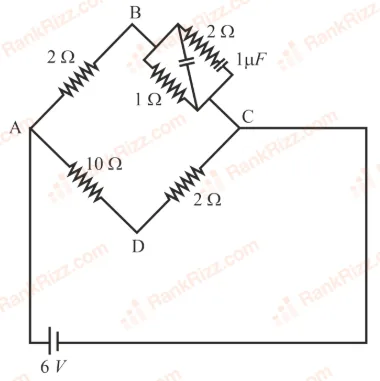
For the given circuit, in the steady state, = ______ V.
A series LCR circuit consists of . , and . The input voltage is 2500 V. The amplitude of current, in the circuit, is ______ A.
Two light waves of wavelengths 800 and 600 nm are used in Young's double slit experiment to obtain interference fringes on a screen placed 7 m away from plane of slits. If the two slits are separated by 0.35 mm, then shortest distance from the central bright maximum to the point where the bright fringes of the two wavelength coincide will be ______ mm.
If the binding energy of ground state electron in a hydrogen atom is 13.6 eV, then, the energy required to remove the electron from the second excited state of Li will be: eV. The value of is ______.