RankRizz

JEE Main 01 Feb 2023, Shift 1 Question Paper

All 90 questions of JEE Main 01 Feb 2023, Shift 1, in the order they were asked, one subject to a page. Pick an answer on any question to check it against the key. Free to read, nothing to download.

Questions

90

Physics · Chemistry · Maths

Answer key

90

questions with a checked key

Price

Free

no sign-up

Physics

Q1Dimensional analysis: deriving and checking relations

P+aV2(V−b)=RTP + \frac{a}{V^2}(V - b) = RT represents the equation of state of some gases. Where PP is the pressure, VV is the volume, TT is the temperature and a,b,Ra, b, R are the constants. The physical quantity, which has dimensional formula as that of b2a\frac{b^2}{a}, will be:

  1. A

    Bulk modulus

  2. B

    Modulus of rigidity

  3. C

    Compressibility

  4. D

    Energy density

Q2Distance, displacement, speed, velocity and acceleration (average vs instantaneous)

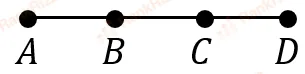
An object moves with speed v1v_1, v2v_2 and v3v_3 along a line segment ABAB, BCBC and CDCD respectively as shown in the figure, where AB=BCAB = BC and AD=3ABAD = 3AB, then the average speed of the object will be:

Figure for JEE Main 2023 Physics question on Distance, displacement, speed, velocity and acceleration (average vs instantaneous)
  1. A

    v1+v2+v33\frac{v_1+v_2+v_3}{3}

  2. B

    3v1v2+v2v3+v3v1\frac{3}{v_1v_2+v_2v_3+v_3v_1}

  3. C

    3v1v2v3v1v2+v2v3+v3v1\frac{3v_1v_2v_3}{v_1v_2+v_2v_3+v_3v_1}

  4. D

    v1+v2+v33v1v2v3\frac{v_1+v_2+v_3}{3v_1v_2v_3}

Q3Projectiles from a height and on inclined planes

A child stands on the edge of the cliff 10 m above the ground and throws a stone horizontally with an initial speed of 5 m s−1^{-1}. Neglecting the air resistance, the speed with which the stone hits the ground will be _____ m s−1^{-1} (given, g=10g = 10 m s−2^{-2}).

  1. A

    20

  2. B

    15

  3. C

    30

  4. D

    25

Q4Static and kinetic friction

A block of mass 5 kg is placed at rest on a table of rough surface. Now, if a force of 30 N is applied in the direction parallel to surface of the table, the block slides through a distance of 50 m in an interval of time 10 s. Coefficient of kinetic friction is (given, g=10g = 10 m s−2^{-2}):

  1. A

    0.60

  2. B

    0.75

  3. C

    0.50

  4. D

    0.25

Q5Escape speed

If earth has a mass nine times and radius twice to the of a planet PP. Then ve3x\frac{v_e}{3}\sqrt{x} ms−1^{-1} will be the minimum velocity required by a rocket to pull out of gravitational force of PP, where vev_e is escape velocity on earth. The value of xx is

  1. A

    2

  2. B

    3

  3. C

    18

  4. D

    1

Q6Acceleration due to gravity and its variation

Given below are two statements:
Statement-I: Acceleration due to gravity is different at different places on the surface of earth.
Statement-II: Acceleration due to gravity increases as we go down below the earth's surface.
In the light of the above statements, choose the correct answer from the options given below

  1. A

    Both Statement I and Statement II are true

  2. B

    Both Statement I and Statement II are false

  3. C

    Statement I is true but Statement II is false

  4. D

    Statement I is false but Statement II is true

Q7Surface tension and surface energy

A mercury drop of radius 10−310^{-3} m is broken into 125 equal size droplets. Surface tension of mercury is 0.45 N m−1^{-1}. The gain in surface energy is:

  1. A

    2.26×10−52.26 \times 10^{-5} J

  2. B

    28×10−528 \times 10^{-5} J

  3. C

    17.5×10−517.5 \times 10^{-5} J

  4. D

    5×10−55 \times 10^{-5} J

Q8Isothermal and adiabatic processes

A sample of gas at temperature TT is adiabatically expanded to double its volume. The work done by the gas in the process is, (given γ=32\gamma = \frac{3}{2}):

  1. A

    W=TR2−2W = TR\sqrt{2} - 2

  2. B

    W=TR2−2W = \frac{T}{R}\sqrt{2} - 2

  3. C

    W=RT(2−2)W = \frac{R}{T}(2 - \sqrt{2})

  4. D

    W=RT(2−2)W = RT(2 - \sqrt{2})

Q9Kinetic interpretation of pressure and temperature

The average kinetic energy of a molecule of the gas is

  1. A

    proportional to absolute temperature

  2. B

    proportional to volume

  3. C

    proportional to pressure

  4. D

    dependent on the nature of the gas

Q10Progressive waves: wave equation, phase and intensity

A steel wire with mass per unit length 7.0×10−37.0 \times 10^{-3} kg m−1^{-1} is under tension of 70 N. The speed of transverse waves in the wire will be:

  1. A

    200π200\pi m s−1^{-1}

  2. B

    100 m s−1^{-1}

  3. C

    10 m s−1^{-1}

  4. D

    50 m s−1^{-1}

Q11Electric field of continuous charge distributions

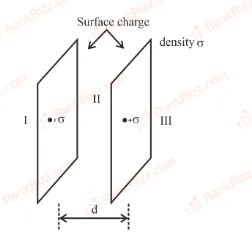
Let σ\sigma be the uniform surface charge density of two infinite thin plane sheets as shown in the figure. Then the electric fields in three different regions, EIE_I, EIIE_{II} and EIIIE_{III} are:

Figure for JEE Main 2023 Physics question on Electric field of continuous charge distributions
  1. A

    EI⃗=2σϵ0n^,EII=0,EIII⃗=2σϵ0n^\vec{E_I} = \frac{2\sigma}{\epsilon_0}\hat{n}, E_{II} = 0, \vec{E_{III}} = \frac{2\sigma}{\epsilon_0}\hat{n}

  2. B

    EI⃗=0,EII⃗=σϵ0n^,EIII=0\vec{E_I} = 0, \vec{E_{II}} = \frac{\sigma}{\epsilon_0}\hat{n}, E_{III} = 0

  3. C

    EI⃗=σ2ϵ0n^,EII=0,EIII⃗=σ2ϵ0n^\vec{E_I} = \frac{\sigma}{2\epsilon_0}\hat{n}, E_{II} = 0, \vec{E_{III}} = \frac{\sigma}{2\epsilon_0}\hat{n}

  4. D

    EI⃗=−σϵ0n^,EII=0,EIII⃗=σϵ0n^\vec{E_I} = \frac{-\sigma}{\epsilon_0}\hat{n}, E_{II} = 0, \vec{E_{III}} = \frac{\sigma}{\epsilon_0}\hat{n}

Q12Wheatstone bridge

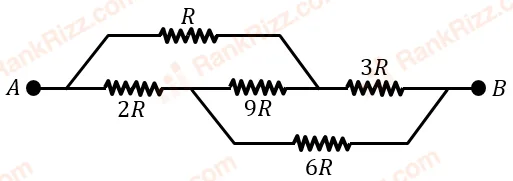
The equivalent resistance between A and B of the network shown in the figure:

Figure for JEE Main 2023 Physics question on Wheatstone bridge
  1. A

    112R311\frac{2R}{3}

  2. B

    14 R

  3. C

    21 R

  4. D

    83\frac{8}{3} R

Q13Biot-Savart law: straight wires and moving charges

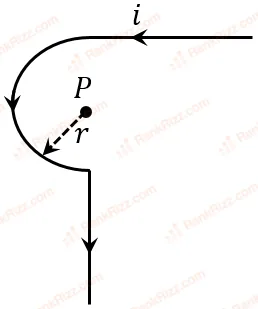
Find the magnetic field at point P as shown in the figure. The curved portion is a semicircle connected to two long straight wires.

Figure for JEE Main 2023 Physics question on Biot-Savart law: straight wires and moving charges
  1. A

    μ0I2r(1+2π)\frac{\mu_0 I}{2r}(1 + \frac{2}{\pi})

  2. B

    μ0I2r(1+1π)\frac{\mu_0 I}{2r}(1 + \frac{1}{\pi})

  3. C

    μ0I2r(12+12π)\frac{\mu_0 I}{2r}(\frac{1}{2} + \frac{1}{2\pi})

  4. D

    μ0I2r(12+1π)\frac{\mu_0 I}{2r}(\frac{1}{2} + \frac{1}{\pi})

Q14AC generator and transformer

Match the List-I with List-II.
A. AC generator   I. Presence of both L and C
B. Transformer   II. Electromagnetic Induction
C. Resonance phenomenon to occur   III. Quality factor
D. Sharpness of resonance   IV. Mutual Inductance

  1. A

    A-IV, B-II, C-I, D-III

  2. B

    A-II, B-I, C-III, D-IV

  3. C

    A-II, B-IV, C-I, D-III

  4. D

    A-IV, B-III, C-I, D-II

Q15Electromagnetic spectrum and uses

Match the List-I with List-II:
A. Microwaves   I. Radioactive decay of the nucleus
B. Gamma rays   II. Rapid acceleration and deceleration of electron in aerials
C. Radio waves   III. Inner shell electrons
D. X-rays   IV. Klystron valve

  1. A

    A-I, B-II, C-III, D-IV

  2. B

    A-IV, B-I, C-II, D-III

  3. C

    A-I, B-III, C-IV, D-II

  4. D

    A-IV, B-III, C-II, D-I

Q16Polarisation: Malus's law and Brewster's law

'nn' polarizing sheets are arranged such that each makes an angle 45° with the proceeding sheet. An unpolarized light of intensity II is incident into this arrangement. The output intensity is found to be I64\frac{I}{64}. The value of nn will be:

  1. A

    3

  2. B

    6

  3. C

    5

  4. D

    4

Q17de Broglie wavelength of matter waves

A proton moving with one tenth of velocity of light has a certain de Broglie wavelength of λ\lambda. An alpha particle having certain kinetic energy has the same de-Broglie wavelength λ\lambda. The ratio of kinetic energy of proton and that of alpha particle is:

  1. A

    2 : 1

  2. B

    4 : 1

  3. C

    1 : 2

  4. D

    1 : 4

Q18Nuclear size, mass defect and binding energy

The mass of proton, neutron and helium nucleus are respectively 1.0073 u, 1.0087 u and 4.0015u. The binding energy of helium nucleus is:

  1. A

    14.2 MeV

  2. B

    28.4 MeV

  3. C

    56.8 MeV

  4. D

    7.1 MeV

Q19p-n junction diode and its characteristics

Match the List I with List II
A. Intrinsic Semiconductor   I. Fermi-level near valence band
B. n-type semiconductor   II. Fermi-level at middle of valence and conduction band
C. p-type semiconductor   III. Fermi-level near conduction band
D. Metals   IV. Fermi-level inside conduction band

  1. A

    (A) →\to I, (B) →\to II, (C) →\to III, (D) →\to IV

  2. B

    (A) →\to II, (B) →\to I, (C) →\to III, (D) →\to IV

  3. C

    (A) →\to II, (B) →\to III, (C) →\to I, (D) →\to IV

  4. D

    (A) →\to III, (B) →\to I, (C) →\to II, (D) →\to IV

Q20Elements of communication and propagation of EM waves

Which of the following frequencies does not belong to FM broadcast.

  1. A

    106 MHz

  2. B

    64 MHz

  3. C

    99 MHz

  4. D

    89 MHz

Q21Work done by constant and variable forces

A small particle moves to position 5i^−2j^+k^5\hat{i} - 2\hat{j} + \hat{k} from its initial position 2i^+3j^−4k^2\hat{i} + 3\hat{j} - 4\hat{k} under the action of force 5i^+2j^+7k^5\hat{i} + 2\hat{j} + 7\hat{k} N. The value of work done will be _____ J.

Q22Rolling with friction, slipping and impulsive forces

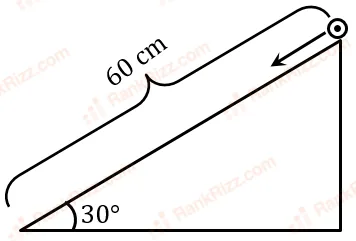
A solid cylinder is released from rest from the top of an inclined plane of inclination 30° and length 60 cm. If the cylinder rolls without slipping, its speed upon reaching the bottom of the inclined plane is _____ m s−1^{-1}.
(Given g=10g = 10 m s−2^{-2})

Figure for JEE Main 2023 Physics question on Rolling with friction, slipping and impulsive forces
Q23Bulk modulus and compressibility

A certain pressure 'P' is applied to 1 litre of water and 2 litre of a liquid separately. Water gets compressed to 0.01% whereas the liquid gets compressed to 0.03%. The ratio of Bulk modulus of water to that of the liquid is 3x\frac{3}{x}. The value of xx is _____.

Q24SHM: equation, phase, velocity and acceleration

The amplitude of a particle executing SHM is 3 cm. The displacement at which its kinetic energy will be 25% more than the potential energy is: _____ cm.

Q25Electric field of continuous charge distributions

Two equal positive point charges are separated by a distance 2a2a. The distance of a point from the centre of the line joining two charges on the equatorial line (perpendicular bisector) at which force experienced by a test charge q0q_0 becomes maximum is ax\frac{a}{\sqrt{x}}. The value of xx is _____.

Q26Potentiometer

In an experiment to find emf of a cell using potentiometer, the length of null point for a cell of emf 1.5 V is found to be 60 cm. If this cell is replaced by another cell of emf EE, the length-of null point increases by 40 cm. The value of EE is x10\frac{x}{10} V. The value of xx is _____.

Q27Motion of charged particles in a magnetic field

A charge particle of 2 μ\muC accelerated by a potential difference of 100 V enters a region of uniform magnetic field of magnitude 4 mT at right angle to the direction of field. The charge particle completes semicircle of radius 3 cm inside magnetic field. The mass of the charge particle is _____ ×10−18\times 10^{-18} kg.

Q28Series LCR circuits: impedance and phase

A series LCR circuit is connected to an ac source of 220 V, 50 Hz. The circuit contain a resistance R=100R = 100 Ω\Omega and an inductor of inductive reactance XL=79.6X_L = 79.6 Ω\Omega. The capacitance of the capacitor needed to maximize the average rate at which energy is supplied will be _____ μ\muF.

Q29Spherical mirrors: mirror formula and magnification

A thin cylindrical rod of length 10 cm is placed horizontally on the principle axis of a concave mirror of focal length 20 cm. The rod is placed in a such a way that mid point of the rod is at 40 cm from the pole of mirror. The length of the image formed by the mirror will be x3\frac{x}{3} cm. The value of xx is _____.

Q30Hydrogen spectrum and spectral series

A light of energy 12.75 eV is incident on a hydrogen atom in its ground state. The atom absorbs the radiation and reaches to one of its excited states. The angular momentum of the atom in the excited state is xπ×10−17\frac{x}{\pi} \times 10^{-17} eVs. The value of xx is _____ (use h=4.14×10⁻¹⁵h = 4.14 \times 10^{-15} eVs, c=3×10⁸c = 3 \times 10^8 m s−1^{-1})

NEXT IN THIS PAPER →Chemistry, Q31 onwards