RankRizz

JEE Main 12 Jan 2019, Shift 1 Question Paper

All 90 questions of JEE Main 12 Jan 2019, Shift 1, in the order they were asked, one subject to a page. Pick an answer on any question to check it against the key. Free to read, nothing to download.

Questions

90

Physics · Chemistry · Maths

Answer key

90

questions with a checked key

Price

Free

no sign-up

Physics

Q1Relative velocity in two dimensions

A person standing on an open ground hears the sound of a jet aeroplane, coming from north at an angle 60°60° with ground level, but he finds the aeroplane right vertically above his position. If vv is the speed of sound, speed of the plane is:

  1. A

    2v3\frac{2v}{\sqrt{3}}

  2. B

    vv

  3. C

    v2\frac{v}{2}

  4. D

    32v\frac{\sqrt{3}}{2}v

Q2Relative motion in one dimension

A passenger train of length 60 m travels at a speed of 80 km/hr. Another freight train of length 120 m travels at a speed of 30 km/hr. The ratio of times taken by the passenger train to completely cross the freight train when: (i) they are moving in the same direction, and (ii) in the opposite directions is:

  1. A

    52\frac{5}{2}

  2. B

    32\frac{3}{2}

  3. C

    115\frac{11}{5}

  4. D

    2511\frac{25}{11}

Q3Head-on collisions and coefficient of restitution

A simple pendulum, made of a string of length ll and a bob of mass mm, is released from a small angle θ0\theta_0. It strikes a block of mass MM, kept on horizontal surface at its lowest point of oscillations, elastically. It bounces back and goes up to an angle θ1\theta_1. Then M is given by:

  1. A

    m(θ0−θ1θ0+θ1)m\left(\frac{\theta_0 - \theta_1}{\theta_0 + \theta_1}\right)

  2. B

    m(θ0+θ1θ0−θ1)m\left(\frac{\theta_0 + \theta_1}{\theta_0 - \theta_1}\right)

  3. C

    m2(θ0+θ1θ0−θ1)\frac{m}{2}\left(\frac{\theta_0 + \theta_1}{\theta_0 - \theta_1}\right)

  4. D

    m2(θ0−θ1θ0+θ1)\frac{m}{2}\left(\frac{\theta_0 - \theta_1}{\theta_0 + \theta_1}\right)

Q4Centre of mass of a system of particles

The position vector of the center of mass rcm⃗\vec{r_{cm}} of an asymmetric uniform bar of negligible area of cross-section as shown in figure is:

Figure for JEE Main 2019 Physics question on Centre of mass of a system of particles
  1. A

    rcm⃗=138Lx^+58Ly^\vec{r_{cm}} = \frac{13}{8}L\hat{x} + \frac{5}{8}L\hat{y}

  2. B

    rcm⃗=58Lx^+138Ly^\vec{r_{cm}} = \frac{5}{8}L\hat{x} + \frac{13}{8}L\hat{y}

  3. C

    rcm⃗=38Lx^+118Ly^\vec{r_{cm}} = \frac{3}{8}L\hat{x} + \frac{11}{8}L\hat{y}

  4. D

    rcm⃗=118Lx^+38Ly^\vec{r_{cm}} = \frac{11}{8}L\hat{x} + \frac{3}{8}L\hat{y}

Q5Moment of inertia of standard bodies and composite systems

Let the moment of inertia of a hollow cylinder of length 30 cm (inner radius 10 cm and outer radius 20 cm), about its axis be I. The radius of a thin cylinder of the same mass such that its moment of inertia about its axis is also I, is:

  1. A

    16 cm

  2. B

    14 cm

  3. C

    12 cm

  4. D

    18 cm

Q6Satellites: orbital speed, period, energy and geostationary orbits

A satellite of mass M is in a circular orbit of radius R about the center of the earth. A meteorite of the same mass, falling towards the earth, collides with the satellite completely inelastic. The speeds of the satellite and the meteorite are the same, just before the collision. The subsequent motion of the combined body will be:

  1. A

    In an elliptical orbit

  2. B

    Such that it escapes to infinity

  3. C

    In a circular orbit of a different radius

  4. D

    In the same circular orbit of radius R

Q7Kepler's laws and planetary motion

A straight rod of length L extends from x=ax = a to x=L+ax = L + a. The gravitational force it exerts on a point mass 'm' at x=0x = 0, if the mass per unit length of the rod is A+Bx2A + Bx^2, is given by:

  1. A

    Gm[A(1a+L−1a)+BL]Gm\left[A\left(\frac{1}{a+L} - \frac{1}{a}\right) + BL\right]

  2. B

    Gm[A(1a+L−1a)−BL]Gm\left[A\left(\frac{1}{a+L} - \frac{1}{a}\right) - BL\right]

  3. C

    Gm[A(1a−1a+L)−BL]Gm\left[A\left(\frac{1}{a} - \frac{1}{a+L}\right) - BL\right]

  4. D

    Gm[A(1a−1a+L)+BL]Gm\left[A\left(\frac{1}{a} - \frac{1}{a+L}\right) + BL\right]

Q8Heat conduction and thermal resistance

A cylinder of radius R is surrounded by a cylindrical shell of inner radius R and outer radius 2R. The thermal conductivity of the material of the inner cylinder is K1K_1 and that of the outer cylinder is K2K_2. Assuming no loss of heat, the effective thermal conductivity of the system for heat flowing along the length of the cylinder is:

  1. A

    2K1+3K25\frac{2K_1 + 3K_2}{5}

  2. B

    K1+K22\frac{K_1 + K_2}{2}

  3. C

    K1+K2K_1 + K_2

  4. D

    K1+3K24\frac{K_1 + 3K_2}{4}

Q9Work done in thermodynamic processes and P-V diagrams

For the given cyclic process CAB as shown for a gas, the work done is:

Figure for JEE Main 2019 Physics question on Work done in thermodynamic processes and P-V diagrams
  1. A

    10 J

  2. B

    5 J

  3. C

    1 J

  4. D

    30 J

Q10Degrees of freedom, equipartition of energy and internal energy

An ideal gas occupies a volume of 2m32 m^3 at a pressure of 3×10⁶Pa3 \times 10^6 Pa. The energy of the gas is:

  1. A

    108J10^8 J

  2. B

    9×10⁶J9 \times 10^6 J

  3. C

    3×10²J3 \times 10^2 J

  4. D

    6×10⁴J6 \times 10^4 J

Q11Simple, compound and torsional pendulums

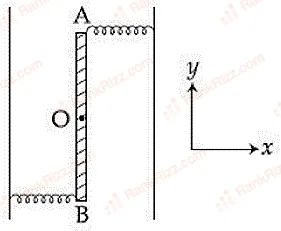
Two light identical springs of spring constant k are attached horizontally at the two ends of a uniform horizontal rod AB of length l and mass m. The rod is pivoted at its center 'O' and can rotate freely in horizontal plane. The other ends of the two springs are fixed to rigid supports as shown in figure. The rod is gently pushed through a small angle and released. The frequency of resulting oscillation is:

Figure for JEE Main 2019 Physics question on Simple, compound and torsional pendulums
  1. A

    12π3km\frac{1}{2\pi}\sqrt{\frac{3k}{m}}

  2. B

    12πkm\frac{1}{2\pi}\sqrt{\frac{k}{m}}

  3. C

    12π6km\frac{1}{2\pi}\sqrt{\frac{6k}{m}}

  4. D

    12π2km\frac{1}{2\pi}\sqrt{\frac{2k}{m}}

Q12Progressive waves: wave equation, phase and intensity

A travelling harmonic wave is represented by the equation y(x,t)=10−3sin⁡(50t+2x)y(x, t) = 10^{-3} \sin(50t + 2x), where x and y are in meter and t is in seconds. Which of the following is a correct statement about the wave?

  1. A

    The wave is propagating along the positive x-axis with speed 25 m s−1^{-1}

  2. B

    The wave is propagating along the positive x-axis with speed 100 m s−1^{-1}

  3. C

    The wave is propagating along the negative x-axis with speed 25 m s−1^{-1}

  4. D

    The wave is propagating along the negative x-axis with speed 100 m s−1^{-1}

Q13Electric dipole and dipole in external field

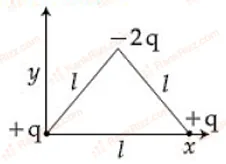
Determine the electric dipole moment of the system of three charges, placed on the vertices of an equilateral triangle, as shown in the figure:

Figure for JEE Main 2019 Physics question on Electric dipole and dipole in external field
  1. A

    3qli^−j^2\sqrt{3}ql\frac{\hat{i}-\hat{j}}{\sqrt{2}}

  2. B

    −3qlj^-\sqrt{3}ql\hat{j}

  3. C

    2qlj^2ql\hat{j}

  4. D

    (ql)i^+j^2(ql)\frac{\hat{i}+\hat{j}}{\sqrt{2}}

Q14Electric potential and potential energy

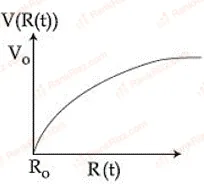
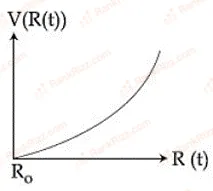
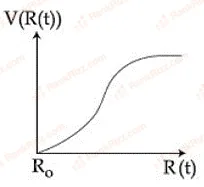
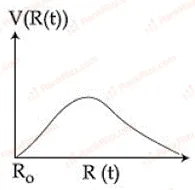
There is a uniform spherically symmetric surface charge density at a distance R0R_0 from the origin. The charge distribution is initially at rest and starts expanding because of mutual repulsion. The figure that represents best the speed V(R(t))V(R(t)) of the distribution as a function of its instantaneous radius R(t)R(t) is:

  1. A
    Figure for JEE Main 2019 Physics question on Electric potential and potential energy
  2. B
    Figure for JEE Main 2019 Physics question on Electric potential and potential energy
  3. C
    Figure for JEE Main 2019 Physics question on Electric potential and potential energy
  4. D
    Figure for JEE Main 2019 Physics question on Electric potential and potential energy
Q15Capacitors in DC circuits (steady state)

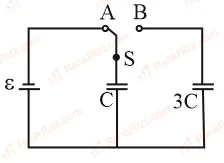
The figure shows a capacitor of capacitance C connected to a battery via a switch, having a total charge Q on it, in steady-state. When the switch S is turned from position A to position B, the energy dissipated in the circuit is

Figure for JEE Main 2019 Physics question on Capacitors in DC circuits (steady state)
  1. A

    18Q2C\frac{1}{8}\frac{Q^2}{C}

  2. B

    38Q2C\frac{3}{8}\frac{Q^2}{C}

  3. C

    34Q2C\frac{3}{4}\frac{Q^2}{C}

  4. D

    58Q2C\frac{5}{8}\frac{Q^2}{C}

Q16Galvanometer conversion to ammeter and voltmeter

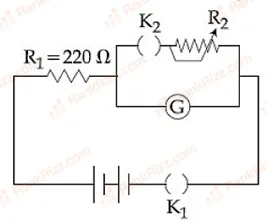
The galvanometer deflection, when key K1K_1 is closed but K2K_2 is open, equals θ0\theta_0 (see figure). On closing K2K_2 also and adjusting R2R_2 to 5Ω5\Omega, the deflection in galvanometer becomes θ05\frac{\theta_0}{5}. The resistance of the galvanometer is, then, given by [Neglect the internal resistance of battery]:

Figure for JEE Main 2019 Physics question on Galvanometer conversion to ammeter and voltmeter
  1. A

    12Ω12 \Omega

  2. B

    22Ω22 \Omega

  3. C

    5Ω5 \Omega

  4. D

    25Ω25 \Omega

Q17Potentiometer

An ideal battery of emf 4V and resistance R are connected in series in the primary circuit of a potentiometer of length 1 m and resistance 5Ω5\Omega. The value of R, to give a potential difference of 5 mV across 10 cm of potentiometer wire, is:

  1. A

    480Ω480 \Omega

  2. B

    495Ω495 \Omega

  3. C

    395Ω395 \Omega

  4. D

    490Ω490 \Omega

Q18Electric power and heating effect of current

Two electric bulbs, rated at (25 W, 220 V) and (100 W, 220 V), are connected in series across a 220 V voltage source. If the 25 W and 100 W bulbs draw powers P1P_1 and P2P_2 respectively, then:

  1. A

    P1=4P_1 = 4 W, P2=16P_2 = 16 W

  2. B

    P1=9P_1 = 9 W, P2=16P_2 = 16 W

  3. C

    P1=16P_1 = 16 W, P2=9P_2 = 9 W

  4. D

    P1=16P_1 = 16 W, P2=4P_2 = 4 W

Q19Motion of charged particles in a magnetic field

A proton and an α\alpha-particle (with their masses in the ratio of 1 : 4 and charges in the ratio of 1 : 2) are accelerated from rest through a potential difference V. If a uniform magnetic field (B) is set up perpendicular to their velocities, the ratio of the radii rp:rαr_p : r_{\alpha} of the circular paths described by them will be:

  1. A

    1 : 3

  2. B

    1:21 : \sqrt{2}

  3. C

    1 : 2

  4. D

    1:31 : \sqrt{3}

Q20Biot-Savart law: straight wires and moving charges

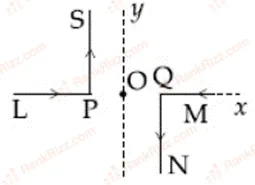
As shown in the figure, two infinitely long, identical wires are bent by 90° and placed in such a way that the segments LP and QM are along the x-axis, while segments PS and QN are parallel to the y-axis. If OP=OQ=4OP = OQ = 4 cm, and the magnitude of the magnetic field at O is 10−410^{-4} T, and the two wires carry equal currents (see figure), the magnitude of the current in each wire and the direction of the magnetic field at O will be (μ0=4π×10−7NA−2)\left(\mu_0 = 4\pi \times 10^{-7} NA^{-2}\right):

Figure for JEE Main 2019 Physics question on Biot-Savart law: straight wires and moving charges
  1. A

    20 A, perpendicular into the page

  2. B

    20 A, perpendicular out of the page

  3. C

    40 A, perpendicular into the page

  4. D

    40 A, perpendicular out of the page

Q21LR circuits: growth and decay of current

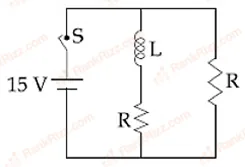
In the figure shown, a circuit contains two identical resistors with resistance R=5ΩR = 5\Omega and an inductance with L=2L = 2 mH. An ideal battery of 15V is connected in the circuit. What will be the current through the battery long after the switch is closed?

Figure for JEE Main 2019 Physics question on LR circuits: growth and decay of current
  1. A

    5.5 A

  2. B

    6 A

  3. C

    3 A

  4. D

    7.5 A

Q22Spherical mirrors: mirror formula and magnification

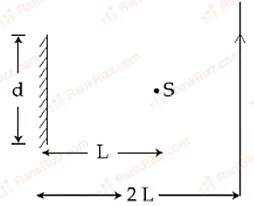
A point source of light, S is placed at a distance L in front of the center of plane mirror of width d which is hanging vertically on a wall. A man walks in front of the mirror along a line parallel to the mirror, at a distance 2L as shown below. The distance over which the man can see the image of the light source in the mirror is:

Figure for JEE Main 2019 Physics question on Spherical mirrors: mirror formula and magnification
  1. A

    3d

  2. B

    2d

  3. C

    d

  4. D

    d2\frac{d}{2}

Q23Properties of EM waves: fields, energy, intensity and momentum

A light wave is incident normally on a glass slab of refractive index 1.5. If 4% of light gets reflected and the amplitude of the electric field of the incident light is 30 V/m, then the amplitude of the electric field for the wave propagating in the glass medium will be:

  1. A

    30 V/m

  2. B

    6 V/m

  3. C

    24 V/m

  4. D

    10 V/m

Q24Thin lenses: lens formula, lens maker's formula and power

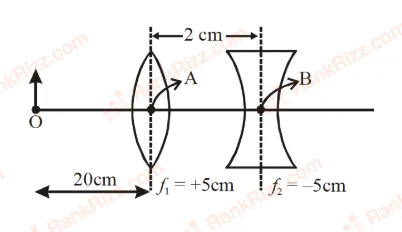
What is the position and nature of image formed by lens combination shown in figure? (f1f_1, f2f_2 are focal lengths)

Figure for JEE Main 2019 Physics question on Thin lenses: lens formula, lens maker's formula and power
  1. A

    40 cm from point B at right; real

  2. B

    203\frac{20}{3} cm from point B at right, real

  3. C

    70 cm from point B at right; real

  4. D

    70 cm from point B at left; virtual

Q25de Broglie wavelength of matter waves

A particle A of mass m and charge q is accelerated by a potential difference of 50 V. Another particle B of mass 4m and charge q is accelerated by a potential difference of 2500 V. The ratio of de-Broglie wavelengths λAλB\frac{\lambda_A}{\lambda_B} is close to:

  1. A

    0.07

  2. B

    10.00

  3. C

    4.47

  4. D

    14.14

Q26Hydrogen spectrum and spectral series

A particle of mass m moves in a circular orbit in a central potential field U(r)=12kr2U(r) = \frac{1}{2}kr^2. If Bohr's quantization conditions are applied, radii of possible orbitals and energy levels vary with quantum number n as:

  1. A

    rn∝n2r_n \propto n^2, En∝1n2E_n \propto \frac{1}{n^2}

  2. B

    rn∝nr_n \propto \sqrt{n}, En∝nE_n \propto n

  3. C

    rn∝nr_n \propto n, En∝nE_n \propto n

  4. D

    rn∝nr_n \propto \sqrt{n}, En∝1nE_n \propto \frac{1}{n}

Q27Logic gates and digital circuits

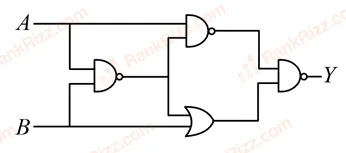
The output of the given logic circuit is:

Figure for JEE Main 2019 Physics question on Logic gates and digital circuits
  1. A

    ABˉA\bar{B}

  2. B

    AˉB\bar{A}B

  3. C

    AB+AˉBAB + \bar{A}B

  4. D

    ABˉ+AˉBA\bar{B} + \bar{A}B

Q28Modulation and demodulation

A 100V carrier wave is made to vary between 160 V and 40 V by a modulating signal. What is the modulation index?

  1. A

    0.3

  2. B

    0.6

  3. C

    0.4

  4. D

    0.5

Q29Screw gauge: pitch, least count and zero error

The least count of the main scale of a screw gauge is 1 mm. The minimum number of divisions on its circular scale required to measure 5 μ\mum diameter of a wire is:

  1. A

    50

  2. B

    100

  3. C

    500

  4. D

    200

Q30Meter bridge

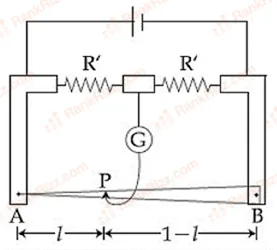
In a meter bridge, the wire of length 1 m has a non-uniform cross-section such that, the variation dRdl\frac{dR}{dl} of its resistance R with length l is dRdl∝1l\frac{dR}{dl} \propto \frac{1}{\sqrt{l}}. Two equal resistances are connected as shown in the figure. The galvanometer has zero deflection when the jockey is at point P. What is the length AP?
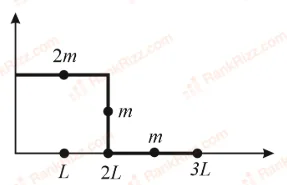
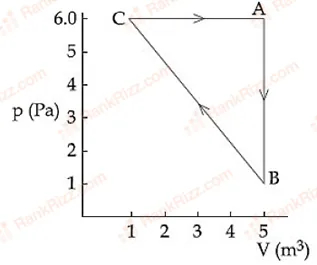
Figure for JEE Main 2019 Physics question on Meter bridge
  1. A

    0.2 m

  2. B

    0.35 m

  3. C

    0.3 m

  4. D

    0.25 m

NEXT IN THIS PAPER →Chemistry, Q31 onwards