All 90 questions of JEE Main 11 Jan 2019, Shift 2, in the order they were asked, one subject to a page. Pick an answer on any question to check it against the key. Free to read, nothing to download.
Questions
90
Physics · Chemistry · Maths
Answer key
87
questions with a checked key
Price
Free
no sign-up
Physics
Q1Equations of motion for uniform acceleration
A particle moves from the point (2.0i^+4.0j^) m, at t=0, with an initial velocity (5.0i^+4.0j^) ms−1. It is acted upon by a constant force which produces a constant acceleration (4.0i^+4.0j^) ms−2. What is the distance of the particle from the origin at time 2 s?
A particle of mass m is moving in a straight line with momentum p. Starting at time t=0, a force F=kt acts in the same direction on the moving particle during time interval T so that its momentum changes from p to 3p. Here k is a constant. The value of T is
Q4Torque and the rotational form of Newton's second law
The magnitude of torque on a particle of mass 1 kg is 2.5 Nm about the origin. If the force acting on it is 1 N, and the distance of the particle from the origin is 5 m, the angle between the force and the position vector is (in radians):
Q5Torque and the rotational form of Newton's second law
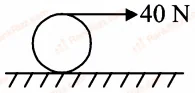
A string is wound around a hollow cylinder of mass 5 kg and radius 0.5 m. If the string is now pulled with a horizontal force of 40 N, and the cylinder is rolling without slipping on a horizontal surface (see figure), then the angular acceleration of the cylinder will be (Neglect the mass and thickness of the string)
Q6Moment of inertia of standard bodies and composite systems
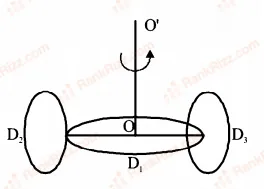
A circular disc D1 of mass M and radius R has two identical discs D2 and D3 of the same mass M and radius R attached rigidly at its opposite ends (see figure). The moment of inertia of the system about the axis OO', passing through the centre of D1, as shown in the figure, will be
The mass and the diameter of a planet are three times the respective values for the Earth. The period of oscillation of a simple pendulum on the Earth is 2 s. The period of oscillation of the same pendulum on the planet would be:
Two rods A and B of identical dimensions are at temperature 30°C. If A is heated upto 180°C and B upto T°C, then the new lengths are the same. If the ratio of the coefficients of linear expansion of A and B is 4 : 3, then the value of T is
A thermometer graduated according to a linear scale reads a value x0 when in contact with boiling water, and x0/3 when in contact with ice. What is the temperature of an object in °C, if this thermometer in the contact with the object reads x0/2?
In a process, temperature and volume of one mole of an ideal monoatomic gas are varied according to the relation VT = K, where K is a constant. In this process the temperature of the gas is increased by ΔT. The amount of heat absorbed by gas is (R is gas constant):
When 100 g of a liquid A at 100°C is added to 50 g of a liquid B at temperature 75°C, the temperature of the mixture becomes 90°C. The temperature of the mixture, if 100 g of liquid A at 100°C is added to 50 g of liquid B at 50°C, will be:
A metal ball of mass 0.1 kg is heated upto 500°C and dropped into a vessel of heat capacity 800 JK−1 and containing 0.5 kg water. The initial temperature of water and vessel is 30°C. What is the approximate percentage increment in the temperature of the water? [Specific Heat Capacities of water and metal are, respectively, 4200 Jkg−1K−1 and 400 Jkg−1K−1]
A pendulum is executing simple harmonic motion and its maximum kinetic energy is K1. If the length of the pendulum is doubled and it performs simple harmonic motion with the same amplitude as in the first case, its maximum kinetic energy is K2
A simple pendulum of length 1 m is oscillating with an angular frequency 10 rad/s. The support of the pendulum starts oscillating up and down with a small angular frequency of 1 rad/s and an amplitude of 10−2 m. The relative change in the angular frequency of the pendulum is best given by:
An electric field of 1000 V/m is applied to an electric dipole at angle of 45°. The value of electric dipole moment is 10−29 C.m. What is the potential energy of the electric dipole?
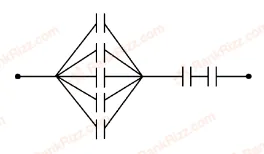
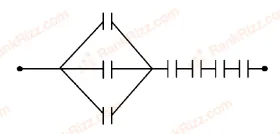
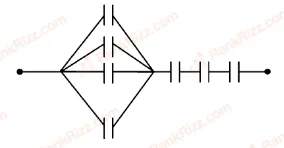
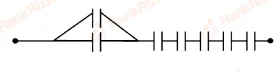
Seven capacitors, each of capacitance 2μF, are to be connected in a configuration to obtain an effective capacitance of (136)μF. Which of the combinations, shown in figures below, will achieve the desired value?
Q18Galvanometer conversion to ammeter and voltmeter
A galvanometer having a resistance of 20Ω and 30 division on both sides has figure of merit 0.005 ampere/division. The resistance that should be connected in series such that it can be used as a voltmeter upto 15 volt, is:
Q19Magnetisation, magnetic intensity, susceptibility and permeability
A paramagnetic substance in the form of a cube with sides 1 cm has a magnetic dipole moment of 20×10−6 J/T when a magnetic intensity of 60×103 A/m is applied. Its magnetic susceptibility is:
Q20Motion of charged particles in a magnetic field
The region between y=0 and y=d contains a magnetic field B=Bz^. A particle of mass m and charge q enters the region with a velocity v=vi^. If d=2qBmv, the acceleration of the charged particle at the point of its emergence at the other side is:
Q21Motion of charged particles in a magnetic field
A particle of mass m and charge q is in an electric and magnetic field given by E=2i^+3j^; B=4j^+6k^. The charged particle is shifted from the origin to the point P(x=1;y=1) along a straight path. The magnitude of the total work done is:
A copper wire is wound on a wooden frame, whose shape is that of an equilateral triangle. If the linear dimension of each side of the frame is increased by a factor of 3, keeping the number of turns of the coil per unit length of the frame the same, then the self inductance of the coil:
Q23Properties of EM waves: fields, energy, intensity and momentum
A 27 mW laser beam has a cross-sectional area of 10 mm2. The magnitude of the maximum electric field in this electromagnetic wave is given by: [Given permittivity of space ϵ0=9×10⁻¹² SI units, Speed of light c=3×10⁸ m/s]
Q24Refraction at plane surfaces, Snell's law and apparent depth
A monochromatic light is incident at a certain angle on an equilateral triangular prism and suffers minimum deviation. If the refractive index of the material of the prism is 3, then the angle of incidence is:
In a double-slit experiment, green light (5303 Å) falls on a double slit having a separation of 19.44μm and a width of 4.05μm. The number of bright fringes between the first and the second diffraction minima is
In a photoelectric experiment, the wavelength of the light incident on a metal is changed from 300 nm to 400 nm. The decrease in the stopping potential is close to: (ehc=1240 nm⋅V)
In a hydrogen like atom, when an electron jumps from the M-shell to the L-shell, the wavelength of emitted radiation is L. If an electron jumps from N-shell to the L-shell, the wavelength of emitted radiation will be:
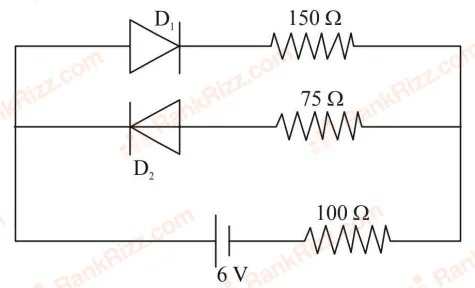
The circuit shown below contains two ideal diodes, each with a forward resistance of 50Ω. If the battery voltage is 6 V, the current through the 100Ω resistance (in Amperes) is:
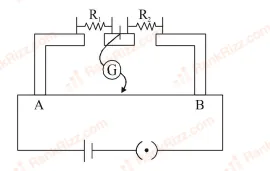
In the experimental set up of metre bridge shown in the figure, the null point is obtained at a distance of 40 cm from A. If a 10Ω resistor is connected in series with R1, the null point shifts by 10 cm. The resistance that should be connected in parallel with (R1+10)Ω such that the null point shifts back to its initial position is