Q1Errors in measurement and significant figures
The relative error in the determination of the surface area of a sphere is . Then the relative error in the determination of its volume is:
- A
- B
- C
- D
All 90 questions of JEE Main 15 Apr 2018, Shift 1, in the order they were asked, one subject to a page. Pick an answer on any question to check it against the key. Free to read, nothing to download.
Questions
90
Physics · Chemistry · Maths
Answer key
90
questions with a checked key
Price
Free
no sign-up
The relative error in the determination of the surface area of a sphere is . Then the relative error in the determination of its volume is:
An automobile, travelling at 40 km/h, can be stopped at a distance of 40 m by applying brakes. If the same automobile is travelling at 80 km/h, the minimum stopping distance, in metres, is (assume no skidding):
75 m
160 m
100 m
150 m
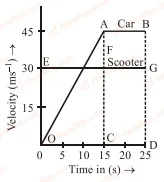
The velocity-time graphs of a car and a scooter are shown in the figure. (i) the difference between the distance travelled by the car and the scooter in 15 s and (ii) the time at which the car will catch up with the scooter are, respectively.
337.5 m and 25 s
225.5 m and 10 s
112.5 m and 22.5 s
112.5 m and 15 s
A given object takes n times more time to slide down a 45 rough inclined plane as it takes to slide down a perfectly smooth 45 incline. The coefficient of kinetic friction between the object and the incline is:
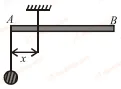
A uniform rod AB is suspended from a point X, at a variable distance x from A, as shown. To make the rod horizontal, a mass m is suspended from its end A. A set of (m, x) values is recorded. The appropriate variable that give a straight line, when plotted, are:
A force of 40 N acts on a point B at the end of an L-shaped object, as shown in the figure. The angle that will produce maximum moment of the force about point A is given by: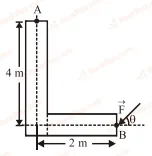
A body of mass m is moving in a circular orbit of radius R about a planet of mass M. At some instant, it splits into two equal masses. The first mass moves in a circular orbit of radius , and the other mass, in a circular orbit of radius . The difference between the final and initial total energies is:
Take the mean distance of the moon and the sun from the earth to be km and km respectively. Their masses are kg and kg respectively. The radius of the earth is 6400 km. Let be the difference in the forces exerted by the moon at the nearest and farthest points on the earth and be the difference in the force exerted by the sun at the nearest and farthest points on the earth. Then, the number closest to is:
2
6
0.6
A thin uniform tube is bent into a circle of radius r in the vertical plane. Equal volumes of two immiscible liquids, whose densities are and () fill half the circle. The angle between the radius vector passing through the common interface and the vertical is:
A Carnot's engine works as a refrigerator between 250 K and 300 K. It receives 500 cal heat from the reservoir at the lower temperature. The amount of work done in each cycle to operate the refrigerator is:
420 J
2100 J
772 J
2520 J
One mole of an ideal monoatomic gas is compressed isothermally in a rigid vessel to double its pressure at room temperature, 27C. The work done on the gas will be:
300R ln 6
300R
300R ln 7
300R ln 2
A tuning fork vibrates with frequency 256 Hz and gives one beat per second with the third normal mode of vibration of an open pipe. What is the length of the pipe? (Speed of sound in air is 340 ms)
190 cm
180 cm
220 cm
200 cm
A body of mass M and charge q is connected to a spring of spring constant k. It is oscillating along x-direction about its equilibrium position, taken to be at x = 0, with an amplitude A. An electric field E is applied along the x-direction. Which of the following statements is correct?
The total energy of the system is
The new equilibrium position is at a distance from x = 0
The new equilibrium position is at a distance from x = 0
The total energy of the system is
A charge Q is placed at a distance a/2 above the centre of the square surface of edge a as shown in the figure. The electric flux through the square surface is: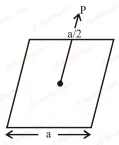
The equivalent capacitance between A and B in the circuit given below is:
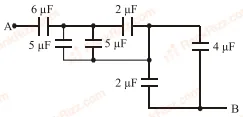
4.9 F
3.6 F
5.4 F
2.4 F
In the given circuit all resistances are of value R ohm each. The equivalent resistance between A and B is:
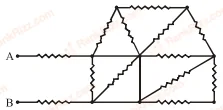
2R
3R
In a meter bridge, as shown in the figure, it is given that resistance Y = 12.5 and that the balance is obtained at a distance 39.5 cm from end A (by jockey J). After interchanging the resistances X and Y a new balance point is found at a distance from end A. What are the values of X and ?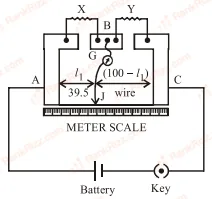
19.15 and 39.5 cm
8.16 and 60.5 cm
19.15 and 60.5 cm
8.16 and 39.5 cm
The B-H curve for a ferromagnet is shown in the figure. The ferromagnet is placed inside a long solenoid with 1000 turns/cm. The current that should be passed in the solenoid to demagnetize the ferromagnet completely is: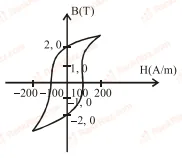
2 mA
1 mA
40 A
20 A
A Helmholtz coil has pair of loops, each with N turns and radius R. They are placed coaxially at distance R and the same current I flows through the loops in the same direction. The magnitude of magnetic field at P, midway between the centres A and C, is given by (Refer to figure):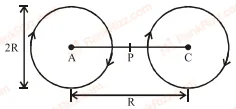
An ideal capacitor of capacitance 0.2 F is charged to a potential difference of 10 V. The charging battery is then disconnected. The capacitor is then connected to an ideal inductor of self inductance 0.5 mH. The current at a time when the potential difference across the capacitor is 5 V, is:
0.17 A
0.15 A
0.34 A
0.25 A
A monochromatic beam of light has a frequency Hz and is propagating along the direction . It is polarized along the direction. The acceptable form for the magnetic field is:
A planoconvex lens becomes an optical system of 28 cm focal length when its plane surface is silvered and illuminated from left to right as shown in Fig. A. If the same lens is instead silvered on the curved surface and illuminated from other side as in Fig. B, it acts like an optical system of focal length 10 cm. The refractive index of the material of lens is:
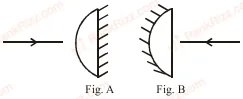
1.50
1.55
1.75
1.51
A particle is oscillating on the X-axis with an amplitude 2 cm about the point cm with a frequency . A concave mirror of focal length 5 cm is placed at the origin (see figure). Identify the correct statements: (A) The image executes periodic motion (B) The image executes non-periodic motion (C) The turning points of the image are asymmetric w.r.t the image of the point at x = 10 cm (D) The distance between the turning points of the oscillation of the image is cm.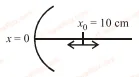
(B), (D)
(B), (C)
(A), (C), (D)
(A), (D)
Light of wavelength 550 nm falls normally on a slit of width cm. The angular position of the second minima from the central maximum will be (in radians):
Two electrons are moving with non-relativistic speeds perpendicular to each other. If corresponding de Broglie wavelengths are and , their de Broglie wavelength in the frame of reference attached to their centre of mass is:
The energy required to remove the electron from a singly ionized Helium atom is 2.2 times the energy required to remove an electron from Helium atom. The total energy required to ionize the Helium atom completely is:
20 eV
79 eV
109 eV
34 eV
A solution containing active cobalt Co having activity of 0.8 Ci and decay constant is injected in an animal's body. If 1 cm of blood is drawn from the animal's body after 10 hrs of injection, the activity found was 300 decays per minute. What is the volume of blood that is flowing in the body? (1 Ci = decay per second and at t = 10 hrs the value of = 0.84)
6 litres
7 litres
4 litres
5 litres
In a common emitter configuration with suitable bias, it is given than is the load resistance and is small signal dynamic resistance (input side). Then, voltage gain, current gain and power gain are given, respectively, by: [ is current gain, , , are respectively base, collector and emitter currents]
The number of amplitude modulated broadcast stations that can be accommodated in a 300 kHz band width for the highest modulating frequency 15 kHz will be:
20
10
8
15
In a screw gauge, 5 complete rotations of the screw cause it to move a linear distance of 0.25 cm. There are 100 circular scale divisions. The thickness of a wire measured by this screw gauge gives a reading of 4 main scale divisions and 30 circular scale divisions. Assuming negligible zero error, the thickness of the wire is:
0.0430 cm
0.3150 cm
0.4300 cm
0.2150 cm