All 90 questions of JEE Main 09 Apr 2014, Online, in the order they were asked, one subject to a page. Pick an answer on any question to check it against the key. Free to read, nothing to download.
Questions
90
Physics · Chemistry · Maths
Answer key
88
questions with a checked key
Price
Free
no sign-up
Physics
Q1Errors in measurement and significant figures
An experiment is performed to obtain the value of acceleration due to gravity g by using a simple pendulum of length L. In this experiment time for 100 oscillations is measured by using a watch of 1 second least count and the value is 90.0 seconds. The length L is measured by using a meter scale of least count 1 mm and the value is 20.0 cm. The error in the determination of g would be:
The position of a projectile launched from the origin at t = 0 is given by r=(40i^+50j^) m at t = 2s. If the projectile was launched at an angle θ from the horizontal, then θ is (take g = 10 ms−2).
Q3Newton's laws, free-body diagrams and equilibrium of a particle
Water is flowing at a speed of 1.5 m s−1 through a horizontal tube of cross-sectional area 10−2 m2 and you are trying to stop the flow by your palm. Assuming that the water stops immediately after hitting the palm, the minimum force that you must exert should be (density of water = 103 kg m−3)
A block A of mass 4 kg is placed on another block B of mass 5 kg, and the block B rests on a smooth horizontal table. If the minimum force that can be applied on A so that both the blocks move together is 12 N, the maximum force that can be applied on B for the blocks to move together will be:
Q5Rolling with friction, slipping and impulsive forces
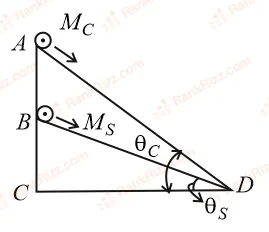
A cylinder of mass MC and sphere of mass MS are placed at points A and B of two inclines, respectively. (See figure). If they roll on the incline without slipping such that their accelerations are the same, then the ratio sinθSsinθC is:
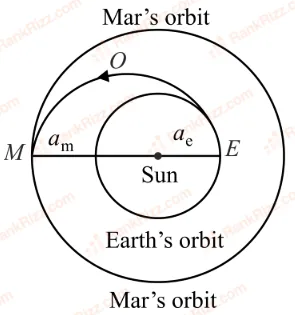
India's Mangalyan was sent to the Mars by launching it into a transfer orbit EOM around the sun. It leaves the earth at E and meets Mars at M. If the semi-major axis of Earth's orbit is ae=1.5×10¹¹ m, that of Mar's orbit am=2.28×10¹¹ m, taking Kepler's laws, give the estimate of time for Mangalyan to reach Mars from Earth.
A capillary tube is immersed vertically in water and the height of the water column is x. When this arrangement is taken into a mine of depth d, the height of the water column is y. If R is the radius of earth, the ratio yx is:
Water of volume 2 L in a closed container is heated with a coil of 1 kW. While water is heated, the container loses energy at a rate of 160 J/s. In how much time will the temperature of water rise from 27°C to 77°C? (Specific heat of water is 4.2 kJ/kg and that of the container is negligible).
The equation of state for a gas is given by PV=nRT+αV, where n is the number of moles and α is a positive constant. The initial temperature and pressure of one mole of the gas contained in a cylinder are T0 and P0 respectively. The work done by the gas when its temperature doubles isobarically will be:
Modern vacuum pumps can evacuate a vessel down to a pressure of 4.0×10⁻¹⁵ atm. at room temperature (300 K). Taking R = 8.3 JK−1 mole−1, 1 atm = 105 Pa and NAvogadro=6×10²³ mole−1, the mean distance between molecules of gas in an evacuated vessel will be of the order of:
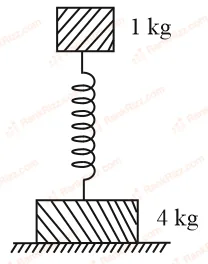
Two bodies of masses 1 kg and 4 kg are connected to a vertical spring, as shown in the figure. The smaller mass executes simple harmonic motion of angular frequency 25 rad s−1, and amplitude 1.6 cm while the bigger mass remains stationary on the ground. The maximum force exerted by the system on the floor is (take g=10 m s−2).
The amplitude of a simple pendulum, oscillating in air with a small spherical bob, decreases from 10 cm to 8 cm in 40 seconds. Assuming that Stokes law is valid, and ratio of the coefficient of viscosity of air to that of carbon dioxide is 1.3, the time in which amplitude of this pendulum will reduce from 10 cm to 5 cm in carbondioxide will be close to (ln 5 = 1.601, ln 2 = 0.693).
Q14SHM: equation, phase, velocity and acceleration
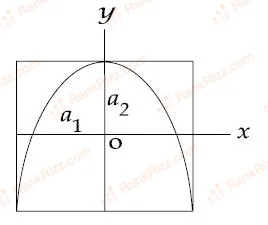
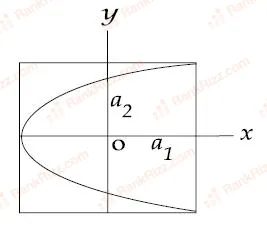
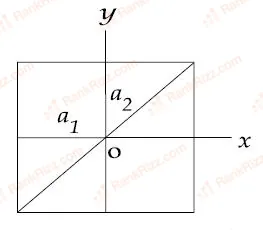
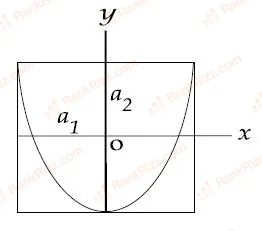
A particle which is simultaneously subjected to two perpendicular simple harmonic motions represented by; x=a1cosωt and y=a2cos2ωt traces a curve given by:
Q15Progressive waves: wave equation, phase and intensity
A transverse wave is represented by: y=π10sin(T2πt−λ2πx). For what value of the wavelength the wave velocity is twice the maximum particle velocity?
The magnitude of the average electric field normally present in the atmosphere just above the surface of the Earth is about 150 N/C, directed inward towards the center of the Earth. This gives the total net surface charge carried by the Earth to be: [Given: ϵ0=8.85×10⁻¹² C2/N-m2, RE=6.37×10⁶ m]
A d.c. main supply of e.m.f. 220 V is connected across a storage battery of e.m.f. 200 V through a resistance of 1 Ω. The battery terminals are connected to external resistance R. The minimum value of R, so that a current passes through the battery to charge it is:
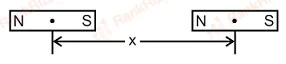
The mid points of two small magnetic dipoles of length d in end-on positions, are separated by a distance x (x≫d). The magnitude of force between them is proportional to x−n where n is:
The magnetic field of earth at the equator is approximately 4×10⁻⁵ T. The radius of earth is 6.4×10⁶ m. Then the dipole moment of the earth will be nearly of the order of:
When the rms voltages VL, VC and VR are measured respectively across the inductor L, the capacitor C and the resistor R in a series LCR circuit connected to an AC source, it is found that the ratio VL:VC:VR=1:2:3. If the rms voltage of the AC source is 100 V, then VR is close to:
Match List I (Wavelength range of electromagnetic spectrum) with List II (Method of production of these waves) and select the correct option from the options given below the lists.
List I: List II: (a) 700 nm to 1 mm (i) Vibration of atoms and molecules (b) 1 nm to 400 nm (ii) Inner shell electrons in atoms moving from one energy level to a lower level (c) < 10−3 nm (iii) Radioactive decay of the nucleus (d) 1 mm to 0.1 m (iv) Magnetron valve
Q23Refraction at plane surfaces, Snell's law and apparent depth
A diver looking up through the water sees the outside world contained in a circular horizon. The refractive index of water is 34, and the diver's eyes are 15 cm below the surface of the water. Then the radius of the circle is:
Q24Optical instruments: microscopes and telescopes
The focal lengths of objective lens and eye lens of a Galilean Telescope are respectively 30 cm and 3.0 cm. Telescope produces virtual, erect image of an object situated far away from it at least distance of distinct vision from the eye lens. In this condition the Magnifying Power of the Galilean Telescope should be:
Q25Young's double slit experiment: fringe width and intensity
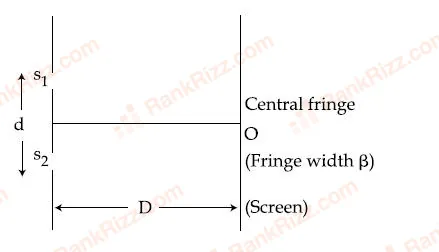
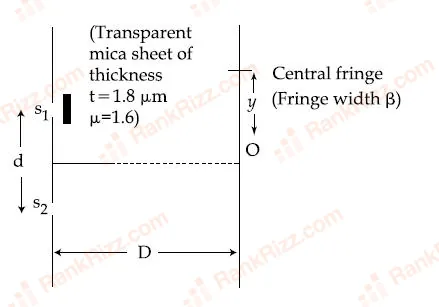
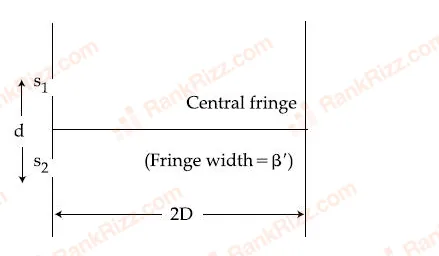
Using monochromatic light of wavelength λ, an experimentalist sets up the Young's double slit experiment in three ways as shown. If she observes that y=β′, the wavelength of light used is:
If the binding energy of the electron in a hydrogen atom is 13.6 eV, the energy required to remove the electron from the first excited state of Li++ is:
An n-p-n transistor has three leads A, B and C. Connecting B and C by moist fingers, A to the positive lead of an ammeter, and C to the negative lead of the ammeter, one finds large deflection. Then, A, B and C refer respectively to:
Q30Elements of communication and propagation of EM waves
A transmitting antenna at the top of a tower has a height 32 m and the height of the receiving antenna is 50 m. What is the maximum distance between them for satisfactory communication in line of sight (LOS) mode?