All 90 questions of JEE Main 06 Apr 2014, Offline, in the order they were asked, one subject to a page. Pick an answer on any question to check it against the key. Free to read, nothing to download.
Questions
90
Physics · Chemistry · Maths
Answer key
90
questions with a checked key
Price
Free
no sign-up
Physics
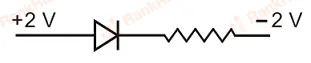
Q1p-n junction diode and its characteristics
The current voltage relation of diode is given by I=(e1000V/T−1) mA, where the applied voltage V is in volts and the temperature T is in degree Kelvin. If a student makes an error measuring ±0.01 V while measuring the current of 5 mA at 300 K, what will be the error in the value of current in mA?
From a tower of height H, a particle is thrown vertically upwards with a speed u. The time taken by the particle, to hit the ground, is n times that taken by it to reach the highest point of its path. The relation between H, u and n is:
A block of mass m is placed on a surface with a vertical cross section given by y=6x3. If the coefficient of friction is 0.5, the maximum height above the ground at which the block can be placed without slipping is:
When a rubber-band is stretched by a distance x, it exerts a restoring force of magnitude F=ax+bx2 where a and b are constants. The work done in stretching the unstretched rubber-band by L is:
Q5Torque and the rotational form of Newton's second law
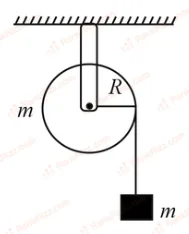
A mass m is supported by a massless string wound around a uniform hollow cylinder of mass m and radius R. If the string does not slip on the cylinder, with what acceleration will the mass fall on release?
A bob of mass m attached to an inextensible string of length l is suspended from a vertical support. The bob rotates in a horizontal circle with an angular speed ω rad/s about the vertical. About the point of suspension:
A
Angular momentum is conserved
B
Angular momentum changes in magnitude but not in direction
C
Angular momentum changes in direction but not in magnitude
D
Angular momentum changes both in direction and magnitude
Four particles, each of mass M and equidistant from each other, move along a circle of radius R under the action of their mutual gravitational attraction. The speed of each particle is:
Q8Fluid pressure, Pascal's law and accelerated/rotating liquids
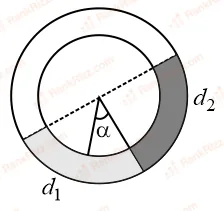
There is a circular tube in a vertical plane. Two liquids which do not mix and of densities d1 and d2 are filled in the tube. Each liquid subtends 90° angle at centre. Radius joining their interface makes an angle α with vertical. Ratio d2d1 is:
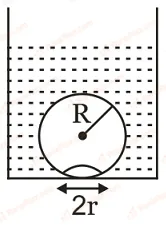
On heating water, bubbles being formed at the bottom of the vessel detach and rise. Take the bubbles to be spheres of radius R and making a circular contact of radius r with the bottom of the vessel. If r≪R, and the surface tension of water is T, value of r just before bubbles detach is: (density of water is ρw)
Q10Fluid pressure, Pascal's law and accelerated/rotating liquids
An open glass tube is immersed in mercury in such a way that a length of 8 cm extends above the mercury level. The open end of the tube is then closed and sealed and the tube is raised vertically up by additional 46 cm. What will be length of the air column above mercury in the tube now? (Atmospheric pressure = 76 cm of Hg)
The pressure that has to be applied to the ends of a steel wire of length 10 cm to keep its length constant when its temperature is raised by 100 °C is: (For steel, Young's modulus is 2×10¹¹ N m−2 and coefficient of thermal expansion is 1.1×10⁻⁵ K−1)
Three rods of Copper, Brass and Steel are welded together to form a Y-shaped structure. Area of cross-section of each rod is 4 cm2. End of copper rod is maintained at 100 °C. Where as ends of brass and steel are kept at 0 °C. Lengths of the copper, brass and steel rods are 46, 13 and 12 cms respectively. The rods are thermally insulated from surroundings except at ends. Thermal conductivities of copper, brass and steel are 0.92, 0.26 and 0.12 CGS units respectively. Rate of heat flow through copper rod is:
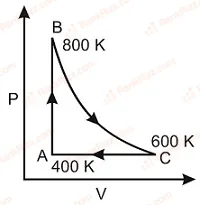
One mole of diatomic ideal gas undergoes a cyclic process ABC as shown in figure. The process BC is adiabatic. The temperatures at A, B and C are 400 K, 800 K and 600 K respectively. Choose the correct statement:
A
The change in internal energy in whole cyclic process is 250 R
B
The change in internal energy in the process CA is 700 R
C
The change in internal energy in the process AB is -350 R
D
The change in internal energy in the process BC is -500 R
Q14SHM: equation, phase, velocity and acceleration
A particle moves with simple harmonic motion in a straight line. In first τ s, after starting from rest it travels a distance a, and in next τ s it travels 2a, in same direction, then:
A pipe of length 85 cm is closed from one end. Find the number of possible natural oscillations of air column in the pipe whose frequencies lie below 1250 Hz. The velocity of sound in air is 340 m/s.
Assume that an electric field E=30x2i^ exists in space. Then the potential difference VA−VO, where VO is the potential at the origin and VA the potential at x = 2 m is:
A parallel plate capacitor is made of two circular plates separated by a distance of 5 mm and with a dielectric of dielectric constant 2.2 between them. When the electric field in the dielectric is 3×10⁴ V/m, the charge density of the positive plate will be close to:
In a large building, there are 15 bulbs of 40 W, 5 bulbs of 100 W, 5 fans of 80 W and 1 heater of 1 kW. The voltage of the electric mains is 220 V. The minimum capacity of the main fuse of the building will be:
Q19Magnetisation, magnetic intensity, susceptibility and permeability
The coercivity of a small magnet, where the ferromagnet gets demagnetised is 3×10³ A/m. The current required to be passed in a solenoid of length 10 cm and number of turns 100, so that the magnet gets demagnetised when inside the solenoid is:
Q20Magnetic dipole moment of current loops and torque on loops
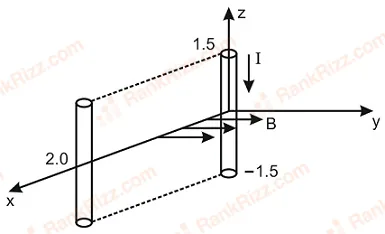
A conductor lies along the z-axis at −1.5≤z<1.5 m and carries a fixed current of 10.0 A in −a^z direction (see figure). For a field B=3.0×10⁻⁴e−0.2xa^y T, find the power required to move the conductor at constant speed to x = 2.0 m, y = 0 m in 5×10⁻³ s. Assume parallel motion along the x-axis.
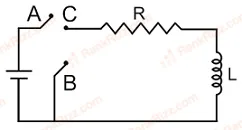
In the circuit shown here, the point 'C' is kept connected to point 'A' till the current flowing through the circuit becomes constant. Afterward, suddenly, point 'C' is disconnected from point 'A' and connected to point 'B' at time t=0. Ratio of the voltage across resistance and the inductor at t=RL will be equal to:
Match List - I (Electromagnetic wave type) with List - II (Its association/application) and select the correct option from the choices given below the lists:
List - I: List - II: (a) Infrared waves (i) To treat muscular strain (b) Radio waves (ii) For broadcasting (c) X-rays (iii) To detect fracture of bones (d) Ultraviolet rays (iv) Absorbed by the ozone layer of the atmosphere
Q24Thin lenses: lens formula, lens maker's formula and power
A thin convex lens made from crown glass (μ=23) has focal length f. When it is measured in two different liquids having refractive indices 34 and 35, it has the focal lengths f1 and f2 respectively. The correct relation between the focal lengths is:
Two beams, A and B of plane polarized light with mutually perpendicular planes of polarization are seen through a polaroid. From the position when the beam A has maximum intensity (and beam B has zero intensity), a rotation of polaroid through 30° makes the two beams appear equally bright. If the initial intensities of the two beams are IA and IB respectively, then IBIA equals:
The radiation corresponding to 3→2 transition of hydrogen atom falls on a metal surface to produce photoelectrons. These electrons are made to enter a magnetic field of 3×10⁻⁴ T. If the radius of the largest circular path followed by these electrons is 10.0 mm, the work function of the metal is close to:
Hydrogen (1H1), Deuterium (1H2), singly ionised Helium (2He4)+ and doubly ionised lithium (3Li6)++ all have one electron around the nucleus. Consider an electron transition from n=2 to n=1. If the wave lengths of emitted radiation are λ1, λ2, λ3 and λ4 respectively then approximately which one of the following is correct?