JEE Advanced 2022 Chemistry question — Electrophilic addition to alkenes
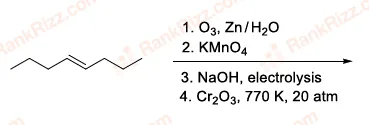
The number of -CH- (methylene) groups in the product formed from the following reaction sequence is _______.
SOLUTION
Analyze the Starting Material
The given reactant is an alkene with a straight carbon chain. Let's count the total number of carbons and identify its structure:
- The molecule is oct-4-ene: CH₃-CH₂-CH₂-CH=CH-CH₂-CH₂-CH₃
- It is a symmetrical alkene with 8 carbon atoms.
Step-by-Step Reaction Sequence
Step 1: Ozonolysis (O₃, Zn/H₂O)
Reductive ozonolysis cleaves the carbon-carbon double bond (C=C) and replaces it with carbonyl groups (C=O).
- Symmetrical cleavage of oct-4-ene yields 2 molecules of butanal.
- Molecule formed: 2 × CH₃-CH₂-CH₂-CHO (Butanal)
Step 2: Oxidation (KMnO₄)
Potassium permanganate (KMnO₄) is a strong oxidizing agent that oxidizes aldehydes into carboxylic acids.
- Oxidation of butanal yields butanoic acid.
- Molecule formed: 2 × CH₃-CH₂-CH₂-COOH (Butanoic acid)
Step 3: Kolbe's Electrolysis (NaOH, electrolysis)
Reacting butanoic acid with NaOH forms sodium butanoate (CH₃-CH₂-CH₂-COONa). When subjected to Kolbe's electrolytic decarboxylation, two alkyl radicals dimerize by losing carbon dioxide (CO₂).
- The alkyl radical generated is the propyl radical: •CH₂-CH₂-CH₃
- Two propyl radicals combine: CH₃-CH₂-CH₂- + -CH₂-CH₂-CH₃ CH₃-CH₂-CH₂-CH₂-CH₂-CH₃
- Product formed: n-hexane (a straight-chain alkane with 6 carbon atoms).
Step 4: Aromatization (Cr₂O₃, 770 K, 20 atm)
Heating n-hexane in the presence of chromium oxide (Cr₂O₃) catalyst at high temperature and pressure undergoes dehydrogenation and cyclization (aromatization).
- n-hexane converts into Benzene (C₆H₆).
- Product formed: Benzene
Count the Methylene (-CH₂-) Groups in the Final Product
- The final product is Benzene (C₆H₆).
- Structurally, benzene consists of a ring where every single carbon is bonded to one hydrogen atom (-CH- groups).
- There are no saturated methylene (-CH₂-) groups present anywhere in a benzene ring.
Therefore, the number of -CH₂- groups in the final product is 0.
Topic: Electrophilic addition to alkenes