JEE ADVANCED 2009 · PAPER 2EASY
JEE Advanced 2009 Chemistry question — Reactive intermediates and rearrangements
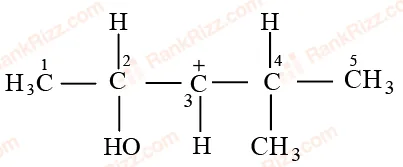
In the following carbocation, that is most likely to migrate to the positively charged carbon is
SOLUTION
Key idea: A 1,2-shift happens when it gives a more stable cation. Migration of H from a carbon bearing –OH gives an oxocarbenium ion stabilised by the O lone pair, i.e. a protonated ketone.
The carbocation is (positive charge at C-3, secondary).
- H from C-4 shift: gives –, a tertiary cation. Better, but stabilised only by hyperconjugation and +I.
- CH₃ from C-4 shift: gives a secondary cation. No gain.
- H from C-2 shift: gives , which has the resonance form . Every atom has a complete octet, so this ion is far more stable than any alkyl carbocation. It loses H⁺ to give pentan-2-one (pinacol-like).
- CH₃ at C-2: C-2 bears H and OH, not CH₃.
Answer: (D) H at C-2
Topic: Reactive intermediates and rearrangements