JEE ADVANCED 2010 · PAPER 1HARD
JEE Advanced 2010 Chemistry question — Aldol condensation, Cannizzaro and related reactions
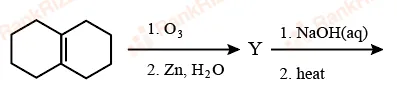
In the scheme given below, the total number of intramolecular aldol condensation products form 'Y' is
SOLUTION
Key idea: Ozonolysis of -octalin opens the central C=C and gives the symmetric ten-membered cyclodecane-1,6-dione. Every possible intramolecular aldol of this dione gives the same product.
- Y is cyclodecane-1,6-dione. The C=O groups are at C1 and C6, and the α-carbons are C2, C5, C7 and C10.
- By the molecule's symmetry, all four α-carbons are equivalent. Every enolate attacks the other carbonyl in the same way. For example, the C2 enolate attacking C6 forms a five-membered ring (C2–C3–C4–C5–C6) fused to a seven-membered ring.
- After dehydration, the single product is a bicyclo[5.3.0]decenone, the hydroazulenone.
- Other attacks are impossible or equivalent. An enolate attacking its own carbonyl's partner across the ring always gives the same 5/7 fused system.
So the number of products is 1.
Answer: 1
Topic: Aldol condensation, Cannizzaro and related reactions