RankRizz

JEE Advanced 2015 Paper 2 Question Paper

All 60 questions of JEE Advanced 2015 Paper 2, in the order they were asked, one subject to a page. Pick an answer on any question to check it against the key. Free to read, nothing to download.

Questions

60

Physics · Chemistry · Maths

Answer key

60

questions with a checked key

Price

Free

no sign-up

Physics

Q1Kepler's laws and planetary motion

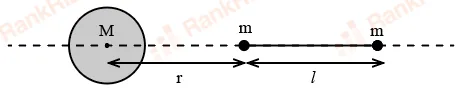
A large spherical mass M is fixed at one position and two identical point masses m are kept on a line passing through the centre of M (see figure). The point masses are connected by a rigid massless rod of length / and this assembly is free to move along the line connecting them. All three masses interact only through their mutual gravitational interaction. When the point mass nearer to M is at a distance r = 3l from M, the tension in the rod is zero for m=k(M288)m = k \left(\frac {M}{288}\right). The value of k is

Figure for JEE Advanced 2015 Physics question on Kepler's laws and planetary motion
Q2Errors in measurement and significant figures

The energy of a system as a function of time t is given as E(t)=A2exp(−αt),E(t)= A^2 exp(-\alpha t), where α=0.2s−1.\alpha = 0.2 s^{-1}. The measurement of A has an error of 1.25%. If the error in the measurement of time is 1.50%, the percentage error in the value of E(t) at t = 5 s is

Q3Moment of inertia of standard bodies and composite systems

The densities of two solid spheres A and B of the same radii R vary with radial distance r as ρA(r)=k(rR)\rho_A(r) = k \left(\frac{r}{R}\right) and ρB(r)=k(rR)5,\rho_B(r) = k \left(\frac{r}{R}\right)^5, respectively, where k is a constant. The moments of inertia of the individual spheres about axes passing through their centres are IAI_A and IB,I_B, respectively. If IBIA=n10,\frac{I_B}{I_A} = \frac{n}{10}, the value of n is

Q4Superposition, interference and beats

Four harmonic waves of equal frequencies and equalintensities I0I_0 have phase angles 0,π3,2π30, \frac{\pi}{3}, \frac{2\pi}{3} and π\pi. When they are superposed, the intensity of the resulting wave is nI0.nI_0. The value of n is

Q5Radioactivity: decay law, half-life and decay modes

For a radioactive material, its activity A and rate of change of its activity R are defined as A=−dNdtA = - \frac{dN}{dt} and R=−dAdt,R = - \frac{dA}{dt}, where N(t) is the number of nuclei at time t. Two radioactive sources P (mean life τ\tau) and Q (mean life 2τ2\tau) have the same activity at t = 0. Their rates of change of activities at t=2τt = 2\tau are RPR_P and RQR_Q, respectively. If RPRQ=ne,\frac{R_P}{R_Q} = \frac{n}{e}, then the value of n is

Q6Prism: deviation and dispersion

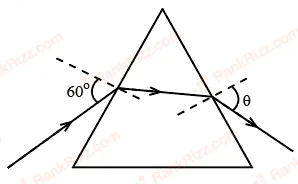
A monochromatic beam of light is incident at 60∘60^\circ on one face of an equilateral prism of refractive index n and emerges from the opposite face making an angle θ(n)\theta(n) with the normal (see the figure). For n=3n = \sqrt 3 the value of θ\theta is 60∘60^\circ and dθdn=m\frac{d \theta}{dn} = m. The value of m is

Figure for JEE Advanced 2015 Physics question on Prism: deviation and dispersion
Q7Wheatstone bridge

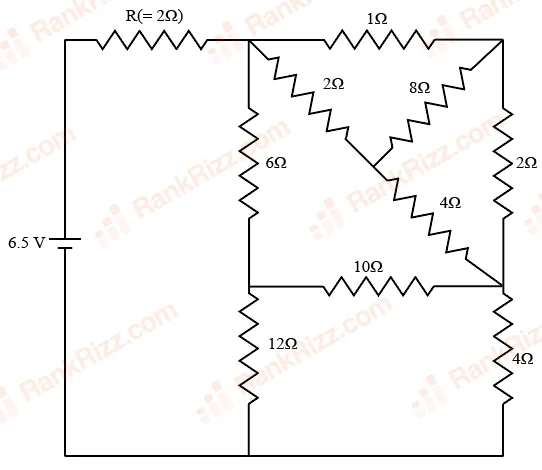
In the following circuit, the current through the resistor R(=2Ω)R (= 2Ω) is I Amperes. The value of I is

Figure for JEE Advanced 2015 Physics question on Wheatstone bridge
Q8de Broglie wavelength of matter waves

An electron in an excited state of Li2+Li^{2+}ion has angular momentum 3h2π.\frac{3h}{2\pi}. The de Broglie wavelength of the electron in this state is pπa0p \pi a_0 (where a0a_0 is the Bohr radius). The value of p is

Q9Equation of continuity and Bernoulli's theorem

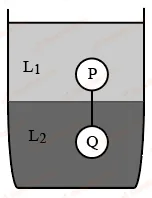
Two spheres P and Q of equal radii have densities ρ1\rho_1 and ρ2\rho_2 respectively. The spheres are connected by a massless string and placed in liquids L1L_1 and L2L_2 of densities σ1\sigma_1 and σ2\sigma_2 and viscosities η1\eta_1 and η2\eta_2 respectively. They float in equilibrium with the sphere P in L1L_1 and sphere Q in L2L_2 and the string being taut (see figure). If sphere P alone in L2L_2 has terminal velocity V→P\overrightarrow{V}_P and Q alone in L1L_1 has terminal velocity V→Q\overrightarrow{V}_Q, then

Figure for JEE Advanced 2015 Physics question on Equation of continuity and Bernoulli's theorem
  1. A

    ∣V→P∣∣V→Q∣=η1η2\frac{|\overrightarrow{V}_P|}{|\overrightarrow{V}_Q|} = \frac{\eta_1}{\eta_2}

  2. B

    ∣V→P∣∣V→Q∣=η2η1\frac{|\overrightarrow{V}_P|}{|\overrightarrow{V}_Q|} = \frac{\eta_2}{\eta_1}

  3. C

    V→P.V→Q>0\overrightarrow{V}_P . \overrightarrow{V}_Q > 0

  4. D

    V→P.V→Q<0\overrightarrow{V}_P . \overrightarrow{V}_Q < 0

Q10Dimensional analysis: deriving and checking relations

In terms of potential difference V, electric current I, permittivity ϵ0\epsilon_0, permeability μ0\mu_0 and speed of light c, the dimensionally correct equation(s) is(are)

  1. A

    μ0I2=ϵ0V2\mu_0 I^2 = \epsilon_0 V^2

  2. B

    ϵ0I=μ0V\epsilon_0 I = \mu_0 V

  3. C

    I=ϵ0cVI = \epsilon_0 cV

  4. D

    μ0cI=ϵ0V\mu_0 c I = \epsilon_0 V

Q11Electric field of continuous charge distributions

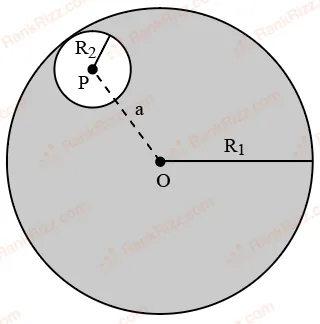
Consider a uniform spherical charge distribution of radius R1R_1 centred at the origin O. In this distribution, a spherical cavity of radius R2R_2 centred at P with distance OP=a=R1−R2OP = a = R_1 - R_2 (see figure) is made. If the electric field inside the cavity at position r→\overrightarrow{r} is E→(r→)\overrightarrow{E} (\overrightarrow{r}) , then the correct statement(s) is(are)

Figure for JEE Advanced 2015 Physics question on Electric field of continuous charge distributions
  1. A

    E→\overrightarrow{E} is uniform, its magnitude is independentof R2R_2 but its direction depends on r→\overrightarrow{r}

  2. B

    E→\overrightarrow{E} is uniform, its magnitude depends on R2R_2 and its direction depends on r→\overrightarrow{r}

  3. C

    E→\overrightarrow{E} is uniform, its magnitude is independentof a but its direction depends on a→\overrightarrow{a}

  4. D

    E→\overrightarrow{E} is uniform and both its magnitude and direction depend on a→\overrightarrow{a}

Q12Stress-strain curve and elastic behaviour

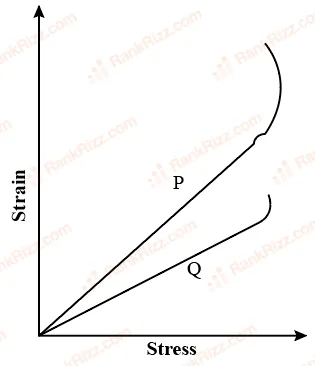
In plotting stress versus strain curves for two materials P and Q, a student by mistake puts strain on the y-axis and stress on the x-axis as shown in the figure. Then the correct statement(s) is(are)

Figure for JEE Advanced 2015 Physics question on Stress-strain curve and elastic behaviour
  1. A

    P has more tensile strength than Q

  2. B

    P is more ductile than Q

  3. C

    P is more brittle than Q

  4. D

    The Young’s modulus of P is more than that of Q

Q13Fluid pressure, Pascal's law and accelerated/rotating liquids

A spherical body of radius R consists of a fluid of constant density and is in equilibrium under its own gravity. If P(r) is the pressure at r(r < R), then the correct option(s) is(are)

  1. A

    P(r=0)=0P (r = 0) = 0

  2. B

    P(r=3R4)P(r=2R3)=6380\frac{P \left(r = \frac{3R}{4}\right)}{P \left(r = \frac{2R}{3}\right)} = \frac{63}{80}

  3. C

    P(r=3R5)P(r=2R5)=1621\frac{P \left(r = \frac{3R}{5}\right)}{P \left(r = \frac{2R}{5}\right)} = \frac{16}{21}

  4. D

    P(r=R2)P(r=R3)=2027\frac{P \left(r = \frac{R}{2}\right)}{P \left(r = \frac{R}{3}\right)} = \frac{20}{27}

Q14Capacitors with dielectrics

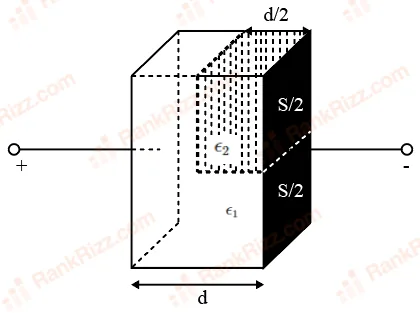
A parallel plate capacitor having plates of area S and plate separation d, has capacitance C1C_1 in air. When two dielectrics of different relative permittivities (ϵ1=2(\epsilon_1 = 2 and ϵ2=4)\epsilon_2 = 4) are introduced between the two plates as shown in thefigure, the capacitance becomes C2C_2. The ratio C2C1\frac{C_2}{C_1} is

Figure for JEE Advanced 2015 Physics question on Capacitors with dielectrics
  1. A

    65\frac{6}{5}

  2. B

    53\frac{5}{3}

  3. C

    75\frac{7}{5}

  4. D

    73\frac{7}{3}

Q15Multi-step processes and gas-piston-spring systems

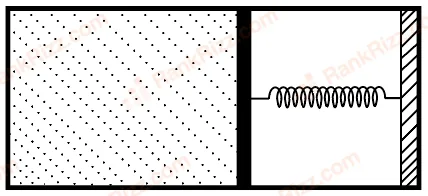
An ideal monoatomic gas is confined in a horizontal cylinder by a spring loaded piston (as shown in the figure). Initially the gas is at temperature T1T_1, pressure P1P_1 and volume V1V_1 and the spring is in its relaxed state. The gas is then heated very slowly to temperature T2T_2, pressure P2P_2 and volume V2V_2. During this process the piston moves out by a distance x. Ignoring the friction between the piston and the cylinder, the correct statement(s) is(are)

Figure for JEE Advanced 2015 Physics question on Multi-step processes and gas-piston-spring systems
  1. A

    If V2=2V1V_2 = 2V_1 and T2=3T1T_2 = 3T_1, then the energy stored in the spring is 14P1V1\frac{1}{4}P_1 V_1

  2. B

    If V2=2V1V_2 = 2V_1 and T2=3T1T_2 = 3T_1, then the change in internal energy is 3P1V13 P_1 V_1

  3. C

    If V2=3V1V_2 = 3V_1 and T2=4T1T_2 = 4T_1, then the work done by the gas is 73P1V1\frac{7}{3}P_1 V_1

  4. D

    If V2=3V1V_2 = 3V_1 and T2=4T1T_2 = 4T_1, then the heat supplied to the gas is 176P1V1\frac{17}{6}P_1 V_1

Q16Nuclear fission, fusion and Q-value

A fission reaction is given by 92236U→54140Xe+3894Sr+x+y_{92}^{236}U \rightarrow _{54}^{140}Xe + _{38}^{94}Sr + x + y where x and y are two particles. Considering 92236U_{92}^{236}U to be at rest, the kinetic energies of the products are denoted by KXe,KSr,Kx(2MeV)K_{Xe}, K_{Sr}, K_x (2 MeV) and Ky(2MeV),K_y (2 MeV), respectively. Let the binding energies per nucleon of 92236U,54140Xe_{92}^{236}U, _{54}^{140}Xe and 3894Sr_{38}^{94}Sr be 7.5 MeV, 8.5 MeV and 8.5 MeV,respectively. Considering different conservation laws, the correct option(s) is(are)

  1. A

    x=n,y=n,KSr=129MeV,KXe=86MeVx = n, y = n, K_{Sr} = 129 MeV, K_{Xe} = 86 MeV

  2. B

    x=p,y=e−,KSr=129MeV,KXe=86MeVx = p, y = e^-, K_{Sr} = 129 MeV, K_{Xe} = 86 MeV

  3. C

    x=p,y=n,KSr=129MeV,KXe=86MeVx = p, y = n, K_{Sr} = 129 MeV, K_{Xe} = 86 MeV

  4. D

    x=n,y=n,KSr=86MeV,KXe=129MeVx = n, y = n, K_{Sr} = 86 MeV, K_{Xe} = 129 MeV

Q17Motion of charged particles in a magnetic field

Consider two different metallic strips (1 and 2) of the same material. Their lengths are the same, widths are w1w_1 and w2w_2 and thicknesses are d1d_1 and d2d_2, respectively. Two points K and M are symmetrically located on the opposite faces parallel to the x-y plane (see figure). V1V_1 and V2V_2 are the potential differences between K and M instrips 1 and 2, respectively. Then,for a given current I flowing through them in a given magnetic field strength B, the correct statement(s) is(are)

  1. A

    If w1=w2w_1 = w_2 and d1=2d2d_1 = 2d_2, then V2=2V1V_2 = 2V_1

  2. B

    If w1=w2w_1 = w_2 and d1=2d2d_1 = 2d_2, then V2=V1V_2 = V_1

  3. C

    If w1=2w2w_1 = 2w_2 and d1=d2d_1 = d_2, then V2=2V1V_2 = 2V_1

  4. D

    If w1=2w2w_1 = 2w_2 and d1=d2d_1 = d_2, then V2=V1V_2 = V_1

Q18Motion of charged particles in a magnetic field

Consider two different metallic strips (1 and 2) of same dimensions (length l, width w and thickness d) with carrier densities n1n_1 and n2n_2, respectively. Strip 1 is placed in magnetic field B1B_1 and strip 2 is placed in magnetic field B2,B_2, both along positive y-directions. Then V1V_1 and V2V_2 are the potential differences developed between K and M in strips 1 and 2, respectively. Assuming that the current I is the same for both the strips, the correct option(s) is(are)

  1. A

    If B1=B2B_1 = B_2 and n1=2n2n_1 = 2n_2, then V2=2V1V_2 = 2V_1

  2. B

    If B1=B2B_1 = B_2 and n1=2n2n_1 = 2n_2, then V2=V1V_2 = V_1

  3. C

    If B1=2B2B_1 = 2B_2 and n1=n2n_1 = n_2, then V2=0.5V1V_2 = 0.5V_1

  4. D

    If B1=2B2B_1 = 2B_2 and n1=n2n_1 = n_2, then V2=V1V_2 = V_1

Q19Prism: deviation and dispersion

For two structures namely S1S_1 with n1=454n_1 = \frac{\sqrt 45}{4} and n2=32n_2 = \frac{3}{2}, and S2S_2 with n1=85n_1 = \frac{8}{5} and n2=75n_2 = \frac{7}{5} and taking the refractive index of water to be 43\frac{4}{3} and that of air to be 1, the correct option(s) is(are)

  1. A

    NA of S1S_1 immersed in water is the sameas that of S2S_2 immersed in liquid of refractive index 16315\frac{16}{3\sqrt 15}

  2. B

    NA of S1S_1 immersed in liquid of refractive index 615\frac{6}{\sqrt 15} is the same as that of S2S_2 immersed in water

  3. C

    NA of S1S_1 placed in air is the same as that of S2S_2 immersed in liquid of refractive index 415\frac{4}{\sqrt 15}

  4. D

    NA of S1S_1 placed in air is the same as that of S2S_2 placed in water

Q20Prism: deviation and dispersion

If two structures of same cross-sectional area, but different numerical apertures NA1NA_1 and NA2(NA2<NA1)NA_2 (NA_2 < NA_1) are joined longitudinally, the numerical aperture of the combined structure is

  1. A

    NA1NA2NA1+NA2\frac{NA_1 NA_2}{NA_1 + NA_2}

  2. B

    NA1+NA2NA_1 + NA_2

  3. C

    NA1NA_1

  4. D

    NA2NA_2

NEXT IN THIS PAPER →Chemistry, Q21 onwards