RankRizz

JEE Advanced 2026 Paper 2 Question Paper

All 54 questions of JEE Advanced 2026 Paper 2, in the order they were asked, one subject to a page. Pick an answer on any question to check it against the key. Free to read, nothing to download.

Questions

54

Physics · Chemistry · Maths

Answer key

41

questions with a checked key

Price

Free

no sign-up

Physics

Q1Electric current, current density and drift velocity

A metal wire of cross-sectional area 0.5 mm20.5\,\mathrm{mm^2} and length 100 m100\,\mathrm{m} is connected across a battery of e.m.f. 2 V2\,\mathrm{V} and internal resistance 1 Ω1\,\Omega. The density, atomic mass and electrical conductivity of the metal are 6.35×10³ kg m−36.35\times 10^{3}\,\mathrm{kg\,m^{-3}}, 63.5 gm/mole63.5\,\mathrm{gm/mole} and 2×10⁸ mho m−12\times 10^{8}\,\mathrm{mho\,m^{-1}}, respectively. Assuming one conduction electron per atom of the metal, the drift velocity (in mm s−1\mathrm{mm\,s^{-1}}) of the electrons in the wire is:

[Take Avogadro's number as 6×10236\times 10^{23} and charge of the electron as 1.6×10⁻¹⁹ C1.6\times 10^{-19}\,\mathrm{C}.]

  1. A

    0.0520.052

  2. B

    0.1040.104

  3. C

    0.2080.208

  4. D

    0.1560.156

Q2Radioactivity: decay law, half-life and decay modes

A nuclear reactor starts producing a radioactive nuclide XX from t=0t=0, at a constant rate of α\alpha per second. Each decay of XX produces energy E0E_0, which is utilized to heat a liquid of mass mm and specific heat ss. Assuming no heat loss from the liquid and taking λ\lambda as the decay constant of XX, the rate of increase in the temperature of the liquid is:

  1. A

    αE0m s(1−e−λt)\dfrac{\alpha E_0}{m\,s}\left(1-e^{-\lambda t}\right)

  2. B

    αE0m s(eλt−1)\dfrac{\alpha E_0}{m\,s}\left(e^{\lambda t}-1\right)

  3. C

    λE0m s(1−e−λt)\dfrac{\lambda E_0}{m\,s}\left(1-e^{-\lambda t}\right)

  4. D

    E0m s(α−λe−λt)\dfrac{E_0}{m\,s}\left(\alpha-\lambda e^{-\lambda t}\right)

Q3Refraction at plane surfaces, Snell's law and apparent depth

A beam of polychromatic light passes through a thin prism of prism angle 6∘6^\circ. The refractive index of the material of the prism varies with wavelength (λ)(\lambda) as n(λ)=αλ+βλ2n(\lambda)=\alpha\lambda+\dfrac{\beta}{\lambda^2}, where α=3 μm−1\alpha=3\,\mu\mathrm{m^{-1}} and β=0.096 μm2\beta=0.096\,\mu\mathrm{m^2}. If λmin⁡\lambda_{\min} is the wavelength at which the angle of minimum deviation DmD_m is smallest, then the correct value of DmD_m at λmin⁡\lambda_{\min} is

  1. A

    6.4∘6.4^\circ

  2. B

    4.8∘4.8^\circ

  3. C

    3.2∘3.2^\circ

  4. D

    2.4∘2.4^\circ

Q4Kepler's laws and planetary motion

A particle of mass mm, and angular momentum ℓ\ell is moving in a circular orbit of radius r0r_0 under the influence of an attractive force F⃗(r)=−kr2r^\vec{F}(r)=-\dfrac{k}{r^2}\hat{r}. Keeping its angular momentum unchanged, the particle is displaced radially by a small distance δr≪r0\delta r\ll r_0, due to which its radial distance varies periodically. The corresponding time period is:

  1. A

    2πℓ3mk2\dfrac{2\pi\ell^3}{mk^2}

  2. B

    2πmk2\pi\sqrt{\dfrac{m}{k}}

  3. C

    2πℓ33mk2\dfrac{2\pi\ell^3}{3mk^2}

  4. D

    2πℓ35mk2\dfrac{2\pi\ell^3}{5mk^2}

Q5Refraction at plane surfaces, Snell's law and apparent depth

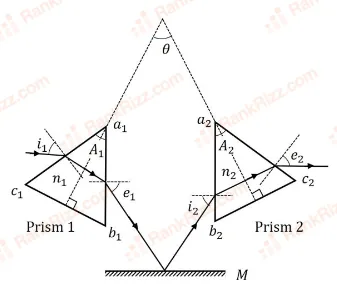
Consider two isosceles prisms 1 and 2 with prism angles A1A_1 and A2A_2 and refractive indices n1n_1 and n2n_2, respectively, as shown in the figure. The faces a1b1a_1b_1 and a2b2a_2b_2 are parallel to each other and perpendicular to the mirror MM. If a ray of light is incident on the face a1c1a_1c_1 and emerges from the face a2c2a_2c_2, then the correct statement(s) is/are:

Figure for JEE Advanced 2026 Physics question on Refraction at plane surfaces, Snell's law and apparent depth
  1. A

    If both the prisms are at minimum deviation condition, then n2n1=sin⁡ ⁣(A12)/sin⁡ ⁣(A22)\dfrac{n_2}{n_1}=\sin\!\left(\dfrac{A_1}{2}\right)\big/\sin\!\left(\dfrac{A_2}{2}\right).

  2. B

    If prism 2 is at minimum deviation condition, then sin⁡i1=n2sin⁡ ⁣(A22)\sin i_1=n_2\sin\!\left(\dfrac{A_2}{2}\right) is always true.

  3. C

    If both the prisms 1 and 2 are at minimum deviation condition with angles of deviation δm1\delta_{m1} and δm2\delta_{m2}, respectively, then θ=δm12(n1−1)+δm22(n2−1)\theta=\dfrac{\delta_{m1}}{2(n_1-1)}+\dfrac{\delta_{m2}}{2(n_2-1)}.

  4. D

    If prism 1 is at minimum deviation condition, then sin⁡i2=n1sin⁡ ⁣(A12)\sin i_2=n_1\sin\!\left(\dfrac{A_1}{2}\right) is always true.

Q6Motion of charged particles in a magnetic field

In a vacuum chamber, a particle of charge 1 μC1\,\mu\mathrm{C} and mass 1 mg1\,\mathrm{mg} is projected with a velocity (i^+2j^) ms−1(\hat{i}+2\hat{j})\,\mathrm{ms^{-1}} from the XZXZ plane at time t=0t=0 in an electric field of 1i^ Vm−11\hat{i}\,\mathrm{Vm^{-1}}. At t=0.2 st=0.2\,\mathrm{s}, the electric field is switched off and a magnetic field of 6j^ T6\hat{j}\,\mathrm{T} is switched on. The acceleration due to gravity is −10j^ ms−2-10\hat{j}\,\mathrm{ms^{-2}}. Correct option(s) is/are:

  1. A

    The vertical distance of the particle from the XZXZ plane at t=0.3 st=0.3\,\mathrm{s} is 15 cm15\,\mathrm{cm}.

  2. B

    The vertical distance of the particle from the XZXZ plane at t=0.4 st=0.4\,\mathrm{s} is 10 cm10\,\mathrm{cm}.

  3. C

    The radius of the trajectory of the particle for t>0.2 st>0.2\,\mathrm{s} is 20 cm20\,\mathrm{cm}.

  4. D

    The particle will be in the XZXZ plane at t=0.35 st=0.35\,\mathrm{s}.

Q7Electric potential and potential energy

Two charges Q1=qQ_1=q and Q2=mqQ_2=mq are placed at the points P1(a,b)P_1(a,b) and P2(ma,mb)P_2(ma,mb), respectively, in the XYXY plane, where a,b≠0a,b\neq 0 and m≠0,1m\neq 0,1. If V1V_1 is the potential at a point in the XYXY plane due to charge Q1Q_1 and V2V_2 is the potential at that point due to charge Q2Q_2. Correct statement(s) for the points at which ∣V1∣=∣V2∣|V_1|=|V_2| is/are:

  1. A

    For m=−1m=-1, locus of these points is ax+by=0ax+by=0.

  2. B

    For m=2m=2, the locus of these points is a circle of radius 23a2+b2\dfrac{2}{3}\sqrt{a^2+b^2} centered at (23a,23b)\left(\dfrac{2}{3}a,\dfrac{2}{3}b\right).

  3. C

    For m=−2m=-2, the locus of these points is a circle of radius 2a2+b22\sqrt{a^2+b^2} centered at (2a,2b)(2a,2b).

  4. D

    For m=−3m=-3, locus of these points is 3bx+3ay=03bx+3ay=0.

Q8Electric dipole and dipole in external field

Consider an electric dipole comprising two charges +q+q and −q-q each with mass mm, separated by a fixed distance dd and initially at rest with its dipole moment pointing along i^\hat{i}. A uniform electric field Ej^E\hat{j} is turned on at time t=0t=0 and it is turned off at t=tft=t_f, when the dipole moment makes an angle θf\theta_f with i^\hat{i}. Neglecting any sources of energy loss, correct option(s) is/are:

  1. A

    The center of mass of the dipole is deflected towards j^\hat{j} in the presence of the field.

  2. B

    If the magnitude of the final angular velocity ωf=2qEmd\omega_f=\sqrt{\dfrac{2qE}{md}}, then θf=π6\theta_f=\dfrac{\pi}{6}.

  3. C

    If θf=π/3\theta_f=\pi/3, then the change in kinetic energy of the dipole is given by 23 qEd2\sqrt{3}\,qEd.

  4. D

    For θf=π/4\theta_f=\pi/4, the dipole rotates around its center of mass with a constant angular velocity after t>tft>t_f.

Q9Multi-step processes and gas-piston-spring systems

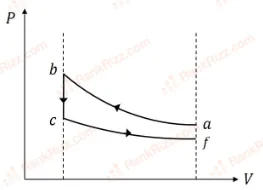
Ten moles of an ideal monatomic gas, initially in state a\boldsymbol{a} at atmospheric pressure and temperature Ta=27∘CT_a=27^\circ\mathrm{C}, is enclosed in a metal cylinder of volume V0V_0 fitted with a frictionless piston. The gas is suddenly compressed to state b\boldsymbol{b} with volume V0/3V_0/3. Now, keeping the piston stationary, the cylinder is submerged in a water bath of temperature 11∘C11^\circ\mathrm{C} until the gas reaches the temperature of the water bath, which is denoted as state c\boldsymbol{c}. Finally, while still in the water bath, the piston is brought slowly to its initial position, which is denoted as state f\boldsymbol{f}. If RR is universal gas constant, then the correct option(s) is/are:

[Given: 91/3=2.089^{1/3}=2.08]

  1. A

    The schematic P-V diagram of the processes described above is:

    Figure for JEE Advanced 2026 Physics question on Multi-step processes and gas-piston-spring systems
  2. B

    The change in internal energy in going from state a\boldsymbol{a} to b\boldsymbol{b} is 4860 R4860\,R.

  3. C

    The net change in the internal energy in the whole process is −240 R-240\,R.

  4. D

    The pressure and temperature of the state b\boldsymbol{b} are 2.082.08 times the atmospheric pressure and 624 K624\,\mathrm{K}, respectively.

Q10Dimensional formulae of physical quantities

Two thin wires, Wire-1 of diameter 0.650 mm0.650\,\mathrm{mm} and Wire-2 of unknown diameter dd are given. To obtain the value of dd, the diameters of the two wires are measured with a screw gauge. The screw gauge has a pitch of 0.5 mm0.5\,\mathrm{mm} and there are 100100 divisions on the circular scale (CS). The smallest division on the linear scale (LS) is 0.5 mm0.5\,\mathrm{mm}. The table shows the readings of LS and CS for the measurements. The value of dd (in μm\mu\mathrm{m}) is:

Readings
LS (mm)CS
Wire-10.542
Wire-21.595
Q11Errors in measurement and significant figures

In a single slit diffraction experiment, a slit of width (0.016±0.002) mm(0.016\pm 0.002)\,\mathrm{mm} is used to measure the wavelength of a monochromatic light source. In the diffraction pattern, the angular distance between the central maximum and first minimum is measured to be (2∘±40′)(2^\circ\pm 40'). The value of the fractional error in the measurement of wavelength is:

[Given: sin⁡(2∘)=0.035\sin(2^\circ)=0.035]

Q12Polarisation: Malus's law and Brewster's law

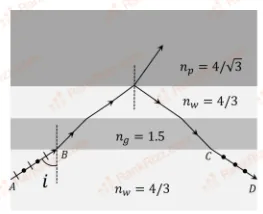
As shown in the figure, a ray ABAB of unpolarized light enters from water of refractive index nw=4/3n_w=4/3 into a medium of refractive index np=4/3n_p=4/\sqrt{3} after passing through a glass plate of refractive index ng=1.5n_g=1.5 and a layer of water. At a particular incident angle ii the reflected ray CDCD is polarized in the direction as shown in the figure. The value of ii (in degrees) is:

Figure for JEE Advanced 2026 Physics question on Polarisation: Malus's law and Brewster's law
Q13Galvanometer conversion to ammeter and voltmeter

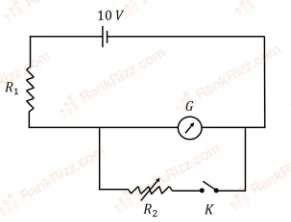
As shown in the figure, the resistance of a galvanometer GG can be found by the half-deflection method. Here the resistance R2R_2 is adjusted such that when the key KK is closed the deflection in the galvanometer becomes half of the value as compared to when KK is open. Half-deflection is obtained at R2=4 ΩR_2=4\,\Omega and thus the galvanometer resistance is found to be 6 Ω6\,\Omega. In this half-deflection condition the current (in mA) through the resistor R1R_1 is:

Figure for JEE Advanced 2026 Physics question on Galvanometer conversion to ammeter and voltmeter
Q14Dimensional analysis: deriving and checking relations

In a new system of units, the units of mass, length, time and current are 5 kg5\,\mathrm{kg}, 5 m5\,\mathrm{m}, 5 s5\,\mathrm{s} and 5 A5\,\mathrm{A}, respectively. If μ0\mu_0 and ϵ0\epsilon_0 are the permeability and permittivity of free space, respectively, then in this new system of units, the magnitude of one SI unit of μ0/ϵ0\sqrt{\mu_0/\epsilon_0}, is:

Q15Equation of continuity and Bernoulli's theorem

Question Stem for Question Nos. 15 and 16

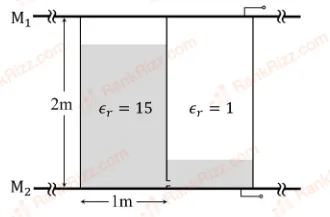
A container of height 2 m2\,\mathrm{m}, length 2 m2\,\mathrm{m} and breadth 1 m1\,\mathrm{m} is made of insulating vertical walls and two large area horizontal metal plates (M1M_1 and M2M_2) which extend far beyond the vertical walls in all directions. The container is partitioned into two equal chambers with a thin insulating vertical wall. The partition wall contains a small hole of cross-sectional area 10 cm2\sqrt{10}\,\mathrm{cm^2} near its bottom edge. Initially the hole is closed and the left chamber of the container is completely filled with a liquid of dielectric constant ϵr=15\epsilon_r=15 and the right chamber is empty (ϵr=1\epsilon_r=1). At time t=0t=0, the hole is opened and the liquid flows from the left chamber to the right chamber. In both the chambers, the space above the liquid has ϵr=1\epsilon_r=1 and is maintained at atmospheric pressure. The schematic of the container at a time t>0t>0 is shown in the figure.

[Given: acceleration due to gravity is 10 ms−210\,\mathrm{ms^{-2}}.]

Figure for JEE Advanced 2026 Physics question on Equation of continuity and Bernoulli's theorem

The height (in m) of the liquid in left chamber at t=500 st=500\,\mathrm{s} is:

Q16Capacitors with dielectrics

A container of height 2 m2\,\mathrm{m}, length 2 m2\,\mathrm{m} and breadth 1 m1\,\mathrm{m} is made of insulating vertical walls and two large area horizontal metal plates (M1M_1 and M2M_2) which extend far beyond the vertical walls in all directions. The container is partitioned into two equal chambers with a thin insulating vertical wall. The partition wall contains a small hole of cross-sectional area 10 cm2\sqrt{10}\,\mathrm{cm^2} near its bottom edge. Initially the hole is closed and the left chamber of the container is completely filled with a liquid of dielectric constant ϵr=15\epsilon_r=15 and the right chamber is empty (ϵr=1\epsilon_r=1). At time t=0t=0, the hole is opened and the liquid flows from the left chamber to the right chamber. In both the chambers, the space above the liquid has ϵr=1\epsilon_r=1 and is maintained at atmospheric pressure. The schematic of the container at a time t>0t>0 is shown in the figure.

[Given: acceleration due to gravity is 10 ms−210\,\mathrm{ms^{-2}}.]

Figure for JEE Advanced 2026 Physics question on Capacitors with dielectrics

The difference in the capacitance (in F) between the metal plates at t=0t=0 and that at t=500 st=500\,\mathrm{s} is (8−n)ϵ0(8-n)\epsilon_0, where ϵ0\epsilon_0 is the permittivity of free space. The value of nn is:

Q17Rolling with friction, slipping and impulsive forces

Question Stem for Question Nos. 17 and 18

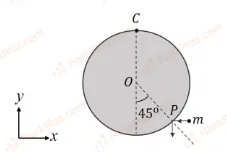
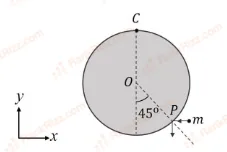
A uniform circular disk of radius 0.2 m0.2\,\mathrm{m} and mass 1 kg1\,\mathrm{kg} is pivoted at its top point CC such that it can rotate freely around CC in the XYXY plane, as shown in the figure. Initially, when the disk is at rest, a particle of mass 20 g20\,\mathrm{g}, travelling along negative xx direction in the XYXY plane with speed 100 ms−1100\,\mathrm{ms^{-1}}, hits the circumference of the disk at a point PP. After collision the particle moves along negative yy direction at a speed of 90 ms−190\,\mathrm{ms^{-1}}.

[Given: the acceleration due to gravity (g)=−10j^ ms−2(g)=-10\hat{j}\,\mathrm{ms^{-2}}]

Figure for JEE Advanced 2026 Physics question on Rolling with friction, slipping and impulsive forces

After the collision the disk starts to rotate around point CC in the XYXY plane. The maximum change in the height (in m) of its center OO is:

Q18Angular momentum of particles and rigid bodies

Question Stem for Question Nos. 17 and 18

A uniform circular disk of radius 0.2 m0.2\,\mathrm{m} and mass 1 kg1\,\mathrm{kg} is pivoted at its top point CC such that it can rotate freely around CC in the XYXY plane, as shown in the figure. Initially, when the disk is at rest, a particle of mass 20 g20\,\mathrm{g}, travelling along negative xx direction in the XYXY plane with speed 100 ms−1100\,\mathrm{ms^{-1}}, hits the circumference of the disk at a point PP. After collision the particle moves along negative yy direction at a speed of 90 ms−190\,\mathrm{ms^{-1}}.

[Given: the acceleration due to gravity (g)=−10j^ ms−2(g)=-10\hat{j}\,\mathrm{ms^{-2}}]

Figure for JEE Advanced 2026 Physics question on Angular momentum of particles and rigid bodies

Amount of energy loss (in J) in the collision is:

NEXT IN THIS PAPER →Chemistry, Q19 onwards