RankRizz

JEE Advanced 2026 Paper 1 Question Paper

All 48 questions of JEE Advanced 2026 Paper 1, in the order they were asked, one subject to a page. Pick an answer on any question to check it against the key. Free to read, nothing to download.

Questions

48

Physics · Chemistry · Maths

Answer key

44

questions with a checked key

Price

Free

no sign-up

Physics

Q1Rolling with friction, slipping and impulsive forces

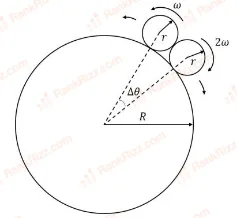
Consider a large disk of radius RR and two smaller disks, each of radius r=R/50r=R/50, lying on its circumference, as shown in the figure. The smaller disks are initially in contact with each other, with an angular separation Δθ\Delta\theta between their centers. They are made to roll without slipping in opposite directions, with constant angular velocities ω\omega and 2ω2\omega while the large disk is held stationary. The time τ\tau at which the smaller disks are again in contact is:

[Use sin⁡(Δθ)=Δθ\sin(\Delta\theta)=\Delta\theta and ignore gravity.]

Figure for JEE Advanced 2026 Physics question on Rolling with friction, slipping and impulsive forces
  1. A

    τ=51×(2π−451)/ω\tau=51\times\left(2\pi-\dfrac{4}{51}\right)/\omega

  2. B

    τ=51×(2π−251)/3ω\tau=51\times\left(2\pi-\dfrac{2}{51}\right)/3\omega

  3. C

    τ=51×(2π−451)/3ω\tau=51\times\left(2\pi-\dfrac{4}{51}\right)/3\omega

  4. D

    τ=51×(2π−251)/ω\tau=51\times\left(2\pi-\dfrac{2}{51}\right)/\omega

Q2Self inductance and energy stored in inductors

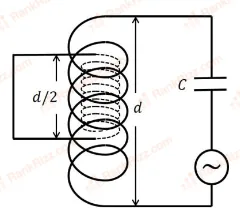
Consider a circuit consisting of a capacitor of capacitance CC and a coil with nn turns per unit length, cross sectional area ss and length dd, where d2≫Sd^2\gg S. There is another coil of length d/2d/2, cross sectional area s/2s/2 and 2n2n turns per unit length completely inside the larger coil, as shown in the figure. The ends of this smaller coil are connected with each other by an insulated conducting wire. The self-inductance of the larger coil is LL. Neglecting edge effects and all the Ohmic resistances, the resonant frequency of the circuit is:

Figure for JEE Advanced 2026 Physics question on Self inductance and energy stored in inductors
  1. A

    415 LC\dfrac{4}{\sqrt{15\,LC}}

  2. B

    65 LC\dfrac{6}{\sqrt{5\,LC}}

  3. C

    23 LC\dfrac{2}{\sqrt{3\,LC}}

  4. D

    23 LC\sqrt{\dfrac{2}{3\,LC}}

Q3Rolling with friction, slipping and impulsive forces

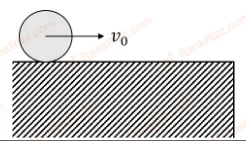
A solid cylinder of radius RR rolls without slipping with a center of mass speed v0=gR3v_0=\sqrt{\dfrac{gR}{3}} on a horizontal surface with a vertical edge, as shown in the figure. Here, gg is the acceleration due to the gravity. At the moment when the cylinder loses contact with the surface due to rotation around the corner, the speed of its center of mass is:

Figure for JEE Advanced 2026 Physics question on Rolling with friction, slipping and impulsive forces
  1. A

    00

  2. B

    5gR7\sqrt{\dfrac{5gR}{7}}

  3. C

    gR15\sqrt{\dfrac{gR}{15}}

  4. D

    3gR7\sqrt{\dfrac{3gR}{7}}

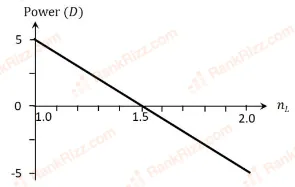
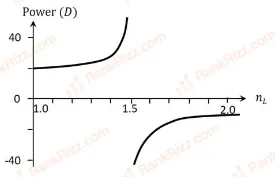
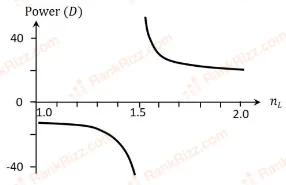
Q4Thin lenses: lens formula, lens maker's formula and power

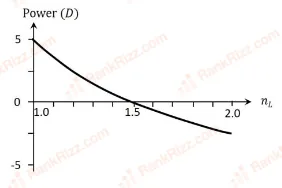
A double convex lens made of glass of refractive index 1.51.5 and radii of curvature of the curved surfaces 20 cm20\,\mathrm{cm} each is immersed in a liquid of refractive index nLn_L. The correct plot showing the variation of the power, in the units of diopter (DD), as a function of nLn_L is:

  1. A
    Figure for JEE Advanced 2026 Physics question on Thin lenses: lens formula, lens maker's formula and power
  2. B
    Figure for JEE Advanced 2026 Physics question on Thin lenses: lens formula, lens maker's formula and power
  3. C
    Figure for JEE Advanced 2026 Physics question on Thin lenses: lens formula, lens maker's formula and power
  4. D
    Figure for JEE Advanced 2026 Physics question on Thin lenses: lens formula, lens maker's formula and power
Q5Hydrogen spectrum and spectral series

Consider a hydrogen atom with vkv_k, rkr_k, and KkK_k denoting the velocity, orbital radius and kinetic energy of the electron in the kthk^{\text{th}} orbit, respectively. The electron undergoes a transition from the nthn^{\text{th}} orbit, emitting radiation corresponding to the Lyman series. Considering hh to be the Planck's constant and ϵ0\epsilon_0 the permittivity of the free space, the correct statement(s) is(are):

  1. A

    Magnitude of change in kinetic energy of electron can be expressed as h4π∣nvnrn−v1r1∣\dfrac{h}{4\pi}\left|\dfrac{n v_n}{r_n}-\dfrac{v_1}{r_1}\right|.

  2. B

    Magnitude of change in de Broglie wavelength of the electron can be expressed as e24ϵ0∣1Kn−1K1∣\dfrac{e^2}{4\epsilon_0}\left|\dfrac{1}{K_n}-\dfrac{1}{K_1}\right|.

  3. C

    Frequency of the radiation emitted can be expressed as e28πϵ0h(1r1−1rn)\dfrac{e^2}{8\pi\epsilon_0 h}\left(\dfrac{1}{r_1}-\dfrac{1}{r_n}\right).

  4. D

    Magnitude of change in total energy of the electron can be expressed as h2π∣v1r1−nvnrn∣\dfrac{h}{2\pi}\left|\dfrac{v_1}{r_1}-\dfrac{n v_n}{r_n}\right|.

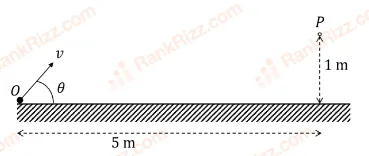
Q6Projectile motion from level ground

A particle is thrown with a speed vv from a point OO at an angle θ\theta with the horizontal plane such that it passes through the point PP at a height of 1 m1\,\mathrm{m} and horizontal distance of 5 m5\,\mathrm{m} from OO, as shown in the figure. If acceleration due to gravity is g ms−2g\,\mathrm{ms^{-2}}, then the correct statement(s) is(are):

Figure for JEE Advanced 2026 Physics question on Projectile motion from level ground
  1. A

    If θ=45∘\theta=45^\circ, then v=5g2 ms−1v=\dfrac{5\sqrt{g}}{2}\,\mathrm{ms^{-1}}.

  2. B

    If θ=45∘\theta=45^\circ, the particle reaches its maximum height before it reaches PP.

  3. C

    If θ=30∘\theta=30^\circ, the particle reaches its maximum height after reaching PP.

  4. D

    If θ=tan⁡−1 ⁣(15)\theta=\tan^{-1}\!\left(\dfrac{1}{5}\right), then v=125g ms−1v=125\sqrt{g}\,\mathrm{ms^{-1}}.

Q7Multi-step processes and gas-piston-spring systems

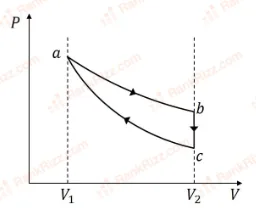
A quasi-static cycle of a monoatomic ideal gas contains an isothermal process (ab\boldsymbol{ab}), followed by an isochoric process (bc\boldsymbol{bc}) and an adiabatic process (ca\boldsymbol{ca}) as shown in the figure. The volumes of the gas are V1V_1 and V2V_2 at a\boldsymbol{a} and b\boldsymbol{b}, respectively. If the cycle has heat input QinQ_{\text{in}} and output QoutQ_{\text{out}}, then the efficiency of the cycle is defined as η=Qin−QoutQin\eta=\dfrac{Q_{\text{in}}-Q_{\text{out}}}{Q_{\text{in}}}. The correct statement(s) is(are):

[Given: ln⁡2≈0.7\ln 2\approx 0.7]

Figure for JEE Advanced 2026 Physics question on Multi-step processes and gas-piston-spring systems
  1. A

    If V2/V1=8V_2/V_1=8, the heat released in the process bc\boldsymbol{bc} is smaller than the heat absorbed in the process ab\boldsymbol{ab}.

  2. B

    For a given value of V2/V1V_2/V_1, η\eta does not depend on the temperature of the isothermal process.

  3. C

    If V2/V1=8V_2/V_1=8, then the temperature of the gas at a\boldsymbol{a} is 4 times the temperature of the gas at c\boldsymbol{c}.

  4. D

    If V2/V1=8V_2/V_1=8, then the pressure of the gas at a\boldsymbol{a} is 4 times the pressure of the gas at b\boldsymbol{b}.

Q8Properties of EM waves: fields, energy, intensity and momentum

The electric field associated with an electromagnetic wave travelling in vacuum is given by E0sin⁡(3y+4z+ωt)i^E_0\sin(3y+4z+\omega t)\hat{i}, where ω\omega is the angular frequency. All quantities are in SI units. The correct statement(s) about this wave is(are):

[Given: speed of light in vacuum c=3×10⁸ ms−1c=3\times 10^8\,\mathrm{ms^{-1}}.]

  1. A

    The wave is travelling in −15(3j^+4k^)-\dfrac{1}{5}\left(3\hat{j}+4\hat{k}\right) direction.

  2. B

    The magnitude of the wave vector is 0.5 m−10.5\,\mathrm{m^{-1}}.

  3. C

    The value of ω\omega is 1.5×10⁹ rad s−11.5\times 10^{9}\,\mathrm{rad\,s^{-1}}.

  4. D

    The magnetic field associated with this wave is given by E0csin⁡(3y+4z+ωt)(4j^−3k^)\dfrac{E_0}{c}\sin(3y+4z+\omega t)(4\hat{j}-3\hat{k}).

Q9SHM of floating bodies, liquids, gases and charged systems

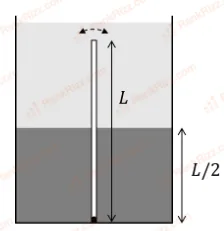
A tank contains two immiscible liquids of densities 6ρ6\rho and 2ρ2\rho. The higher density liquid is filled up to a height L/2L/2 from the bottom. A thin rod of density ρ\rho and length LL is fully immersed and hinged at the bottom so that it can oscillate freely, as shown in the figure. If the rod is slightly disturbed from its equilibrium, the time period of small oscillations is 2πnLg\dfrac{2\pi}{n}\sqrt{\dfrac{L}{g}}, where gg is the acceleration due to gravity. The value of nn is:

Figure for JEE Advanced 2026 Physics question on SHM of floating bodies, liquids, gases and charged systems
Q10Carnot engine and Carnot cycle

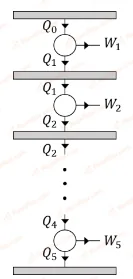
As shown in the figure, five Carnot engines, each with efficiency η\eta and same number of cycles per unit time, are operating between six heat reservoirs. The amount of heat released per cycle by one engine is completely absorbed by the next engine. Consider Q0Q_0 to be the amount of heat absorbed per cycle by the first engine and WW as the amount of total work done by all the engines per cycle, then the net efficiency of the system is found to be ηnet=WQ0=211243\eta_{\text{net}}=\dfrac{W}{Q_0}=\dfrac{211}{243}. The value of η\eta is:

Figure for JEE Advanced 2026 Physics question on Carnot engine and Carnot cycle
Q11Multi-step processes and gas-piston-spring systems

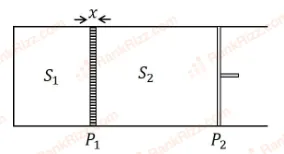
As shown in the figure, an insulated container is fitted with a thermally conducting but immovable partition (P1P_1) and a freely movable but thermally insulated piston (P2P_2). The partition P1P_1 with thermal conductivity KK, cross sectional area AA and width xx divides the container into two sections, S1S_1 and S2S_2, each containing one mole of a monoatomic gas. The piston P2P_2 moves freely such that the gas in S2S_2 is always at the atmospheric pressure. Initially, the difference between the temperatures of S1S_1 and S2S_2 is ΔT0\Delta T_0. The time it takes for the temperature difference to become ΔT02\dfrac{\Delta T_0}{2} is nxR/KAnxR/KA, where RR is the universal gas constant. The value of nn is:

[ Given: ln⁡2≈0.7\ln 2\approx 0.7 ]

Figure for JEE Advanced 2026 Physics question on Multi-step processes and gas-piston-spring systems
Q12Magnetic dipole moment of current loops and torque on loops

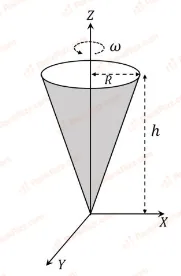
A hollow, right circular cone of base radius RR and height hh, with its tip at the origin is rotating about the ZZ-axis with an angular velocity ω\omega, as shown in the figure. The cone carries a total charge QQ uniformly distributed on its curved surface. The magnitude of magnetic field at a point (0,0,z)(0,0,z), where z≫Rz\gg R and z≫hz\gg h, is nμ04πQR2ωz3\dfrac{n\mu_0}{4\pi}\dfrac{QR^2\omega}{z^3}. The value of nn is:

Figure for JEE Advanced 2026 Physics question on Magnetic dipole moment of current loops and torque on loops
Q13Superposition, interference and beats

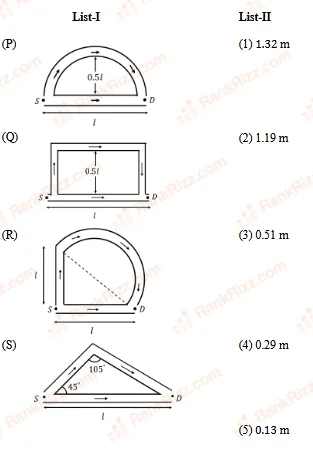
List-I shows four configurations made of straight and semi-circular narrow tubes containing air. A sound wave of wavelength λ=0.29 m\lambda=0.29\,\mathrm{m} enters these structures at the point SS and a sound detector is placed at DD. Between the points SS and DD, the sound travels only through the tubes. List-II contains the possible smallest values of ll (refer to the figures) for which the detector DD records maximum amplitude. Ignore effects of sharp corners. [Given cos⁡(15∘)=0.97\cos(15^\circ)=0.97]

Choose the option that best describes the match between the entries in List-I to those in List-II.

Figure for JEE Advanced 2026 Physics question on Superposition, interference and beats
  1. A

    (P)→\to(4), (Q)→\to(3), (R)→\to(5), (S)→\to(1)

  2. B

    (P)→\to(4), (Q)→\to(3), (R)→\to(1), (S)→\to(5)

  3. C

    (P)→\to(3), (Q)→\to(4), (R)→\to(1), (S)→\to(2)

  4. D

    (P)→\to(3), (Q)→\to(4), (R)→\to(5), (S)→\to(2)

Q14Polarisation: Malus's law and Brewster's law

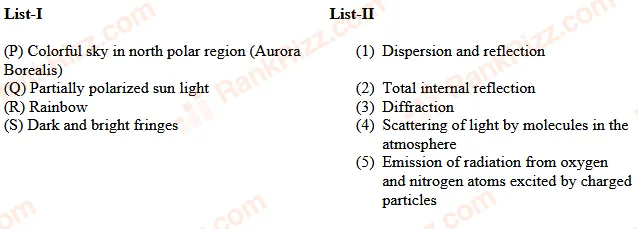
In the List-I, four optical effects are mentioned. The physical phenomena of light which are essential to describe these optical effects are given in List-II. Choose the option which describes the correct match between the entries in List-I to those in List-II.

Figure for JEE Advanced 2026 Physics question on Polarisation: Malus's law and Brewster's law
  1. A

    (P)→\to(5), (Q)→\to(4), (R)→\to(1), (S)→\to(3)

  2. B

    (P)→\to(4), (Q)→\to(2), (R)→\to(1), (S)→\to(3)

  3. C

    (P)→\to(4), (Q)→\to(1), (R)→\to(2), (S)→\to(3)

  4. D

    (P)→\to(5), (Q)→\to(4), (R)→\to(1), (S)→\to(2)

Q15Magnetic flux, Faraday's law and Lenz's law

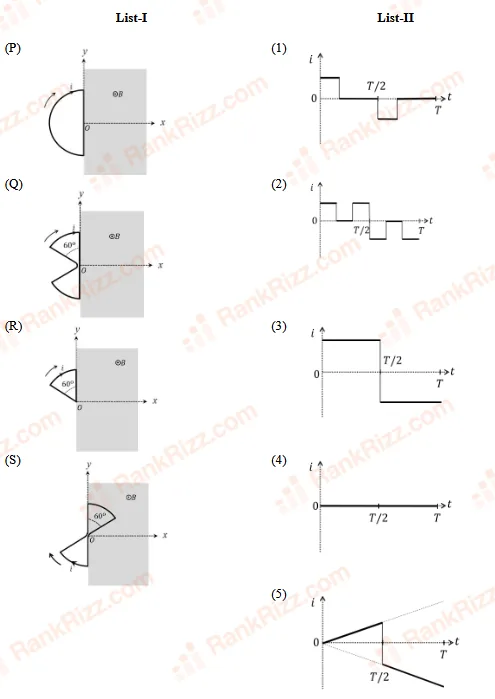
List-I contains four conducting loops lying in the XYXY plane, as shown in the figures. The loops are rotating about ZZ axis passing through the point OO with time period TT in clockwise direction. The region x>0x>0 contains a uniform magnetic field BB in the +z+z direction. List-II contains the qualitative variation of the induced current i(t)i(t) for each of these loops. Choose the option which describes the correct match between the entries in List-I to those in List-II.

Figure for JEE Advanced 2026 Physics question on Magnetic flux, Faraday's law and Lenz's law
  1. A

    (P)→\to(5), (Q)→\to(4), (R)→\to(1), (S)→\to(3)

  2. B

    (P)→\to(3), (Q)→\to(2), (R)→\to(5), (S)→\to(4)

  3. C

    (P)→\to(3), (Q)→\to(2), (R)→\to(1), (S)→\to(4)

  4. D

    (P)→\to(5), (Q)→\to(1), (R)→\to(2), (S)→\to(3)

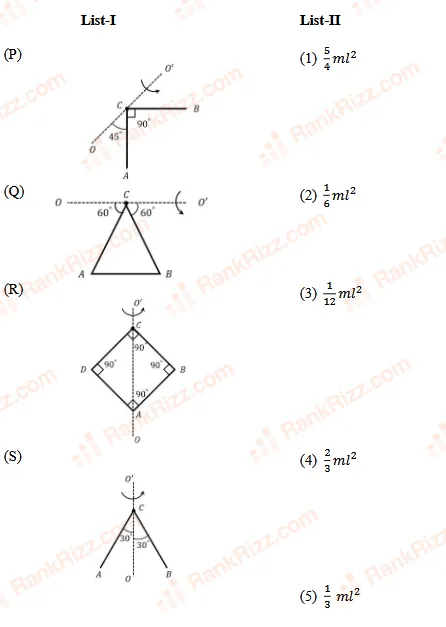
Q16Moment of inertia of standard bodies and composite systems

List-I shows four planar structures made of uniform solid rods each of mass mm and length ll. In the List-II the possible moment of inertia of these structures about an axis OCO′OCO', which lies in the plane of the structures, are given. Choose the option that describes the correct match between the entries in List-I to those in List-II.

Figure for JEE Advanced 2026 Physics question on Moment of inertia of standard bodies and composite systems
  1. A

    (P)→\to(5), (Q)→\to(1), (R)→\to(4), (S)→\to(2)

  2. B

    (P)→\to(1), (Q)→\to(3), (R)→\to(4), (S)→\to(2)

  3. C

    (P)→\to(5), (Q)→\to(3), (R)→\to(2), (S)→\to(1)

  4. D

    (P)→\to(5), (Q)→\to(4), (R)→\to(2), (S)→\to(1)

NEXT IN THIS PAPER →Chemistry, Q17 onwards