RankRizz

JEE Advanced 2020 Paper 2 Question Paper

All 54 questions of JEE Advanced 2020 Paper 2, in the order they were asked, one subject to a page. Pick an answer on any question to check it against the key. Free to read, nothing to download.

Questions

54

Physics · Chemistry · Maths

Answer key

18

questions with a checked key

Price

Free

no sign-up

Physics

Q1Prism: deviation and dispersion

A large square container with thin transparent vertical walls and filled with water (refractive index 43\frac{4}{3}) is kept on a horizontal table. A student holds a thin straight wire vertically inside the water 12 cm from one of its corners, as shown schematically in the figure. Looking at the wire from this corner, another student sees two images of the wire, located symmetrically on each side of the line of sight as shown. The separation (in cm) between these images is ____________.
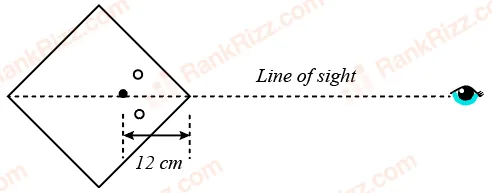
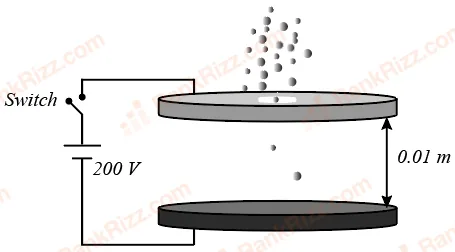
Figure for JEE Advanced 2020 Physics question on Prism: deviation and dispersion
Q2Equation of continuity and Bernoulli's theorem

A train with cross-sectional area StS_t is moving with speed vtv_t inside a long tunnel of cross-sectional area S0(S0=4St)S_0(S_0 = 4S_t). Assume that almost all the air (density ρ\rho)in front of the train flows back between its sides and the walls of the tunnel. Also, the air flow with respect to the train is steady and laminar. Take the ambient pressure and that inside the train to be p0p_0. If the pressure in the region between the sides of the train and the tunnel walls is 𝑝, then p0−p=72Nρvt2p_0 - p = \frac{7}{2N}\rho v_t^2. The value of N is _____________.

Q3Electric field of continuous charge distributions

Two large circular discs separated by a distance of 0.01 m are connected to a battery via a switch as shown in the figure. Charged oil drops of density 900 kg m−3^{−3} are released through a tiny hole at the center of the top disc. Once some oil drops achieve terminal velocity, the switch is closed to apply a voltage of 200 V across the discs. As a result, an oil drop of radius 8×10−78 \times 10^{−7} m stops moving vertically and floats between the discs. The number of electrons present in this oil drop is ________. (neglect the buoyancy force, take acceleration due to gravity = 10 ms−2^{−2} and charge on an electron (e) = 1.6×10−191.6 \times 10^{-19} C)

Figure for JEE Advanced 2020 Physics question on Electric field of continuous charge distributions
Q4Fluid pressure, Pascal's law and accelerated/rotating liquids

A hot air balloon is carrying some passengers, and a few sandbags of mass 1 kg each so that its total mass is 480 kg. Its effective volume giving the balloon its buoyancy is 𝑉. The balloon is floating at an equilibrium height of 100 m. When 𝑁 number of sandbags are thrown out, the balloon rises to a new equilibrium height close to 150 m with its volume 𝑉 remaining unchanged. If the variation of the density of air with height ℎ from the ground is ρ(h)=ρ0e−hh0\rho(h) = \rho_0 e^{-\frac{h}{h_0}}, where ρ0=1.25\rho_0 = 1.25 kg m−3^{-3} and h0=6000h_0 = 6000 m, the value of N is ________________.

Q5Electric dipole and dipole in external field

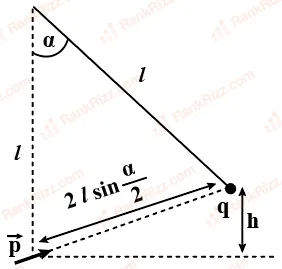
A point charge q of mass 𝑚 is suspended vertically by a string of length 𝑙. A point dipole of dipole moment p→\overrightarrow{p} is now brought towards q from infinity so that the charge moves away. The final equilibrium position of the system including the direction of the dipole, the angles and distances is shown in the figure below. If the work done in bringing the dipole to this position is N×(mgh)N \times (mgh), where g is the acceleration due to gravity, then the value of 𝑁 is _________ . (Note that for three coplanar forces keeping a point mass in equilibrium, Fsin⁡θ\frac{F}{\sin \theta} is the same for all forces, where 𝐹 is any one of the forces and θ\theta is the angle between the other two forces)

Figure for JEE Advanced 2020 Physics question on Electric dipole and dipole in external field
Q6Ideal gas equation and gas laws

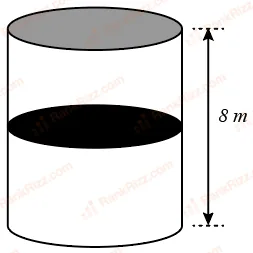
A thermally isolated cylindrical closed vessel of height 8 m is kept vertically. It is divided into two equal parts by a diathermic (perfect thermal conductor) frictionless partition of mass 8.3 kg. Thus the partition is held initially at a distance of 4 m from the top, as shown in the schematic figure below. Each of the two parts of the vessel contains 0.1 mole of an ideal gas at temperature 300 K. The partition is now released and moves without any gas leaking from one part of the vessel to the other. When equilibrium is reached, the distance of the partition from the top (in m) will be _______ (take the acceleration due to gravity = 10 ms−2^{-2} and the universal gas constant = 8.3 J mol−1^{-1} K−1^{-1}).

Figure for JEE Advanced 2020 Physics question on Ideal gas equation and gas laws
Q7Prism: deviation and dispersion

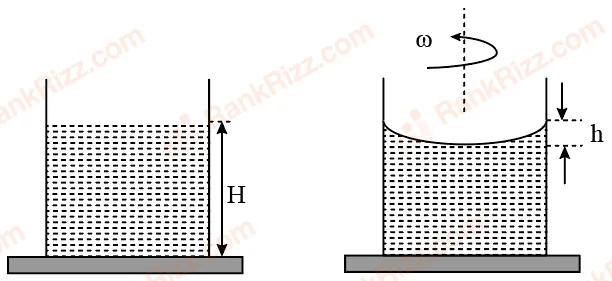
A beaker of radius 𝑟 is filled with water (refractive index 43\frac{4}{3}) up to a height 𝐻 as shown in the figure on the left. The beaker is kept on a horizontal table rotating with angular speed ω\omega. This makes the water surface curved so that the difference in the height of water level at the center and at the circumference of the beaker is h(h≪H,h≪r)h(h \ll H, h \ll r), as shown in the figure on the right. Take this surface to be approximately spherical with a radius of curvature 𝑅. Which of the following is/are correct? (g is the acceleration due to gravity)

Figure for JEE Advanced 2020 Physics question on Prism: deviation and dispersion
  1. A

    R=h2+r22hR = \frac{h^2 + r^2}{2h}

  2. B

    R=3r22hR = \frac{3 r^2}{2h}

  3. C

    Apparent depth of the bottom of the beaker is close to 3H2(1+ω2H2g)−1\frac{3H}{2}\left(1 + \frac{\omega^2 H}{2g}\right)^{-1}

  4. D

    Apparent depth of the bottom of the beaker is close to 3H4(1+ω2H4g)−1\frac{3H}{4}\left(1 + \frac{\omega^2 H}{4g}\right)^{-1}

Q8Potential energy, conservative forces and energy curves

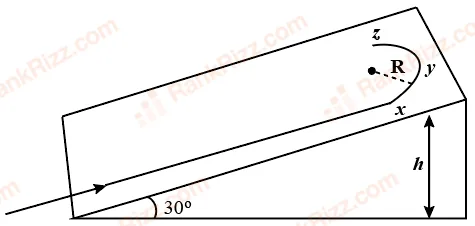
A student skates up a ramp that makes an angle 30∘30^\circ with the horizontal. He/she starts (as shown in the figure) at the bottom of the ramp with speed 𝑣0𝑣_0 and wants to turn around over a semicircular path xyz of radius 𝑅 during which he/she reaches a maximum height ℎ (at point y) from the ground as shown in the figure. Assume that the energy loss is negligible and the force required for this turn at the highest point is provided by his/her weight only. Then (g is the acceleration due to gravity)

Figure for JEE Advanced 2020 Physics question on Potential energy, conservative forces and energy curves
  1. A

    v02−2gh=12gRv_0^2 - 2gh = \frac{1}{2} g R

  2. B

    v02−2gh=32gRv_0^2 - 2gh = \frac{\sqrt{3}}{2} g R

  3. C

    the centripetal force required at points x and z is zero

  4. D

    the centripetal force required is maximum at points x and z

Q9Rolling with friction, slipping and impulsive forces

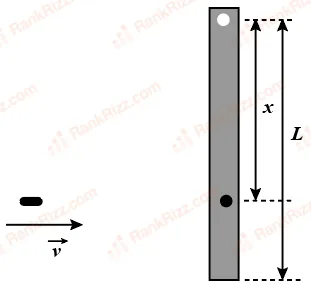
A rod of mass 𝑚 and length 𝐿, pivoted at one of its ends, is hanging vertically. A bullet of the same mass moving at speed 𝑣 strikes the rod horizontally at a distance 𝑥 from its pivoted end and gets embedded in it. The combined system now rotates with angular speed ω\omega about the pivot. The maximum angular speed ωM\omega_M is achieved for x=xMx = x_M. Then

Figure for JEE Advanced 2020 Physics question on Rolling with friction, slipping and impulsive forces
  1. A

    ω=3vxL2+3x2\omega = \frac{3vx}{L^2 + 3x^2}

  2. B

    ω=12vxL2+12x2\omega = \frac{12 vx}{L^2 + 12x^2}

  3. C

    xM=L3x_M = \frac{L}{\sqrt{3}}

  4. D

    ωM=v2L3\omega_M = \frac{v}{2L}\sqrt{3}

Q10X-rays: continuous and characteristic spectra, Moseley's law

In an X-ray tube, electrons emitted from a filament (cathode) carrying current I hit a target (anode) at a distance 𝑑 from the cathode. The target is kept at a potential 𝑉 higher than the cathode resulting in emission of continuous and characteristic X-rays. If the filament current 𝐼 is decreased to I2\frac{I}{2}, the potential difference 𝑉 is increased to 2𝑉, and the separation distance 𝑑 is reduced to d2\frac{d}{2}, then

  1. A

    the cut-off wavelength will reduce to half, and the wavelengths of the characteristic X-rays will remain the same

  2. B

    the cut-off wavelength as well as the wavelengths of the characteristic X-rays will remain the same

  3. C

    the cut-off wavelength will reduce to half, and the intensities of all the X-rays will decrease

  4. D

    the cut-off wavelength will become two times larger, and the intensity of all the X-rays will decrease

Q11Electric charge and Coulomb's law

Two identical non-conducting solid spheres of same mass and charge are suspended in air from a common point by two non-conducting, massless strings of same length. At equilibrium, the angle between the strings is α\alpha. The spheres are now immersed in a dielectric liquid of density 800 kg m−3^{−3} and dielectric constant 21. If the angle between the strings remains the same after the immersion, then

  1. A

    electric force between the spheres remains unchanged

  2. B

    electric force between the spheres reduces

  3. C

    mass density of the spheres is 840 kg m−3^{−3}

  4. D

    the tension in the strings holding the spheres remains unchanged

Q12Non-uniform acceleration using calculus

Starting at time 𝑡=0 from the origin with speed 1 ms−1^{-1}, a particle follows a two-dimensional trajectory in the x-y plane so that its coordinates are related by the equation y=x22y = \frac{x^2}{2}. The x and y components of its acceleration are denoted by 𝑎𝑥𝑎_𝑥 and 𝑎y𝑎_y, respectively. Then

  1. A

    ax=1a_x = 1 ms−2^{-2} implies that when the particle is at the origin, ay=1a_y = 1 ms−2^{-2}

  2. B

    ax=0a_x = 0 implies ay=1a_y = 1 ms−2^{-2} at all times

  3. C

    at 𝑡=0, the particle’s velocity points in the 𝑥-direction

  4. D

    ax=0a_x = 0 implies that at 𝑡 = 1 s, the angle between the particle’s velocity and the 𝑥 axis is 45∘45^\circ

Q13Multi-step processes and gas-piston-spring systems

A spherical bubble inside water has radius 𝑅. Take the pressure inside the bubble and the water pressure to be p0p_0. The bubble now gets compressed radially in an adiabatic manner so that its radius becomes (𝑅 − 𝑎). For a≪Ra \ll R the magnitude of the work done in the process is given by (4πp0Ra2)X2(4 \pi p_0 R a^2)X^2, where 𝑋 is a constant and γ=CpCV=4130\gamma = \frac{C_p}{C_V} = \frac{41}{30}. The value of X is ____________.

Q14Wheatstone bridge

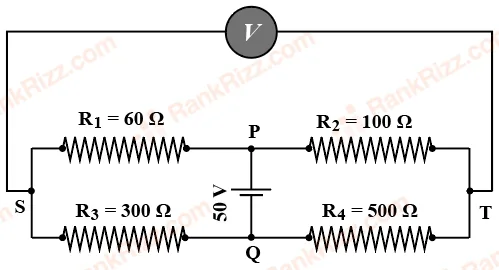
In the balanced condition, the values of the resistances of the four arms of a Wheatstone bridge are shown in the figure below. The resistance 𝑅3𝑅_3 has temperature coefficient 0.0004 ∘C−1^\circ C^{−1}. If the temperature of 𝑅3𝑅_3 is increased by 100 ∘C^\circ C, the voltage developed between 𝑆 and 𝑇 will be __________ volt.

Figure for JEE Advanced 2020 Physics question on Wheatstone bridge
Q15Energy stored, force between plates and charge sharing

Two capacitors with capacitance values C1=2000±10C_1 = 2000 \pm 10 pF and C2=3000±15C_2 = 3000 \pm 15 pF are connected in series. The voltage applied across this combination is 𝑉=5.00±0.02𝑉 = 5.00 \pm 0.02 V. The percentage error in the calculation of the energy stored in this combination of capacitors is _______.

Q16Bulk modulus and compressibility

A cubical solid aluminium (bulk modulus = −VdPdV=70-V \frac{dP}{dV} = 70 GPa) block has an edge length of 1 m on the surface of the earth. It is kept on the floor of a 5 km deep ocean. Taking the average density of water and the acceleration due to gravity to be 103^3 kg m−3^{−3} and 10 ms−2^{−2}, respectively, the change in the edge length of the block in mm is _____.

Q17Self inductance and energy stored in inductors

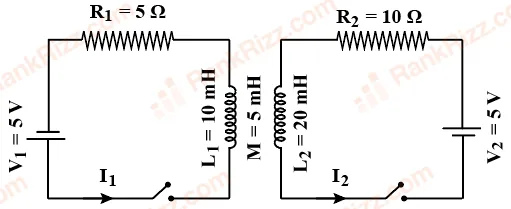
The inductors of two 𝐿𝑅 circuits are placed next to each other, as shown in the figure. The values of the self-inductance of the inductors, resistances, mutual-inductance and applied voltages are specified in the given circuit. After both the switches are closed simultaneously, the total work done by the batteries against the induced 𝐸𝑀𝐹 in the inductors by the time the currents reach their steady state values is________ mJ.

Figure for JEE Advanced 2020 Physics question on Self inductance and energy stored in inductors
Q18Thermal radiation: Stefan's law, Wien's law and Kirchhoff's law

A container with 1 kg of water in it is kept in sunlight, which causes the water to get warmer than the surroundings. The average energy per unit time per unit area received due to the sunlight is 700 Wm−2^{−2} and it is absorbed by the water over an effective area of 0.05 m2^2. Assuming that the heat loss from the water to the surroundings is governed by Newton’s law of cooling, the difference (in ∘C^\circ C) in the temperature of water and the surroundings after a long time will be _____________. (Ignore effect of the container, and take constant for Newton’s law of cooling = 0.001 s−1^{−1}, Heat capacity of water = 4200 J kg−1^{−1} K−1^{−1})

NEXT IN THIS PAPER →Chemistry, Q19 onwards