RankRizz

JEE Advanced 2020 Paper 1 Question Paper

All 54 questions of JEE Advanced 2020 Paper 1, in the order they were asked, one subject to a page. Pick an answer on any question to check it against the key. Free to read, nothing to download.

Questions

54

Physics · Chemistry · Maths

Answer key

40

questions with a checked key

Price

Free

no sign-up

Physics

Q1Equilibrium of rigid bodies and toppling

A football of radius R is kept on a hole of radius r (𝑟 < 𝑅) made on a plank kept horizontally. One end of the plank is now lifted so that it gets tilted making an angle 𝜃 from the horizontal as shown in the figure below. The maximum value of θ\theta so that the football does not start rolling down the plank satisfies (figure is schematic and not drawn to scale)
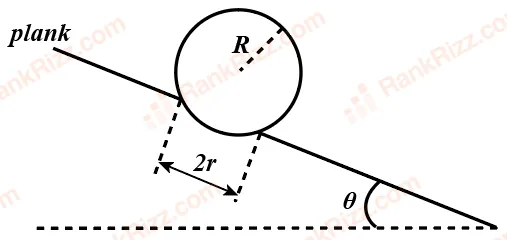
Figure for JEE Advanced 2020 Physics question on Equilibrium of rigid bodies and toppling
  1. A

    sin⁡θ=rR\sin \theta = \frac{r}{R}

  2. B

    tan⁡θ=rR\tan \theta = \frac{r}{R}

  3. C

    sin⁡θ=r2R\sin \theta = \frac{r}{2R}

  4. D

    cos⁡θ=r2R\cos \theta = \frac{r}{2R}

Q2Motional emf in moving rods and loops

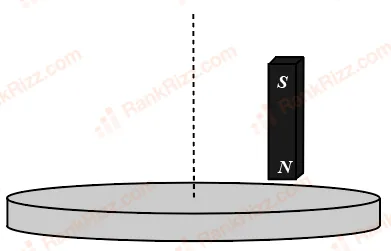
A light disc made of aluminium (a nonmagnetic material) is kept horizontally and is free to rotate about its axis as shown in the figure. A strong magnet is held vertically at a point above the disc away from its axis. On revolving the magnet about the axis of the disc, the disc will (figure is schematic and not drawn to scale)

Figure for JEE Advanced 2020 Physics question on Motional emf in moving rods and loops
  1. A

    rotate in the direction opposite to the direction of magnet’s motion

  2. B

    rotate in the same direction as the direction of magnet’s motion

  3. C

    not rotate and its temperature will remain unchanged

  4. D

    not rotate but its temperature will slowly rise

Q3Rolling with friction, slipping and impulsive forces

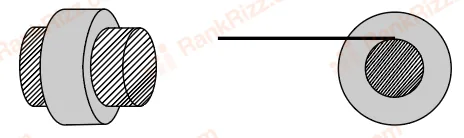
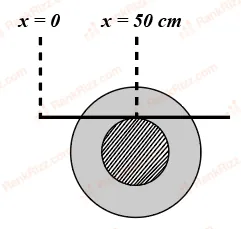
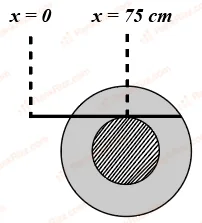
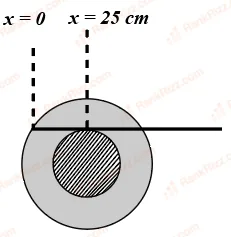
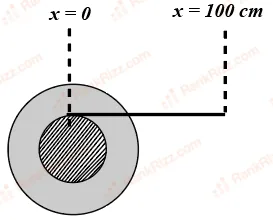
A small roller of diameter 20 cm has an axle of diameter 10 cm (see figure below on the left). It is on a horizontal floor and a meter scale is positioned horizontally on its axle with one edge of the scale on top of the axle (see figure on the right). The scale is now pushed slowly on the axle so that it moves without slipping on the axle, and the roller starts rolling without slipping. After the roller has moved 50 cm, the position of the scale will look like (figures are schematic and not drawn to scale)

Figure for JEE Advanced 2020 Physics question on Rolling with friction, slipping and impulsive forces
  1. A
    Figure for JEE Advanced 2020 Physics question on Rolling with friction, slipping and impulsive forces
  2. B
    Figure for JEE Advanced 2020 Physics question on Rolling with friction, slipping and impulsive forces
  3. C
    Figure for JEE Advanced 2020 Physics question on Rolling with friction, slipping and impulsive forces
  4. D
    Figure for JEE Advanced 2020 Physics question on Rolling with friction, slipping and impulsive forces
Q4Force on current-carrying conductors and between parallel wires

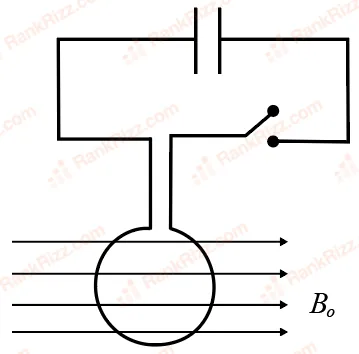
A circular coil of radius R and N turns has negligible resistance. As shown in the schematic figure, its two ends are connected to two wires and it is hanging by those wires with its plane being vertical. The wires are connected to a capacitor with charge Q through a switch. The coil is in a horizontal uniform magnetic field BoB_{o} parallel to the plane of the coil. When the switch is closed, the capacitor gets discharged through the coil in a very short time. By the time the capacitor is discharged fully, magnitude of the angular momentum gained by the coil will be (assume that the discharge time is so short that the coil has hardly rotated during this time)

Figure for JEE Advanced 2020 Physics question on Force on current-carrying conductors and between parallel wires
  1. A

    π2NQB0R2\frac{\pi}{2} NQB_{0}R^{2}

  2. B

    πNQB0R2\pi NQB_{0}R^{2}

  3. C

    2πNQB0R22\pi NQB_{0}R^{2}

  4. D

    4πNQB0R24\pi NQB_{0}R^{2}

Q5Young's double slit experiment: fringe width and intensity

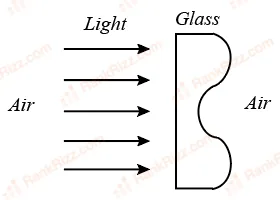
A parallel beam of light strikes a piece of transparent glass having cross section as shown in the figure below. Correct shape of the emergent wavefront will be (figures are schematic and not drawn to scale)

Figure for JEE Advanced 2020 Physics question on Young's double slit experiment: fringe width and intensity
  1. A
    Figure for JEE Advanced 2020 Physics question on Young's double slit experiment: fringe width and intensity
  2. B
    Figure for JEE Advanced 2020 Physics question on Young's double slit experiment: fringe width and intensity
  3. C
    Figure for JEE Advanced 2020 Physics question on Young's double slit experiment: fringe width and intensity
  4. D
    Figure for JEE Advanced 2020 Physics question on Young's double slit experiment: fringe width and intensity
Q6Fluid pressure, Pascal's law and accelerated/rotating liquids

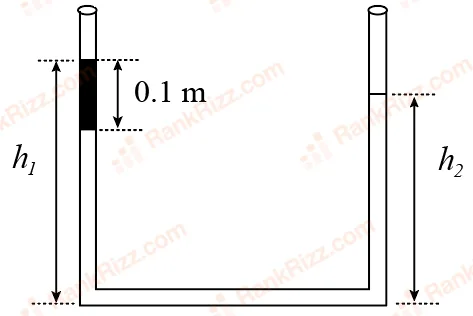
An open-ended U-tube of uniform cross-sectional area contains water (density 103kgm−310^{3}kg m^{−3}). Initially the water level stands at 0.29 m from the bottom in each arm. Kerosene oil (a water-immiscible liquid) of density 800 kgm−3m^{−3} is added to the left arm until its length is 0.1 m, as shown in the schematic figure below. The ratio (h1h2)\left(\frac{ℎ1}{ℎ2}\right) of the heights of the liquid in the two arms is 

Figure for JEE Advanced 2020 Physics question on Fluid pressure, Pascal's law and accelerated/rotating liquids
  1. A

    1535\frac{15}{35}

  2. B

    3533\frac{35}{33}

  3. C

    76\frac{7}{6}

  4. D

    54\frac{5}{4}

Q7Hydrogen spectrum and spectral series

A particle of mass m moves in circular orbits with potential energy 𝑉(𝑟) = 𝐹𝑟, where F is a positive constant and r is its distance from the origin. Its energies are calculated using the Bohr model. If the radius of the particle’s orbit is denoted by R and its speed and energy are denoted by v and E, respectively, then for the nthn^{th} orbit (here h is the Planck’s constant)

  1. A

    R∝n1/3R \propto n^{1/3} and V∝n2/3V \propto n^{2/3}

  2. B

    R∝n2/3R \propto n^{2/3} and V∝n1/3V \propto n^{1/3}

  3. C

    E=32(n2h2F24π2m)1/3E = \frac{3}{2}\left(\frac{n^{2}h^{2}F^{2}}{4\pi^{2}m}\right)^{1/3}

  4. D

    E=2(n2h2F24π2m)1/3E = 2\left(\frac{n^{2}h^{2}F^{2}}{4\pi^{2}m}\right)^{1/3}

Q8Thermal radiation: Stefan's law, Wien's law and Kirchhoff's law

The filament of a light bulb has surface area 64mm264 mm^{2}. The filament can be considered as a black
body at temperature 2500 K emitting radiation like a point source when viewed from far. At night the light bulb is observed from a distance of 100 m. Assume the pupil of the eyes of the observer to be circular with radius 3 mm. Then
(Take Stefan-Boltzmann constant = 5.67×10⁻⁸Wm−2K−45.67 \times 10−8 Wm^{−2}K^{−4}, Wien’s displacement constant = 2.90×10⁻³m−K2.90 \times 10^{−3} m^{-K}, Planck’s constant = 6.63×10−346.63 \times 10^{−34}Js, speed of light in vacuum = 3.00×10⁸ms−13.00 \times 10^{8} ms^{−1})

  1. A

    power radiated by the filament is in the range 642 W to 645 W

  2. B

    radiated power entering into one eye of the observer is in the range 3.15×10⁻⁸Wto3.25×10−8W3.15 \times 10^{−8} W to 3.25 \times 10^{−8} W

  3. C

    the wavelength corresponding to the maximum intensity of light is 1160 nm

  4. D

    taking the average wavelength of emitted radiation to be 1740 nm, the total number of photons entering per second into one eye of the observer is in the range 2.75×10112.75 \times 10^{11} to 2.85×10112.85 \times 10^{11}

Q9Dimensional analysis: deriving and checking relations

Sometimes it is convenient to construct a system of units so that all quantities can be expressed in
terms of only one physical quantity. In one such system, dimensions of different quantities are given
in terms of a quantity X as follows: [position]=[𝑋α];[speed]=[𝑋β];[acceleration]=[𝑋p];[linearmomentum]=[𝑋q];[force]=[𝑋r][position] = [𝑋^{\alpha}]; [speed] = [𝑋^{\beta}]; [acceleration] =[𝑋^{p}]; [linear momentum] = [𝑋^{q}]; [force] = [𝑋^{r}]. Then

  1. A

    α+p−2β\alpha + p - 2\beta

  2. B

    p+q−r=βp + q - r = \beta

  3. C

    p−q+r=αp - q + r = \alpha

  4. D

    p+q+r=βp + q + r = \beta

Q10Electric field of continuous charge distributions

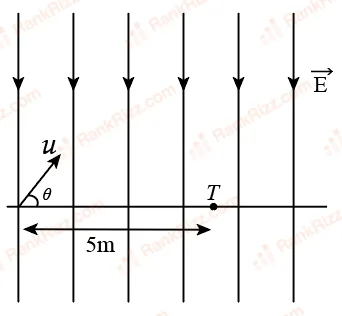
A uniform electric field, E→=−4003y^NC−1\overrightarrow{E} = −400\sqrt{3}\hat{y} NC^{−1} is applied in a region. A charged particle of mass m carrying positive charge q is projected in this region with an initial speed of 210×106ms−12\sqrt{10} \times 106 ms^{−1}. This particle is aimed to hit a target T, which is 5 m away from its entry point into the field as shown schematically in the figure. Take qm=1010Ckg−1\frac{q}{m} = 10^{10} Ckg^{−1}. Then

Figure for JEE Advanced 2020 Physics question on Electric field of continuous charge distributions
  1. A

    the particle will hit T if projected at an angle 45∘45^{\circ} from the horizontal

  2. B

    the particle will hit T if projected either at an angle 30∘30^{\circ} or 60∘60^{\circ} from the horizontal

  3. C

    time taken by the particle to hit T could be 56μs\sqrt{\frac{5}{6}} \mu s as well as 52μs\sqrt{\frac{5}{2}} \mu s

  4. D

    time taken by the particle to hit T is 53μs\sqrt{\frac{5}{3}} \mu s

Q11Electric current, current density and drift velocity

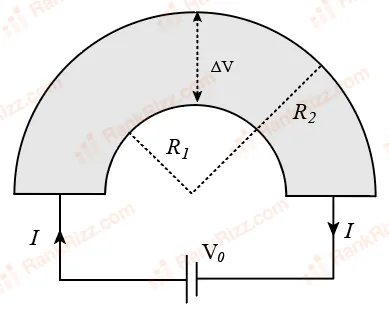
Shown in the figure is a semicircular metallic strip that has thickness t and resistivity ρ\rho. Its inner radius is R1R_{1} and outer radius is R2R_{2}. If a voltage V0V_{0} is applied between its two ends, a current I flows in it. In addition, it is observed that a transverse voltage △V\triangle V develops between its inner and outer surfaces due to purely kinetic effects of moving electrons (ignore any role of the magnetic field due to the current). Then (figure is schematic and not drawn to scale)

Figure for JEE Advanced 2020 Physics question on Electric current, current density and drift velocity
  1. A

    I=v0tπρI = \frac{v_{0}t}{\pi \rho} In (R2R1)\left(\frac{R_{2}}{R_{1}}\right)

  2. B

    the outer surface is at a higher voltage than the inner surface

  3. C

    the outer surface is at a lower voltage than the inner surface

  4. D

    △V∝I2\triangle V \propto I^{2}

Q12Ideal gas equation and gas laws

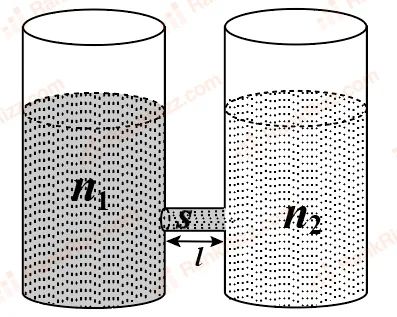
As shown schematically in the figure, two vessels contain water solutions (at temperature 𝑇) of
potassium permanganate (KMnO4KMnO_{4}) of different concentrations n1n_{1} and n2(n1>n2)n_{2} (n_{1} > n_{2}) molecules per unit volume with △n=(n1−n2)<<n1\triangle n = (n_{1} − n_{2}) << n_{1}. When they are connected by a tube of small length l and cross-sectional area S, KMnO4KMnO_{4} starts to diffuse from the left to the right vessel through the tube. Consider the collection of molecules to behave as dilute ideal gases and the difference in their partial pressure in the two vessels causing the diffusion. The speed 𝑣 of the molecules is limited by the viscous force −βvoneachmolecule,where−\beta v on each molecule, where\betaisaconstant.Neglectingalltermsoftheorderis a constant. Neglecting all terms of the order\left(\tirangle n\right)^{2},whichofthefollowingis/arecorrect?(, which of the following is/are correct? (k_{B}$$ is the Boltzmann constant)

Figure for JEE Advanced 2020 Physics question on Ideal gas equation and gas laws
  1. A

    the force causing the molecules to move across the tube is △nkBTS\triangle nk_{B}TS

  2. B

    force balance implies n1βvl=△nkBTn_{1} \beta vl = \triangle nk_{B}T

  3. C

    total number of molecules going across the tube per sec is (△nl)(kBTβ)\left(\frac{\triangle n}{l}\right) \left(\frac{k_{B}T}{\beta}\right)

  4. D

    rate of molecules getting transferred through the tube does not change with time

Q13Static and kinetic friction

Put a uniform meter scale horizontally on your extended index fingers with the left one at 0.00 cm and the right one at 90.00 cm. When you attempt to move both the fingers slowly towards the center, initially only the left finger slips with respect to the scale and the right finger does not. After some distance, the left finger stops and the right one starts slipping. Then the right finger stops at a distance xRx_{R} from the center (50.00 cm) of the scale and the left one starts slipping again. This happens because of the difference in the frictional forces on the two fingers. If the coefficients of static and dynamic friction between the fingers and the scale are 0.40 and 0.32, respectively, the value of xRx_{R} (in
cm) is ______.

Q14Surface tension and surface energy

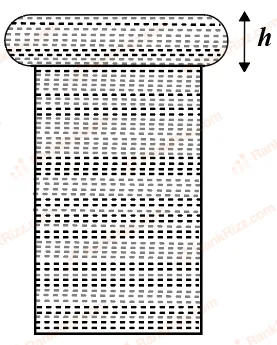
When water is filled carefully in a glass, one can fill it to a height h above the rim of the glass due to the surface tension of water. To calculate h just before water starts flowing, model the shape of the water above the rim as a disc of thickness h having semicircular edges, as shown schematically in the figure. When the pressure of water at the bottom of this disc exceeds what can be withstood due to the surface tension, the water surface breaks near the rim and water starts flowing from there. If the density of water, its surface tension and the acceleration due to gravity are 103kgm−3,0.07Nm−110^{3}kg m^{−3}, 0.07 Nm^{−1} and 10ms−210 ms^{−2}, respectively, the value of h (in mm) is _________.

Figure for JEE Advanced 2020 Physics question on Surface tension and surface energy
Q15Electric dipole and dipole in external field

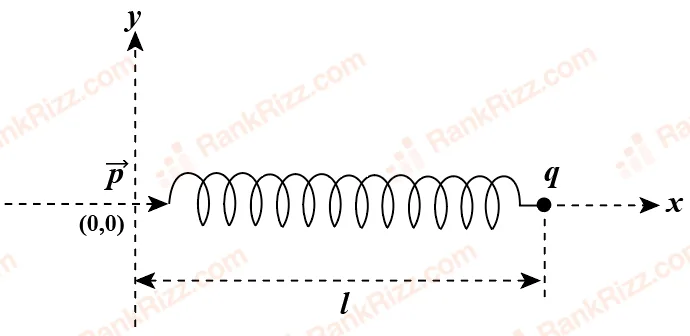
One end of a spring of negligible unstretched length and spring constant k is fixed at the origin (0,0). A point particle of mass m carrying a positive charge q is attached at its other end. The entire system is kept on a smooth horizontal surface. When a point dipole p→\overrightarrow{p} pointing towards the charge q is fixed at the origin, the spring gets stretched to a length l and attains a new equilibrium position (see figure below). If the point mass is now displaced slightly by △l<<l\triangle l << l from its equilibrium position and released, it is found to oscillate at frequency 1δkm\frac{1}{\delta}\sqrt{\frac{k}{m}}. The value of δ\delta is ______.

Figure for JEE Advanced 2020 Physics question on Electric dipole and dipole in external field
Q16Multi-step processes and gas-piston-spring systems

Consider one mole of helium gas enclosed in a container at initial pressure p1p_{1} and volume v[1]v_[1]. It expands isothermally to volume 4𝑉14𝑉_{1}. After this, the gas expands adiabatically and its volume becomes 32𝑉132𝑉_{1}. The work done by the gas during isothermal and adiabatic expansion processes are 𝑊𝑖𝑠𝑜𝑊_{𝑖𝑠𝑜} and 𝑊𝑎𝑑𝑖𝑎𝑊_{𝑎𝑑𝑖𝑎}, respectively. If the ratio 𝑊𝑖𝑠𝑜𝑊𝑎𝑑𝑖𝑎\frac{𝑊_{𝑖𝑠𝑜}}{𝑊_{𝑎𝑑𝑖𝑎}} 𝑓 In2, then 𝑓 is ________.

Q17Doppler effect in sound

A stationary tuning fork is in resonance with an air column in a pipe. If the tuning fork is moved with a speed of 2ms−12 ms^{−1} in front of the open end of the pipe and parallel to it, the length of the pipe should be changed for the resonance to occur with the moving tuning fork. If the speed of sound in air is 320ms−1320 ms^{−1}, the smallest value of the percentage change required in the length of the pipe is
____________.

Q18Electric flux and Gauss's law

A circular disc of radius 𝑅 carries surface charge density \sigma (𝑟) = \sigma 0 (1 − \frac{r}{R}\right), where σ0\sigma_{0} is a constant and 𝑟 is the distance from the center of the disc. Electric flux through a large spherical surface that encloses the charged disc completely is ϕ0\phi_{0}. Electric flux through another spherical surface of radius R4\frac{R}{4} and concentric with the disc is ϕ\phi. Then the ratio ϕ0ϕ\frac{\phi_{0}}{\phi} is_________.

NEXT IN THIS PAPER →Chemistry, Q19 onwards