RankRizz

JEE Advanced 2017 Paper 2 Question Paper

All 54 questions of JEE Advanced 2017 Paper 2, in the order they were asked, one subject to a page. Pick an answer on any question to check it against the key. Free to read, nothing to download.

Questions

54

Physics · Chemistry · Maths

Answer key

54

questions with a checked key

Price

Free

no sign-up

Physics

Q1Non-uniform acceleration using calculus

Consider an expanding sphere of instantaneous radius R whose total mass remains constant. The expansion is such that the instantaneous density ρ\rho remains uniform throughout the volume. The rate of fractional change in density (1ρdρdt)(\frac{1}{\rho}\frac{d\rho}{dt}) is constant. The velocity ν\nu of any point on the surface of the expanding sphere is proportional to

  1. A

    RR

  2. B

    R3R^{3}

  3. C

    1R\frac{1}{R}

  4. D

    R23R^{\frac{2}{3}}

Q2Rolling with friction, slipping and impulsive forces

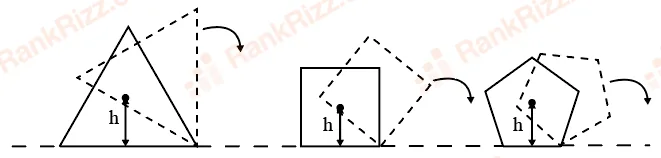
Consider regular polygons with number of sides n=3,4,5.....as shown in the figure. The center of mass of all the polygons is at height h from the ground. They roll on a horizontal surface about the leading vertex without slipping and sliding as depicted. The maximum increase in height of the locus of the center of mass for each polygon is △\triangle. Then △\triangle depends on n and has

Figure for JEE Advanced 2017 Physics question on Rolling with friction, slipping and impulsive forces
  1. A

    △=hsin⁡2(πn)\triangle=h \sin^{2}(\frac{\pi}{n})

  2. B

    △=h(1cos⁡(πn)−1)\triangle=h (\frac{1}{\cos(\frac{\pi}{n})}-1)

  3. C

    △=hsin⁡(2πn)\triangle=h \sin(\frac{2\pi}{n})

  4. D

    △=htan⁡2(π2n)\triangle=h \tan^{2}(\frac{\pi}{2n})

Q3Photoelectric effect and Einstein's equation

A photoelectric material having work-function ϕ0\phi_{0} is illuminated with light of wavelength λ(λ<hcϕ0)\lambda (\lambda < \frac{hc}{\phi_{0}}). The fastest photoelectron has a de Broglie wavelength λd\lambda_{d}. A change in wavelength of the incident light by △λ\triangle \lambda results in a change △λd\triangle \lambda_{d} in λd\lambda_{d}. Then the ratio △λd△λ\frac{\triangle\lambda_{d}}{\triangle\lambda} is proportional to

  1. A

    λdλ\frac{\lambda_{d}}{\lambda}

  2. B

    λd2λ2\frac{\lambda^{2}_{d}}{\lambda^{2}}

  3. C

    λd3λ\frac{\lambda^{3}_{d}}{\lambda}

  4. D

    λd3λ2\frac{\lambda^{3}_{d}}{\lambda^{2}}

Q4Magnetic field of circular loops, arcs and coils

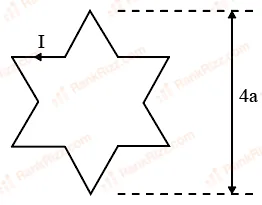
A symmetric star shaped conducting wire loop is carrying a steady state current I as shown in the figure. The distance between the diametrically opposite vertices of the star is 4a4a. The magnitude of the magnetic field at the center of the loop is

Figure for JEE Advanced 2017 Physics question on Magnetic field of circular loops, arcs and coils
  1. A

    μ0I4πa6[3−1]\frac{\mu_{0}I}{4 \pi a}6[\sqrt{3}-1]

  2. B

    μ0I4πa6[3+1]\frac{\mu_{0}I}{4 \pi a}6[\sqrt{3}+1]

  3. C

    μ0I4πa3[3−1]\frac{\mu_{0}I}{4 \pi a}3[\sqrt{3}-1]

  4. D

    μ0I4πa3[2−3]\frac{\mu_{0}I}{4 \pi a}3[2-\sqrt{3}]

Q5Vectors: addition, subtraction, resolution and unit vectors

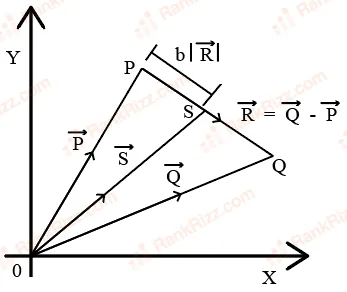
Three vectors P→,Q→\overrightarrow{P},\overrightarrow{Q} and R→\overrightarrow{R} are shown in the figure. Let be any point on the vector R→\overrightarrow{R}. The distance between the points PP and SS is b∣R→∣b\mid\overrightarrow{R}\mid. The general relation among vectors P→,Q→\overrightarrow{P},\overrightarrow{Q} and S→\overrightarrow{S} is

Figure for JEE Advanced 2017 Physics question on Vectors: addition, subtraction, resolution and unit vectors
  1. A

    S→=(1−b)P→+bQ→\overrightarrow{S}=(1-b)\overrightarrow{P}+b\overrightarrow{Q}

  2. B

    S→=(b−1)P→+bQ→\overrightarrow{S}=(b-1)\overrightarrow{P}+b\overrightarrow{Q}

  3. C

    S→=(1−b2)P→+bQ→\overrightarrow{S}=(1-b^{2})\overrightarrow{P}+b\overrightarrow{Q}

  4. D

    S→=(1−b)P→+b2Q→\overrightarrow{S}=(1-b)\overrightarrow{P}+b^{2}\overrightarrow{Q}

Q6Escape speed

A rocket is launched normal to the surface of the Earth, away from the Sun, along the line joining the Sun and the Earth. The Sun is 3×1053\times10^{5} times heavier than the Earth and is at a distance 2.5×1042.5\times10^{4} times larger than the radius of the Earth. The escape velocity from Earth’s gravitational field is
νe=11.2kms−1\nu_{e}=11.2 kms^{-1}. The minimum initial velocity νs\nu_{s} required for the rocket to be able to leave the Sun-Earth system is closest to

(Ignore the rotation and revolution of the Earth and the presence of any other planet)

  1. A

    νs=22km s−1\nu_{s}=22 km\ s^{-1}

  2. B

    νs=42km s−1\nu_{s}=42 km\ s^{-1}

  3. C

    νs=62km s−1\nu_{s}=62 km\ s^{-1}

  4. D

    νs=72km s−1\nu_{s}=72 km\ s^{-1}

Q7Errors in measurement and significant figures

A person measures the depth of a well by measuring the time interval between dropping a stone and receiving the sound of impact with the bottom of the well. The error in his measurement of time is δT=0.01\delta T=0.01 seconds and he measures the depth of the well to be L=20L=20 meters. Take the acceleration due to gravity g=10ms−2g = 10 ms^{-2} and the velocity of sound is 300ms−1300 ms^{-1}. Then the fractional error in the measurement, δLL\frac{\delta L}{L}, is closest to

  1. A

    0.2%

  2. B

    1%

  3. C

    3%

  4. D

    5%

Q8Motion of charged particles in a magnetic field

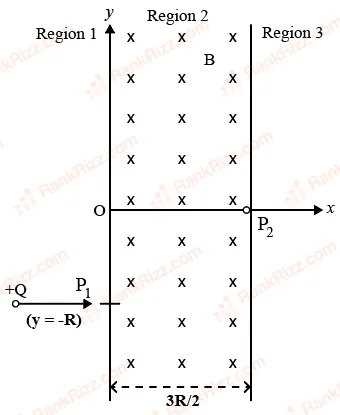
A uniform magnetic field B exists in the region between x=0x=0 and x=3R2x=\frac{3R}{2} (region 2 in the figure) pointing normally into the plane of the paper. A particle with charge +Q+Q and momentum pp directed along x-axis enters region 2 from region 1 at point P1(Y=−R)P_{1}(Y=-R).Which of the following option(s) is/are correct?

Figure for JEE Advanced 2017 Physics question on Motion of charged particles in a magnetic field
  1. A

    For B>23PQRB>\frac{2}{3}\frac{P}{QR}, the particle will re-enter region 1

  2. B

    For B=813PQRB=\frac{8}{13}\frac{P}{QR}, the particle will enter region 3 through the point P2P_{2} on x-axis

  3. C

    When the particle re-enters region 1 through the longest possible path in region 2,the magnitude of the change in its linear momentum between point P1P_{1} and the farthest point from axis is P2\frac{P}{\sqrt{2}}

  4. D

    For a fixed B, particles of same charge Q and same velocity V, the distance between the point P1P_{1} and the point of re-entry into region 1 is inversely proportional to the mass of the particle

Q9AC basics: rms and average values, phasors

The instantaneous voltages at three terminals marked X,Y and Z are given by VX=V0sin⁡ωtV_{X}= V_{0} \sin \omega t, VY=V0sin⁡(ωt+2π3)V_{Y}= V_{0} \sin (\omega t+\frac{2\pi}{3})
and VZ=V0sin⁡(ωt+4π3)V_{Z}= V_{0} \sin (\omega t+\frac{4\pi}{3}). An ideal voltmeter is configured to read rms value of the potential difference between its terminals. It is connected between points X and Y and then between Y and Z The reading(s) of the voltmeter will be

  1. A

    VXYrms=V032V^{rms}_{XY}= V_{0} \sqrt{\frac{3}{2}}

  2. B

    VYZrms=V012V^{rms}_{YZ}= V_{0} \sqrt{\frac{1}{2}}

  3. C

    VXYrms=V0V^{rms}_{XY}= V_{0}

  4. D

    independent of the choice of the two terminals

Q10Electric flux and Gauss's law

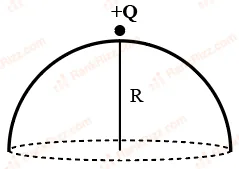
A point charge +Q+Q is placed just outside an imaginary hemispherical surface of radius R as shown in the figure. Which of the following statements is/are correct?

Figure for JEE Advanced 2017 Physics question on Electric flux and Gauss's law
  1. A

    The electric flux passing through the curved surface of the hemisphere is −Q2ϵ0(1−12)-\frac{Q}{2\epsilon _{0}}(1-\frac{1}{\sqrt{2}})

  2. B

    Total flux through the curved and the flat surfaces is Qϵ0\frac{Q}{\epsilon _{0}}

  3. C

    The component of the electric field normal to the flat surface is constant over the surface

  4. D

    The circumference of the flat surface is an equipotential

Q11Young's double slit experiment: fringe width and intensity

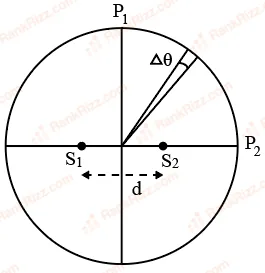
Two coherent monochromatic point sources S1S_{1} and S2S_{2} of wavelength λ=600\lambda=600 nm are placed symmetrically on either side of the center of the circle as shown. The sources are separated by a distance d=1.8d=1.8 mm. This arrangement produces interference fringes visible as alternate bright and dark spots on the circumference of the circle. The angular separation between two consecutive bright spots is △θ\triangle\theta. Which of the following options is/are correct?

Figure for JEE Advanced 2017 Physics question on Young's double slit experiment: fringe width and intensity
  1. A

    A dark spot will be formed at the point P2P_{2}

  2. B

    At P2P_{2} the order of the fringe will be maximum

  3. C

    The total number of fringes produced between P1P_{1} and P2P_{2} in the first quadrant is close to 3000

  4. D

    The angular separation between two consecutive bright spots decreases as we move from P1P_{1} to P2P_{2} along the first quadrant

Q12Self inductance and energy stored in inductors

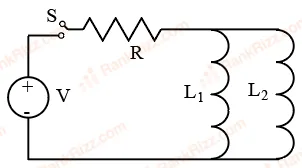
A source of constant voltage V is connected to a resistance R and two ideal inductors L1L_{1} and L2L_{2} through a switch as shown. There is no mutual inductance between the two inductors. The switch S is initially open. At = 0, the switch is closed and current begins to flow. Which of the following options is/are correct?

Figure for JEE Advanced 2017 Physics question on Self inductance and energy stored in inductors
  1. A

    After a long time, the current through L1L_{1} will be VRL2L1+L2\frac{V}{R}\frac{L_{2}}{L_{1}+L_{2}}

  2. B

    After a long time, the current through L2L_{2} will be VRL1L1+L2\frac{V}{R}\frac{L_{1}}{L_{1}+L_{2}}

  3. C

    The ratio of the currents through L1L_{1} and L2L_{2} is fixed at all times (t>0)(t>0)

  4. D

    At t=0, the current through the resistance R is VR\frac{V}{R}

Q13Rolling with friction, slipping and impulsive forces

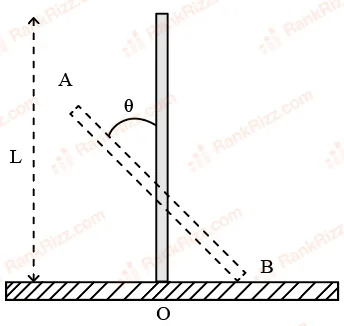
A rigid uniform bar AB of length L is slipping from its vertical position on a frictionless floor (as shown in the figure). At some instant of time, the angle made by the bar with the vertical is θ\theta Which of the following statements about its motion is/are correct?

Figure for JEE Advanced 2017 Physics question on Rolling with friction, slipping and impulsive forces
  1. A

    The midpoint of the bar will fall vertically downward

  2. B

    The trajectory of the point A is a parabola

  3. C

    Instantaneous torque about the point in contact with the floor is proportional to sin θsin\ \theta

  4. D

    When the bar makes an angle θ\theta with the vertical, the displacement of its midpoint from the initial position is proportional to (1−Cos θ)(1-Cos\ \theta)

Q14Equilibrium of rigid bodies and toppling

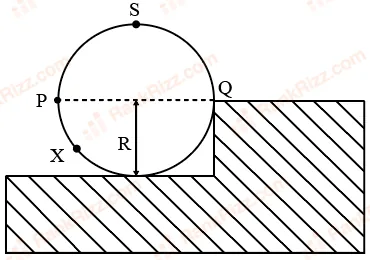
A wheel of radius R and mass M is placed at the bottom of a fixed step of height R as shown in the figure. A constant force is continuously applied on the surface of the wheel so that it just climbs the step without slipping. Consider the torque τ\tau about an axis normal to the plane of the paper passing through the point Q. Which of the following options is/are correct?

Figure for JEE Advanced 2017 Physics question on Equilibrium of rigid bodies and toppling
  1. A

    If the force is applied at point P tangentially then τ\tau decreases continuously as the wheel climbs

  2. B

    If the force is applied normal to the circumference at point X then τ\tau is constant

  3. C

    If the force is applied normal to the circumference at point P then τ\tau is zero

  4. D

    If the force is applied tangentially at point S then τ≠0\tau\neq0 but the wheel never climbs the step

Q15RC circuits: charging and discharging

In Process 1, the energy stored in the capacitor ECE_{C} and heat dissipated across resistance EDE_{D} are related by:

  1. A

    EC=EDE_{C}=E_{D}

  2. B

    EC=ED1n2E_{C}=E_{D}1n 2

  3. C

    EC=12EDE_{C}=\frac{1}{2}E_{D}

  4. D

    EC=2EDE_{C}=2E_{D}

Q16RC circuits: charging and discharging

In Process 2, total energy dissipated across the resistance EDE_{D} is:

  1. A

    ED=12CV02E_{D}=\frac{1}{2}CV_{0}^{2}

  2. B

    ED=3(12CV02)E_{D}=3(\frac{1}{2}CV_{0}^{2})

  3. C

    ED=13(12CV02)E_{D}=\frac{1}{3}(\frac{1}{2}CV_{0}^{2})

  4. D

    ED=3CV02E_{D}=3 CV_{0}^{2}

Q17Moment of inertia of standard bodies and composite systems

The total kinetic energy of the ring is

  1. A

    Mω02R2M\omega_{0}^{2}R^{2}

  2. B

    12Mω02(R−r)2\frac{1}{2}M\omega_{0}^{2}(R-r)^{2}

  3. C

    Mω02(R−r)2M\omega_{0}^{2}(R-r)^{2}

  4. D

    32Mω02(R−r)2\frac{3}{2}M\omega_{0}^{2}(R-r)^{2}

Q18Rolling with friction, slipping and impulsive forces

The minimum value of μ\mu below which the ring will drop down is

  1. A

    gμ(R−r)\sqrt{\frac{g}{\mu(R-r)}}

  2. B

    2gμ(R−r)\sqrt{\frac{2g}{\mu(R-r)}}

  3. C

    3g2μ(R−r)\sqrt{\frac{3g}{2\mu(R-r)}}

  4. D

    g2μ(R−r)\sqrt{\frac{g}{2\mu(R-r)}}

NEXT IN THIS PAPER →Chemistry, Q19 onwards