RankRizz

JEE Advanced 2017 Paper 1 Question Paper

All 54 questions of JEE Advanced 2017 Paper 1, in the order they were asked, one subject to a page. Pick an answer on any question to check it against the key. Free to read, nothing to download.

Questions

54

Physics · Chemistry · Maths

Answer key

54

questions with a checked key

Price

Free

no sign-up

Physics

Q1Ideal gas equation and gas laws

A flat plate is moving normal to its plane through a gas under the action of a constant force F. The gas is kept at a very low pressure. The speed of the plate v is much less than the average speed u of the gas molecules. Which of the following options is/are true?

  1. A

    The pressure difference between the leading and trailing faces of the plate is proportional to uv

  2. B

    The resistive force experienced by the plate is proportional to v

  3. C

    The plate will continue to move with constant non-zero acceleration, at all times

  4. D

    At a later time the external force F balances the resistive force
Q2Motion of centre of mass, momentum conservation and explosions

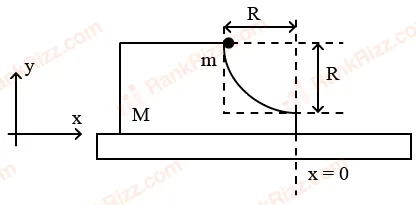
A block of mass M has a circular cut with a frictionless surface as shown. The block rests on the horizontal frictionless surface of a fixed table. Initially the right edge of the block is at x = 0, in a co-ordinate system fixed to the table. A point mass m is released from rest at the topmost point of the path as shown and it slides down. When the mass loses contact with the block, its position is x and the velocity is v. At that instant, which of the following options is/are correct?

Figure for JEE Advanced 2017 Physics question on Motion of centre of mass, momentum conservation and explosions
  1. A

    The position of the point mass m is: −2mRM+m-\sqrt{2} \frac{mR}{M + m}

  2. B

    The velocity of the point mass m is v=2gR1+mMv = \sqrt{\frac{2gR}{1 + \frac{m}{M}}}

  3. C

    The x component of displacement of the center of mass of the block M is: −mRM+m-\frac{mR}{M + m}

  4. D

    The velocity of the block M is: V=−mM2gRV = -\frac{m}{M}\sqrt{2gR}

Q3Progressive waves: wave equation, phase and intensity

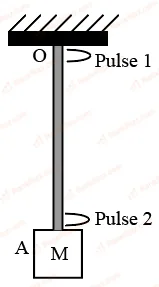
A block M hangs vertically at the bottom end of a uniform rope of constant mass per unit length. The top end of the rope is attached to a fixed rigid support at O. A transverse wave pulse (Pulse 1) of wavelength λ0\lambda_0 is produced at point O on the rope. The pulse takes time TOAT_{OA} to reach point A. If the wave pulse of wavelength λ0\lambda_0 is produced at point A (Pulse 2) without disturbing the position of M it takes time TOAT_{OA} to reach point O. Which of the following options is/are correct?

Figure for JEE Advanced 2017 Physics question on Progressive waves: wave equation, phase and intensity
  1. A

    The time TAO=TOAT_{AO} = T_{OA}

  2. B

    The velocities of the two pulses (Pulse 1 and Pulse 2) are the same at the midpoint of rope

  3. C

    The wavelength of Pulse 1 becomes longer when it reaches point A

  4. D

    The velocity of any pulse along the rope is independent of its frequency and wavelength

Q4Thermal radiation: Stefan's law, Wien's law and Kirchhoff's law

A human body has a surface area of approximately 1 m2m^2. The normal body temperature is 10 K above the surrounding room temperature T0T_0. Take the room temperature to be T0=300KT_0 = 300 K. For T0=300KT_0 = 300 K, the value of σT04=460Wm−2\sigma T_0^4 = 460 Wm^{-2} (where σ\sigma is the Stefan-Boltzmann constant). Which of the following options is/are correct?

  1. A

    The amount of energy radiated by the body in 1 second is close to 60 Joules

  2. B

    If the surrounding temperature reduces by a small amount △T0≪T0\triangle T_0 \ll T_0, then to maintain the same body temperature the same (living) human being needs to radiate △W=4σT03△T0\triangle W = 4 \sigma T_0^3 \triangle T_0 more energy per unit time

  3. C

    Reducing the exposed surface area of the body (e.g. by curling up) allows humans to maintain the same body temperature while reducing the energy lost by radiation

  4. D

    If the body temperature rises significantly then the peak in the spectrum of electromagnetic radiation emitted by the body would shift to longer wavelengths

Q5Magnetic flux, Faraday's law and Lenz's law

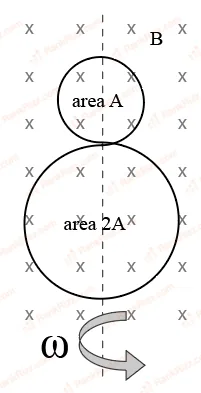
A circular insulated copper wire loop is twisted to form two loops of area 𝐴 and 2𝐴 as shown in the figure. At the point of crossing the wires remain electrically insulated from each other. The entire loop lies in the plane (of the paper). A uniform magnetic field 𝐵 points into the plane of the paper. At 𝑡 = 0, the loop starts rotating about the common diameter as axis with a constant angular velocity ω in the magnetic field. Which of the following options is/are correct?

Figure for JEE Advanced 2017 Physics question on Magnetic flux, Faraday's law and Lenz's law
  1. A

    The emf induced in the loop is proportional to the sum of the areas of the two loops

  2. B

    The amplitude of the maximum net emf induced due to both the loops is equal to the amplitude of maximum emf induced in the smaller loop alone

  3. C

    The net emf induced due to both the loops is proportional to cos⁡ωt\cos \omega t

  4. D

    The rate of change of the flux is maximum when the plane of the loops is perpendicular to plane of the paper

Q6AC basics: rms and average values, phasors

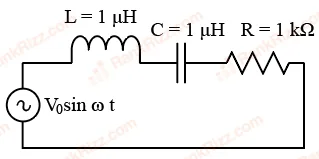
In the circuit shown, L=1μH,C=1μFL = 1 \mu H, C = 1 \mu F and R=1kΩ.R = 1 kΩ. They are connected in series with an a.c. source V=V0sin⁡ωtV = V_0 \sin \omega t as shown. Which of the following options is/are correct?

Figure for JEE Advanced 2017 Physics question on AC basics: rms and average values, phasors
  1. A

    The current will be in phase with the voltage if ω=104rad.s−1\omega = 10^4 rad. s^{-1}

  2. B

    The frequency at which the current will be in phase with the voltage is independent of 𝑅

  3. C

    At ω∼0\omega \sim 0 the current flowing through the circuit becomes nearly zero

  4. D

    At ω≫106rad.s−1\omega \gg 10^6 rad. s^{-1}, the circuit behaves like a capacitor

Q7Prism: deviation and dispersion

For an isosceles prism of angle 𝐴 and refractive index μ\mu, it is found that the angle of minimum deviation δm=A\delta_m = A. Which of the following options is/are correct?

  1. A

    For the angle of incidence i1=Ai_1 = A, the ray inside the prism is parallel to the base of the prism

  2. B

    For this prism, the refractive index μ\mu and the angle of prism 𝐴 are related as A=12cos⁡−1(μ2)A = \frac{1}{2} \cos^{-1}\left(\frac{\mu}{2}\right)

  3. C

    At minimum deviation, the incident angle i1i_1 and the refracting angle r1r_1 at the first refracting surface are related by r1=(i1/2)r_1 = (i_1/2)

  4. D

    For this prism, the emergent ray at the second surface will be tangential to the surface when the angle of incidence at the first surface is i1=sin⁡−1[sin⁡A4cos⁡2A2−1−cos⁡A]i_1 = \sin^{-1} \left[\sin A \sqrt{4 \cos^2 \frac{A}{2} - 1} - \cos A\right]

Q8Surface tension and surface energy

A drop of liquid of radius R=10−2mR = 10^{-2} m having surface tension S=0.14πNm−1S = \frac{0.1}{4 \pi} Nm^{-1} divides itself into 𝐾 identical drops. In this process the total change in the surface energy △U=10−3J\triangle U = 10^{-3} J. If K=10αK = 10^\alpha then the value of α\alpha is

Q9Hydrogen spectrum and spectral series

An electron in a hydrogen atom undergoes a transition from an orbit with quantum number nin_i to another with quantum number nfn_f. ViV_i and VfV_f are respectively the initial and final potential energies of the electron. If ViVf=6.25\frac{V_i}{V_f} = 6.25, then the smallest possible nfn_f is

Q10Prism: deviation and dispersion

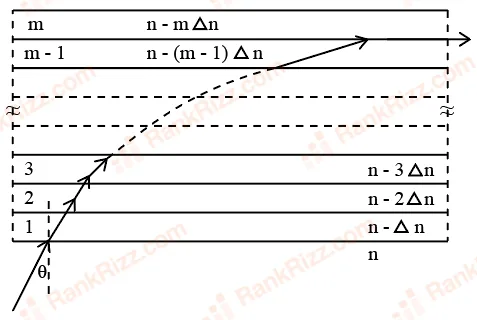
A monochromatic light is travelling in a medium of refractive index n = 1.6. It enters a stack of glass layers from the bottom side at an angle θ=30∘\theta = 30^\circ. The interfaces of the glass layers are parallel to each other. The refractive indices of different glass layers are monotonically decreasing as nm=n−m△nn_m = n - m \triangle n, where nmn_m is the refractive index of the mthm^{th} slab and △n=0.1\triangle n = 0.1 (see the figure) The ray is refracted out parallel to the interface between the (m−1)th(m - 1)^{th} and mthm^{th} slabs from the right side of the stack. What is the value of m?

Figure for JEE Advanced 2017 Physics question on Prism: deviation and dispersion
Q11Doppler effect in sound

A stationary source emits sound of frequency f0=492Hzf_0 = 492 Hz. The sound is reflected by a large car approaching the source with a speed of 2ms−12 ms^{-1}. The reflected signal is received by the source and superposed with the original. What will be the beat frequency of the resulting signal in Hz? (Given that the speed of sound in air is 330ms−1330 ms^{-1} and the car reflects the sound at the frequency it has received).

Q12Radioactivity: decay law, half-life and decay modes

131I^{131}I is an isotope of Iodine that β\beta decays to an isotope of Xenon with a half-life of 8 days. A small amount of a serum labelled with 131I^{131}I is injected into the blood of a person. The activity of the amount of 131I^{131}I injected was 2.4×1052.4 \times 10^5 Becquerel (Bq). It is known that the
injected serum will get distributed uniformly in the blood stream in less than half an hour. After 11.5 hours, 2.5 ml of blood is drawn from the person’s body, and gives an activity of 115 Bq. The total volume of blood in the person’s body, in liters is approximately (you may use ex≈1+xe^x \approx 1 + x for ∣x∣≪1\mid x \mid \ll 1 and ln⁡2≈0.7\ln 2 \approx 0.7).

Q13Motion of charged particles in a magnetic field

In which case will the particle move in a straight line with constant velocity?

  1. A

    (III) (ii) (R)

  2. B

    (IV) (i) (S)

  3. C

    (III) (iii) (P)

  4. D

    (II) (iii) (S)

Q14Motion of charged particles in a magnetic field

In which case will the particle describe a helical path with axis along the positive z direction?

  1. A

    (IV) (i) (S)

  2. B

    (II) (ii) (R)

  3. C

    (III) (iii) (P)

  4. D

    (IV) (ii) (R)

Q15Motion of charged particles in a magnetic field

In which case would the particle move in a straight line along the negative direction of y-axis (i.e., move along −y^-\hat{y})?

  1. A

    (II) (iii) (Q)

  2. B

    (III) (ii) (R)

  3. C

    (IV) (ii) (S)

  4. D

    (III) (ii) (P)

Q16Zeroth and first law of thermodynamics

Which of the following options is the only correct representation of a process in which △U=△Q−P△V\triangle U = \triangle Q - P \triangle V?

  1. A

    (II) (iv) (R)

  2. B

    (III) (iii) (P)

  3. C

    (II) (iii) (S)

  4. D

    (II) (iii) (P)

Q17Multi-step processes and gas-piston-spring systems

Which one of the following options is the correct combination?

  1. A

    (IV) (ii) (S)

  2. B

    (III) (ii) (S)

  3. C

    (II) (iv) (P)

  4. D

    (II) (iv) (R)

Q18Zeroth and first law of thermodynamics

Which one of the following options correctly represents a thermodynamic process that is used as a correction in the determination of the speed of sound in an ideal gas?

  1. A

    (I) (ii) (Q)

  2. B

    (IV) (ii) (R)

  3. C

    (III) (iv) (R)

  4. D

    (I) (iv) (Q)

NEXT IN THIS PAPER →Chemistry, Q19 onwards