RankRizz

JEE Advanced 2016 Paper 1 Question Paper

All 54 questions of JEE Advanced 2016 Paper 1, in the order they were asked, one subject to a page. Pick an answer on any question to check it against the key. Free to read, nothing to download.

Questions

54

Physics · Chemistry · Maths

Answer key

54

questions with a checked key

Price

Free

no sign-up

Physics

Q1Photoelectric effect and Einstein's equation

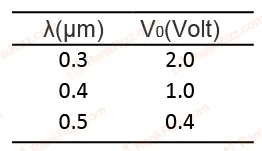
In a historical experiment to determine Planck’s constant, a metal surface was irradiated with light of different wavelengths. The emitted photo electron energies were measured by applying a stopping potential. The relevant data for the wavelength (λ\lambda) of incident light and the corresponding stopping potential (V0V_0) are given below :

Figure for JEE Advanced 2016 Physics question on Photoelectric effect and Einstein's equation

Given that c=3×10⁸ms−1c = 3 \times 10^8 ms^{-1} and e=1.6×10⁻¹⁹Ce = 1.6 \times 10^{-19} C, Planck’s constant (in units of J s) found from such an experiment is

  1. A

    6.0×10−346.0 \times 10^{-34}

  2. B

    6.4×10−346.4 \times 10^{-34}

  3. C

    6.6×10−346.6 \times 10^{-34}

  4. D

    6.8×10−346.8 \times 10^{-34}

Q2Equilibrium of rigid bodies and toppling

A uniform wooden stick of mass 1.6 kg and length / rests in an inclined manneron a smooth, vertical wall of height A(</) such that a small portion of the stick extends beyond the wall. The reaction force of the wall on the stick is perpendicular to the stick. The stick makes an angle of 30∘30^\circ with the wall and the bottom of the stick is on a roughfloor. The reaction of the wall on the stick is equal in magnitudeto the reaction of the floor on the stick. The ratio h/l and thefrictional force f at the bottom of the stick are (g = 10 ms2^2)

  1. A

    hl=316,f=1633N\frac{h}{l} = \frac{\sqrt{3}}{16}, f = \frac{16\sqrt{3}}{3} N

  2. B

    hl=316,f=1633N\frac{h}{l} = \frac{3}{16}, f = \frac{16\sqrt{3}}{3} N

  3. C

    hl=3316,f=833N\frac{h}{l} = \frac{3\sqrt{3}}{16}, f = \frac{8\sqrt{3}}{3} N

  4. D

    hl=3316,f=1633N\frac{h}{l} = \frac{3\sqrt{3}}{16}, f = \frac{16\sqrt{3}}{3} N

Q3Multi-step processes and gas-piston-spring systems

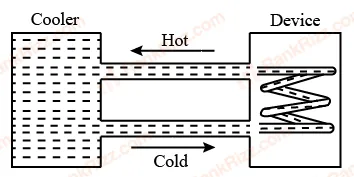
A water cooler of storage capacity 120 litres can cool water at a constant rate of P watts. In a closed circulation system (as shown schematically in the figure), the water from the cooler is used to cool an external device that generates constantly 3 kW of heat (thermal load). The temperature of water fed into the device cannot exceed 30∘C30^\circ C and the entire stored 120 litres of water is initially cooled to 10∘C10^\circ C. The entire system is thermally insulated. The minimum value of P (in watts) for which the device can be operated for 3 hours is

Figure for JEE Advanced 2016 Physics question on Multi-step processes and gas-piston-spring systems

(Specific heat of water is 4.2 KJ kg−1^{-1} K−1^{-1} and the density of water is 1000 kg m−3^{-3})

  1. A

    1600

  2. B

    2067

  3. C

    2533

  4. D

    3933

Q4Prism: deviation and dispersion

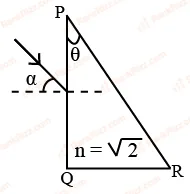
A parallel beam of light is incident from air at an angle a on the side PQ of a right angled triangular prism of refractive index n=2n = \sqrt{2}. Light undergoes total internal reflection in the prism at the face PR when a has a minimum value of 45∘45^\circ. The angle θ\theta of the prism is

Figure for JEE Advanced 2016 Physics question on Prism: deviation and dispersion
  1. A

    15∘15^\circ

  2. B

    22.5∘22.5^\circ

  3. C

    30∘30^\circ

  4. D

    45∘45^\circ

Q5Ohm's law, resistance, resistivity and colour code

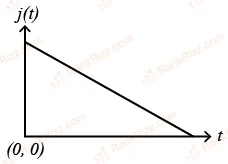
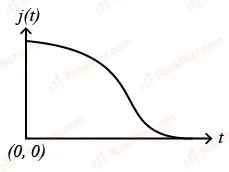
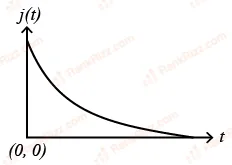
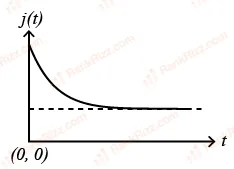
An infinite line charge of uniform electric charge density λ\lambda lies along the axis of an electrically conducting infinite cylindrical shell of radius R. At time t = 0, the space inside the cylinder is filled with a material of permittivity ε and electrical conductivity σ\sigma. The electrical conduction in the material follows Ohm’s law. Which one of the following graphs best describes the subsequent variation of the magnitude of current density j(t) at any point in the material?

  1. A
    Figure for JEE Advanced 2016 Physics question on Ohm's law, resistance, resistivity and colour code
  2. B
    Figure for JEE Advanced 2016 Physics question on Ohm's law, resistance, resistivity and colour code
  3. C
    Figure for JEE Advanced 2016 Physics question on Ohm's law, resistance, resistivity and colour code
  4. D
    Figure for JEE Advanced 2016 Physics question on Ohm's law, resistance, resistivity and colour code
Q6Hydrogen spectrum and spectral series

Highly excited states for hydrogen-like atoms (also called Rydberg states) with nuclear charge Ze are defined by their principal quantum number n, where n >> 1. Which of the
following statement(s) is(are) true?

  1. A

    Relative change in the radii of two consecutive orbitals does not depend on Z

  2. B

    Relative change in the radii of two consecutive orbitals varies as 1n\frac{1}{n}

  3. C

    Relative change in the energy of two consecutive orbitals varies as 1n3\frac{1}{n^3}

  4. D

    Relative change in the angular momenta of two consecutive orbitals varies as 1n\frac{1}{n}

Q7Doppler effect in sound

Two loudspeakers M and WN are located 20 m apart and emit sound at frequencies 118 Hz and 121 Hz, respectively. A caris initially at a point P , 1800 m away from the midpoint Q
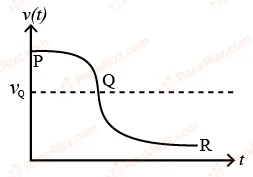
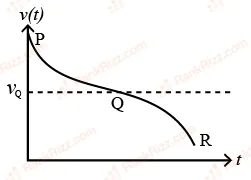
of the line MN and moves towards @ constantly at 60 km/hr along the perpendicular bisector of MN. It crosses Q and eventually reaches a point R, 1800 m away from Q. Let v(t) represent the beat frequency measured by a person sitting in the car at time t. Let VP,VQV_P, V_Q and VRV_R be the beat frequencies measured at locations P, Q and R, respectively. The speed of sound in air is 330 ms−1^{-1} Which of the following statement(s) is(are) true regarding the sound heard bythe person?

  1. A

    VP+VR=2VQV_P + V_R = 2V_Q

  2. B

    The rate of change in beat frequency is maximum when thecar passes through Q

  3. C

    The plot below represents schematically the variation of beat frequency with time

    Figure for JEE Advanced 2016 Physics question on Doppler effect in sound
  4. D

    The plot below represents schematically the variation of beat frequency with time t

    Figure for JEE Advanced 2016 Physics question on Doppler effect in sound
Q8Electric power and heating effect of current

An incandescent bulb has a thin filament of tungsten that is heated to high temperature by passing an electric current. The hot filament emits black-body radiation. The filament is observed to break up at randomlocations after a sufficiently long time of operation due to non-uniform evaporation of tungsten from the filament. If the bulb is powered at constant voltage, which of the following statement(s) is(are) true?

  1. A

    The temperature distribution overthe filament is uniform

  2. B

    The resistance over small sections of the filament decreases with time

  3. C

    The filament emits morelight at higher band of frequencies before it breaks up

  4. D

    The filament consumesless electrical power towards the end ofthe life of the bulb

Q9Combinations of lenses and mirrors

A plano-convex lens is made ofa material of refractive index n. When a smallobject is placed 30 cm awayin front of the curved surface of the lens, an image of double the size of the object is produced. Dueto reflection from the convex surface of the lens, another faint image is observed at a distance of 10 cm away from the lens. Which of the following statement(s)
is(are) true?

  1. A

    The refractive index of the lens is 2.5

  2. B

    The radius of curvature of the convex surface is 45 cm

  3. C

    The faint image is erect and real

  4. D

    The focal length of the lens is 20 cm

Q10Dimensional analysis: deriving and checking relations

A length-scale (J) depends on the permittivity (εε) of a dielectric material, Boltzmann constant (kBk_B), the absolute temperature (T), the number per unit volume (n) of certain charged particles, and the charge (q) carried by each of the particles. Which of the following expression(s) for l is(are) dimensionally correct?

  1. A

    l=(nq2εkBT)l = \sqrt{\left(\frac{nq^2}{ε k_B T}\right)}

  2. B

    l=(εkBTnq2)l = \sqrt{\left(\frac{ε k_B T}{nq^2}\right)}

  3. C

    l=(q2εn23kBT)l = \sqrt{\left(\frac{q^2}{ε n^{\frac{2}{3}} k_B T}\right)}

  4. D

    l=(q2εn13kBT)l = \sqrt{\left(\frac{q^2}{ε n^{\frac{1}{3}} k_B T}\right)}

Q11Self inductance and energy stored in inductors

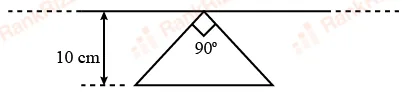
A conducting loop in the shape of a right angled isosceles triangle of height 10 cm is kept such that the 90∘90^\circ vertex is very close to an infinitely long conducting wire (see the figure). The wire is electrically insulated from the loop. The hypotenuse of the triangle is parallel to the wire. The current in the triangular loop is in counter clockwise direction and increased at a constant rate of 10 As−1^{-1}. Which of the following statement(s) is(are) true?

Figure for JEE Advanced 2016 Physics question on Self inductance and energy stored in inductors
  1. A

    The magnitude of induced emf in the wire is (μ0π)\left(\frac{\mu_0}{\pi}\right) volt

  2. B

    If the loop is rotated at a constant angular speed about the wire, an additional emf of (μ0π)\left(\frac{\mu_0}{\pi}\right) volt is induced in the wire

  3. C

    The induced current in the wire is in opposite direction to the current along the hypotenuse

  4. D

    There is a repulsive force between the wire and the loop

Q12Angular momentum of particles and rigid bodies

The position vector r→\overrightarrow{r} of a particle of mass m is given by the following equation 

r→(t)=αt3i^+βt2j^\overrightarrow{r}(t) = \alpha t^3 \hat{i} + \beta t^2 \hat{j}
where α=103ms−3,β=5ms−2\alpha = \frac{10}{3} ms^{-3}, \beta = 5 ms^{-2} and m=0.1 kg. At t=1 s, which of the following statement(s) is(are) true about the particle?

  1. A

    The velocity U→\overrightarrow{U} is given by U→=(10i^+10j^)ms−1\overrightarrow{U} = (10 \hat{i} + 10 \hat{j}) ms^{-1}

  2. B

    The angular momentum L→\overrightarrow{L} with respect to the origin is given by L→=−(53)k^Nms\overrightarrow{L} = - \left(\frac{5}{3}\right) \hat{k} N ms

  3. C

    The force F→\overrightarrow{F} is given by F→=(i^+2j^)N\overrightarrow{F} = (\hat{i} + 2 \hat{j}) N

  4. D

    The torque τ→\overrightarrow{\tau} with respect to the origin is given by τ→=(203)k^Nm\overrightarrow{\tau} = \left(\frac{20}{3}\right) \hat{k} Nm

Q13Prism: deviation and dispersion

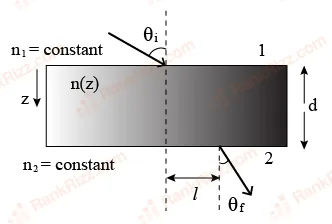
A transparent slab of thickness d has a refractive index n(z) that increases with z. Here z is the vertical distance inside the slab, measured from the top. The slab is placed between two media with uniform refractive indices n1n_1 and n2(>n1)n_2(> n_1), as shown in the figure. A ray of light is incident with angle θi\theta_i from medium 1 and emerges in medium 2 with refraction angle θf\theta_f, with a lateral displacement l.

Figure for JEE Advanced 2016 Physics question on Prism: deviation and dispersion

Which of the following statement(s) is(are) true?

  1. A

    n1sin⁡θi=n2sin⁡θfn_1 \sin \theta_i = n_2 \sin \theta_f

  2. B

    n1sin⁡θi=(n2−n1)sin⁡θfn_1 \sin \theta_i = (n_2 - n_1) \sin \theta_f

  3. C

    l is independentof n2n_2

  4. D

    l is dependenton n(z)

Q14Thermal radiation: Stefan's law, Wien's law and Kirchhoff's law

A metal is heated in a furnace where a sensor is kept above the metal surface to read the power radiated (P) by the metal. The sensor hasa scale that displays log, (PP0)\left(\frac{P}{P_0}\right), where P0P_0 is a constant. When the metal surface is at a temperature of 487∘C487^\circ C, the sensor shows a value 1. Assume that the emissivity of the metallic surface remains constant. What is the value displayed by the sensor when the temperature of the metal surface is raised to 2767∘C2767^\circ C?

Q15Nuclear fission, fusion and Q-value

The isotope 512B_{5}^{12}B having a mass 12.014 u undergoes β\beta- decay to 612C_{6}^{12}C, 612C_{6}^{12}C has an excited state of the nucleus (612C∗_{6}^{12}C^*) at 4.041 MeV above its ground state. If 512B_{5}^{12}B decays to 612C∗_{6}^{12}C^*, the maximumkinetic energy of the β\beta- particle in units of MeV is
(1 u = 931.5 MeV/c2^2, where c is the speed of light in vacuum).

Q16Hydrogen spectrum and spectral series

A hydrogen atom in its ground state is irradiated by light of wavelength 970 A. Taking hc/e=1.237×10−6eVhc/e = 1.237 \times 10^{-6} eV m and the ground state energy of hydrogen atom as —13.6 eV, the numberof lines present in the emission spectrum is

Q17Equation of continuity and Bernoulli's theorem

Consider two solid spheres P and Q each of density 8 gm cm−3^{-3} and diameters 1 cm and 0.5 cm, respectively. Sphere P is dropped into a liquid of density 0.8 gm cm−3^{-3} and viscosity η=3\eta = 3 poiseulles. Sphere Q is dropped into a liquid of density 1.6 gm cm−3^{-3} and viscosity η=2\eta = 2 poiseulles. The ratio of the terminal velocities of P and Q is

Q18Self inductance and energy stored in inductors

Two inductors L1L_1(inductance 1 mH, internal resistance 3 Ω) and L2L_2 (inductance 2 mH, internal resistance 4 Ω), and a resistor R (resistance 12 Ω) are all connected in parallel across a 5 V battery. The circuit is switched on at time ¢=0. The ratio of the maximum to the minimum current (ImaxImin)\left(\frac{I_{max}}{I_{min}}\right) drawn from the battery is

NEXT IN THIS PAPER →Chemistry, Q19 onwards