JEE ADVANCED 2016 · PAPER 1+4 / −2HARD
JEE Advanced 2016 Physics question — Self inductance and energy stored in inductors
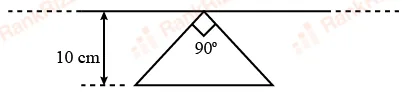
A conducting loop in the shape of a right angled isosceles triangle of height 10 cm is kept such that the vertex is very close to an infinitely long conducting wire (see the figure). The wire is electrically insulated from the loop. The hypotenuse of the triangle is parallel to the wire. The current in the triangular loop is in counter clockwise direction and increased at a constant rate of 10 As. Which of the following statement(s) is(are) true?
SOLUTION
Key idea: The emf induced in the wire is , where the mutual inductance comes from the wire's flux through the triangle. Lenz's law gives the direction.
- Take as the distance from the wire. For an isosceles right triangle with its right-angle vertex at the wire, the strip at distance has width .
- emf in the wire V. So (A) is true.
- Rotating the loop about the wire leaves its geometry relative to the wire unchanged. stays the same, so there is no extra emf, and (B) is false.
- The loop current is anticlockwise and its field inside the loop points out of the page. To oppose the growing flux, the induced current in the wire must make a field into the page below it, which means the wire current runs left to right. The current in the hypotenuse (bottom side of an anticlockwise loop) also runs left to right, so the two are in the same direction and (C) is false.
- The slanted sides are closest to the wire, and their current components run opposite to the wire current. Opposite currents repel, so the net force is repulsive, as Lenz's law expects. (D) is true.
Answer: (A), (D)
Topic: Self inductance and energy stored in inductors