RankRizz

JEE Advanced 2014 Paper 2 Question Paper

All 60 questions of JEE Advanced 2014 Paper 2, in the order they were asked, one subject to a page. Pick an answer on any question to check it against the key. Free to read, nothing to download.

Questions

60

Physics · Chemistry · Maths

Answer key

60

questions with a checked key

Price

Free

no sign-up

Physics

Q1Potential energy, conservative forces and energy curves

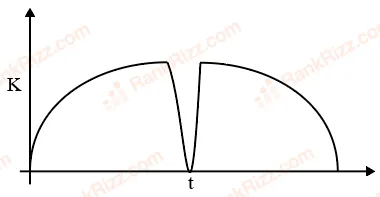
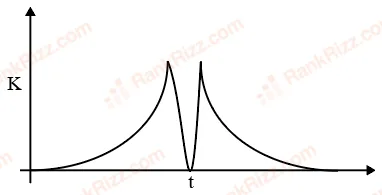
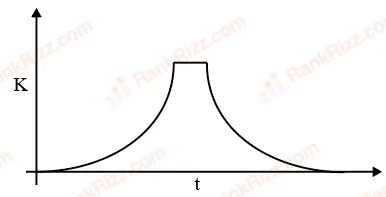
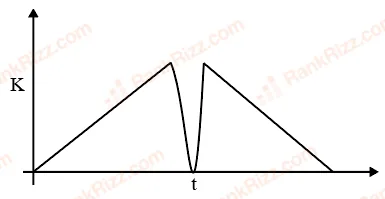
A tennis ball is dropped on a horizontal smooth surface. It bounces back to its original position after hitting the surface. The force on the ball during the collision is proportional to the length of compression of the ball. Which one of the following sketches describes the variation of its kinetic energy K with time t most appropriately? The figures are only illustrative and not to the scale.

  1. A
    Figure for JEE Advanced 2014 Physics question on Potential energy, conservative forces and energy curves
  2. B
    Figure for JEE Advanced 2014 Physics question on Potential energy, conservative forces and energy curves
  3. C
    Figure for JEE Advanced 2014 Physics question on Potential energy, conservative forces and energy curves
  4. D
    Figure for JEE Advanced 2014 Physics question on Potential energy, conservative forces and energy curves
Q2Newton's laws, free-body diagrams and equilibrium of a particle

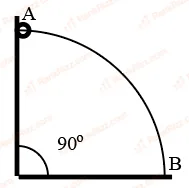
A wire, which passes through the hole in a small bead, is bent in the form of quarter of a circle. The wire is fixed vertically on ground as shown in the figure. The bead is released from near the top of the wire and it slides along the wire without friction. As the bead moves from A to B, the force it applies on the wire is

Figure for JEE Advanced 2014 Physics question on Newton's laws, free-body diagrams and equilibrium of a particle
  1. A

    always radially outwards.

  2. B

    always radially inwards

  3. C

    radially outwards initially and radially inwards later.

  4. D

    radially inwards initially and radially outwards later.

Q3Meter bridge

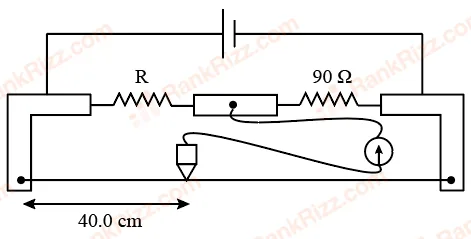
During an experiment with ametre bridge, the galvanometer shows a null point when the jockey is pressed at 40.0 cm using a standard resistance of 90Ω90 Ω,as shown in the figure. The least count of the scale used in the metre bridge is 1 mm. The unknown resistance is

Figure for JEE Advanced 2014 Physics question on Meter bridge
  1. A

    60±0.15Ω60 \pm 0.15Ω

  2. B

    135±0.56Ω135 \pm 0.56Ω

  3. C

    60±0.25Ω60 \pm 0.25Ω

  4. D

    135±0.23Ω135 \pm 0.23Ω

Q4Electric field of continuous charge distributions

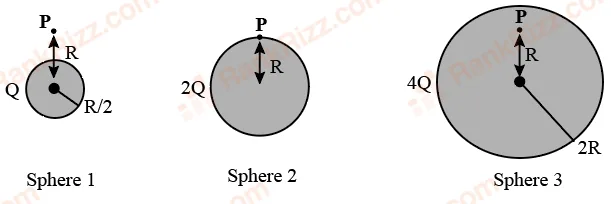
Charges Q, 2Q and 4Q are uniformly distributed in three dielectric solid spheres 1, 2 and 3 of radii R/2, R and 2R, respectively, as shown in figure. If magnitudes of the electric fields at point P at a distance R from the center of spheres 1, 2 and 3 are E1,E2E_1 , E_2 and E3E_3 respectively, then

Figure for JEE Advanced 2014 Physics question on Electric field of continuous charge distributions
  1. A

    E1>E2>E3E_1 > E_2 > E_3

  2. B

    E3>E1>E2E_3 > E_1 > E_2

  3. C

    E2>E1>E3E_2 > E_1 > E_3

  4. D

    E3>E2>E1E_3 > E_2 > E_1

Q5Prism: deviation and dispersion

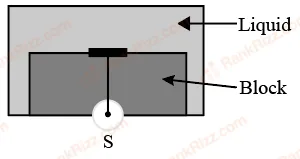
A point source S is placed at the bottom of a transparent block of height 10 mm and refractive index 2.72. It is immersed in a lower refractive index liquid as shown in the figure. It is found that the light emerging from the block to the liquid forms a circular bright spot of diameter 11.54 mm on the top of the block. The refractive index of the liquid is

Figure for JEE Advanced 2014 Physics question on Prism: deviation and dispersion
  1. A

    1.21

  2. B

    1.30

  3. C

    1.36

  4. D

    1.42

Q6Thermal radiation: Stefan's law, Wien's law and Kirchhoff's law

Parallel rays of light of intensity I=912Wm−2I = 912 Wm^{-2} are incident on a spherical black body kept in surroundings of temperature 300 K. Take Stefan-Boltzmann constant σ=5.7×10⁻⁸Wm−2K−4\sigma = 5.7 \times 10^{-8} Wm^{-2} K^{-4} and assume that the energy exchange with the surroundingsis only through radiation. The final steady state temperature of the black body is close to

  1. A

    330 K

  2. B

    660 K

  3. C

    990 K

  4. D

    1550 K

Q7Photoelectric effect and Einstein's equation

A metal surface is illuminated by light of two different wavelengths 248 nm and 310 nm. The maximum speeds of the photoelectrons corresponding to these wavelengths are u1u_1 and u2u_2,respectively. If the ratio u1:u2=2:1u_1 : u_2 = 2 : 1 and hc = 1240 eV nm, the work function of the metal is nearly

  1. A

    3.7 eV

  2. B

    3.2 eV

  3. C

    2.8 eV

  4. D

    2.5 eV

Q8X-rays: continuous and characteristic spectra, Moseley's law

If λCu\lambda_{Cu} is the wavelength of KαK_{\alpha} X-ray line of copper (atomic number 29) and λMo\lambda_{Mo} is the wavelength of the KαK_{\alpha} X-ray line of molybdenum (atomic number 42), then the ratio λCuλMo\frac{\lambda_{Cu}}{\lambda_{Mo}}is close to

  1. A

    1.99

  2. B

    2.14

  3. C

    0.50

  4. D

    0.48

Q9Acceleration due to gravity and its variation

A planet of radius R=110×R = \frac{1}{10} \times (radius of Earth) has the same mass density as Earth. Scientists dig a well of depth R5\frac{R}{5} on it and lower a wire of the same length and of linear mass density 10−3kgm−110^{-3} kgm{-1} into it. If the wire is not touching anywhere, the force applied at the top of the wire by a person holding it in place is (take the radius of Earth =6×10⁶m= 6 \times 10^6 m and the acceleration due to gravity on Earth is 10ms−210 ms^{-2})

  1. A

    96 N

  2. B

    108 N

  3. C

    120 N

  4. D

    150 N

Q10Surface tension and surface energy

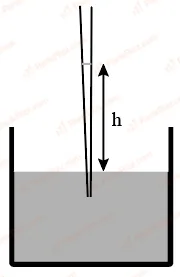
A glass capillary tube is of the shape of a truncated cone with an apex angle α\alpha so that its two ends have cross sections of different radii. When dipped in water vertically, water rises in it to a height h, where the radius of its cross section is b. If the surface tension of water is S, its density is ρ\rho, and its contact angle with glass is θ\theta, the value of h will be (g is the acceleration due to gravity)

Figure for JEE Advanced 2014 Physics question on Surface tension and surface energy
  1. A

    2Sbpgcos⁡(θ−α)\frac{2S}{bpg} \cos (\theta - \alpha)

  2. B

    2Sbpgcos⁡(θ+α)\frac{2S}{bpg} \cos (\theta + \alpha)

  3. C

    2Sbpgcos⁡(θ−α2)\frac{2S}{bpg} \cos \left(\theta - {\frac{\alpha}{2}}\right)

  4. D

    2Sbpgcos⁡(θ+α2)\frac{2S}{bpg} \cos \left(\theta + {\frac{\alpha}{2}}\right)

Q11Zeroth and first law of thermodynamics

Consider the partition to be rigidly fixed so that it does not move. When equilibrium is achieved, the final temperature of the gases will be

  1. A

    550 K

  2. B

    525 K

  3. C

    513 K

  4. D

    490 K

Q12Multi-step processes and gas-piston-spring systems

Now consider the partition to be free to move without friction so that the pressure of gases in both compartments is the same. Then total work done by the gases till the time they achieve equilibrium will be

  1. A

    250 R

  2. B

    200 R

  3. C

    100 R

  4. D

    -100 R

Q13Equation of continuity and Bernoulli's theorem

If the piston is pushed at a speed of 5mms−15 mms^{-1}, the air comes out of the nozzle with a speed of

  1. A

    0.1ms−10.1 ms^{-1}

  2. B

    1ms−11 ms^{-1}

  3. C

    2ms−12 ms^{-1}

  4. D

    8ms−18 ms^{-1}

Q14Equation of continuity and Bernoulli's theorem

If the density of air is ρa\rho_a and that of the liquid ρl\rho_l, then for a given piston speed the rate (volume per unit time) at which the liquid is sprayed will be proportional to

  1. A

    ρaρl\sqrt{\frac{\rho_a}{\rho_l}}

  2. B

    ρaρl\sqrt{{\rho_a}{\rho_l}}

  3. C

    ρlρa\sqrt{\frac{\rho_l}{\rho_a}}

  4. D

    ρl\rho_l

Q15Magnetic field of circular loops, arcs and coils

When d≈ad \approx a but wires are not touching the loop, it is found that the net magnetic field on the axis of the loop is zero at a height h above the loop. In that case

  1. A

    current in wire 1 and wire 2 is the direction PQ and RS, respectively and h≈ah \approx a

  2. B

    current in wire 1 and wire 2 is the direction PQ and SR, respectively and h≈ah \approx a

  3. C

    current in wire 1 and wire 2 is the direction PQ and SR, respectively and h≈1.2ah \approx 1.2a

  4. D

    current in wire 1 and wire 2 is the direction PQ and RS, respectively and h≈1.2ah \approx 1.2a

Q16Force on current-carrying conductors and between parallel wires

Consider d≫ad \gg a, and the loop is rotated about its diameter parallel to the wires by 30∘30^\circ from the position shown in the figure. If the currents in the wires are in the opposite directions, the torque on the loop at its new position will be (assume that the net field due to the wires is constant over the loop)

  1. A

    μ0I2a2d\frac{\mu_0 I^2a^2}{d}

  2. B

    μ0I2a22d\frac{\mu_0 I^2a^2}{2d}

  3. C

    3μ0I2a2d\frac{\sqrt 3 \mu_0 I^2a^2}{d}

  4. D

    3μ0I2a22d\frac{\sqrt 3 \mu_0 I^2a^2}{2d}

Q17Electric field of continuous charge distributions

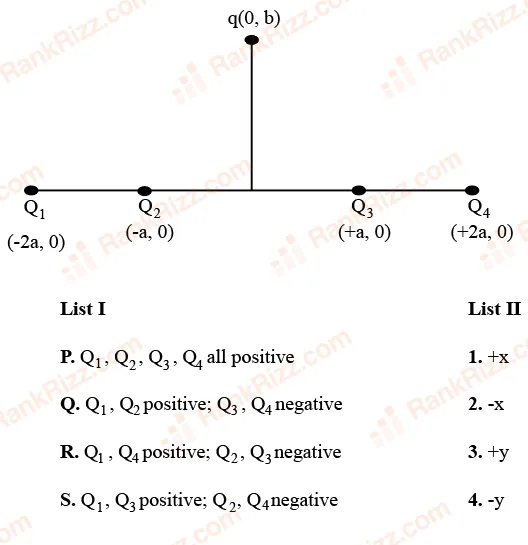
Four charges Q1,Q2,Q3Q_1, Q_2, Q_3 and Q4Q_4 of same magnitude are fixed along the x axis at x = −2a, −a, +a and +2a, respectively. A positive charge q is placed on the positive y axis at a distance b > 0. Four options of the signs of these charges are given in List I. The direction of the forces on the charge q is given in List II. Match List I with List II and select the correct answer using the code given below the lists.

Figure for JEE Advanced 2014 Physics question on Electric field of continuous charge distributions
  1. A

    P-3, Q-1, R-4, S-2

  2. B

    P-4, Q-2, R-3, S-1

  3. C

    P-3, Q-1, R-2, S-4

  4. D

    P-4, Q-2, R-1, S-3

Q18Combinations of lenses and mirrors

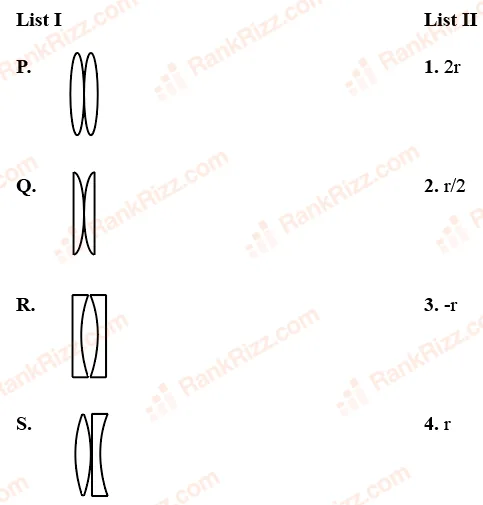
Four combinations of two thin lenses are given in List I. The radius of curvature of all curved surfaces is r and the refractive index of all the lenses is 1.5. Match lens combinations in List I with their focal length in List II and select the correct answer using the code given below the lists.

Figure for JEE Advanced 2014 Physics question on Combinations of lenses and mirrors


Choices:

  1. A

    P-1, Q-2, R-3, S-4

  2. B

    P-2, Q-4, R-3, S-1

  3. C

    P-4, Q-1, R-2, S-3

  4. D

    P-2, Q-1, R-3, S-4

Q19Friction in multi-block systems

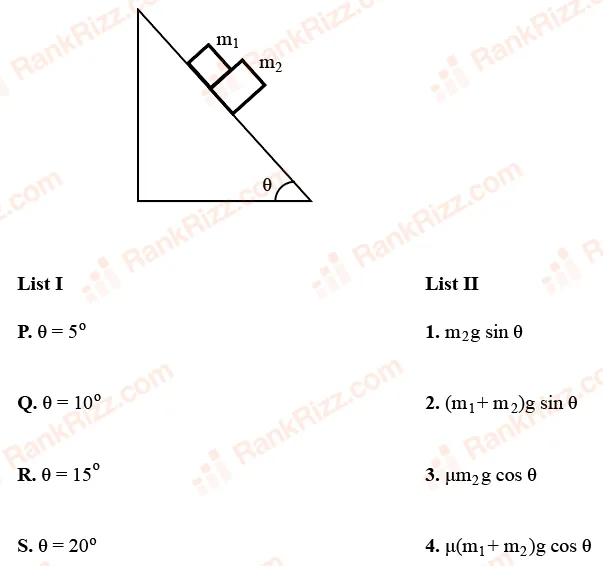
A block of mass m1=1kgm_1 = 1 kg another mass m2=2kgm_2 = 2 kg, are placed together (see figure) on an inclined plane with angle of inclination θ\theta. Various values of θ\theta are given in List I. The coefficient of friction between the block m1m_1 and the plane is always zero. The coefficient of static and dynamic friction between the block m2m_2 and the plane are equal to μ=0.3.\mu = 0.3. In List II expressions for the friction on block m2m_2 are given. Match the correct expression of the friction in List II with the angles given in List I, and choose the correct option. The acceleration due to gravity is denoted by g.
[Useful information :tan⁡(5.5∘)≈0.1;tan⁡(11.5∘)≈0.2;tan⁡(16.5∘)≈0.3]\tan (5.5^\circ) \approx 0.1; \tan(11.5^\circ) \approx 0.2; \tan(16.5^\circ) \approx 0.3]

Figure for JEE Advanced 2014 Physics question on Friction in multi-block systems

Choices:

  1. A

    P-1, Q-1, R-1, S-3

  2. B

    P-2, Q-2, R-2, S-3

  3. C

    P-2, Q-2, R-2, S-4

  4. D

    P-2, Q-2, R-3, S-3

Q20Fluid pressure, Pascal's law and accelerated/rotating liquids

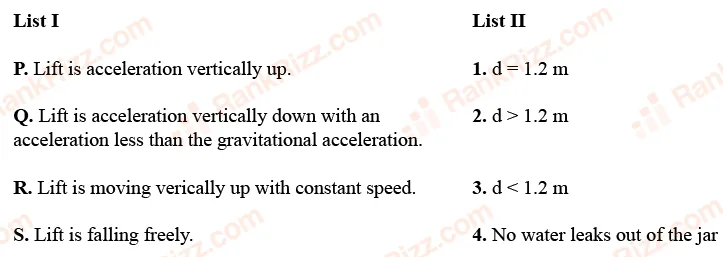
A person in a lift is holding a water jar, which has a small hole at the lower end of its side. When the lift is at rest, the water jet coming out of the hole hits the floor of the lift at a distance of 1.2 m from the person. In the following, state of the lift’s motion is given in List I and the distance where the water jet hits the floor of the lift is given in List II. Match the statements from List I with those in List II and select the correct answer using the code given below the list.

Figure for JEE Advanced 2014 Physics question on Fluid pressure, Pascal's law and accelerated/rotating liquids
  1. A

    P-2, Q-3, R-2, S-4

  2. B

    P-2, Q-3, R-1, S-4

  3. C

    P-1, Q-1, R-1, S-4

  4. D

    P-2, Q-3, R-1, S-1

NEXT IN THIS PAPER →Chemistry, Q21 onwards