RankRizz

JEE Advanced 2014 Paper 1 Question Paper

All 60 questions of JEE Advanced 2014 Paper 1, in the order they were asked, one subject to a page. Pick an answer on any question to check it against the key. Free to read, nothing to download.

Questions

60

Physics · Chemistry · Maths

Answer key

60

questions with a checked key

Price

Free

no sign-up

Physics

Q1AC basics: rms and average values, phasors

At time t = 0, terminal A in the circuit shown in the figure is connected to B by a keyand an alternating current I(t)=I0cos⁡fo(ωt)I(t) = I_0 \cos^fo (\omega t), with I0=1AI_0 = 1 A and ω=500rads−1\omega = 500 rad s^{-1} starts flowing in it with the intial direction shown in the figure. At t=7π6ωt = \frac{7 \pi}{6 \omega}, the key is switched from B to D. Now onwards only A and D are connected. A total charge Q flows from the battery to charge the capacitor fully. If C=20μF,R=10ΩC = 20 \mu F, R = 10 Ω and the battery is ideal with emf of 50V, identify the correct statement (s).
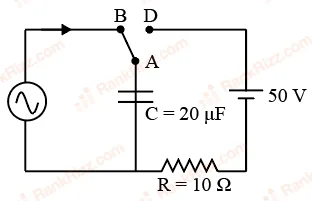
Figure for JEE Advanced 2014 Physics question on AC basics: rms and average values, phasors
  1. A

    Magnitude of the maximum charge on the capacitor before t=7π6ωt = \frac{7 \pi}{6 \omega} is 1×10⁻³C.1 \times 10^{-3} C.

  2. B

    The current in the left part of the circuit just before t=7π6ωt = \frac{7 \pi}{6 \omega} is clockwise.

  3. C

    Immediately after A is connected to D, the current in R is 10A

  4. D

    Q=2×10⁻³C.Q = 2 \times 10^{-3} C.

Q2Young's double slit experiment: fringe width and intensity

A light source, which emits two wavelengths λ1=400nm\lambda_1 = 400 nm and λ2=600nm\lambda_2 = 600 nm, is used in a Young’s double slit experiment. If recorded fringe widths for λ1\lambda_1 and λ2\lambda_2 are β1\beta_1 and β2\beta_2 number of fringes for them within a distance yon one side of the central maximum are m1m_1 and m2m_2, respectively, then

  1. A

    β2>β1\beta_2 > \beta_1

  2. B

    m1>m2m_1 > m_2

  3. C

    From the central maximum, 3rd3^{rd} maximum of λ2\lambda_2 overlaps with 5th5^{th} minimum of λ1\lambda_1

  4. D

    The angular separation of fringes for λ1\lambda_1 is greater than λ2\lambda_2

Q3Progressive waves: wave equation, phase and intensity

One end of a taut string of length 3m along the x axis is fixed at x = 0.The speed of the waves in the string is 100ms−1100 ms^{-1}. The other end of the string is vibrating in the y direction so that stationary waves are set up in the string. The possible waveform(s) of these stationary waves is(are)

  1. A

    y(t)=Asin⁡πx6cos⁡50πt3y(t) = A \sin \frac{\pi x}{6} \cos \frac{50 \pi t}{3}

  2. B

    y(t)=Asin⁡πx3cos⁡100πt3y(t) = A \sin \frac{\pi x}{3} \cos \frac{100 \pi t}{3}

  3. C

    y(t)=Asin⁡5πx6cos⁡250πt3y(t) = A \sin \frac{5 \pi x}{6} \cos \frac{250 \pi t}{3}

  4. D

    y(t)=Asin⁡5πx2cos⁡250πty(t) = A \sin \frac{5 \pi x}{2} \cos {250 \pi t}

Q4Capacitors with dielectrics

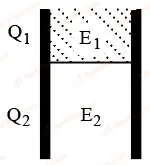
A parallel plate capacitor has a dielectric slab of dielectric constant K between its plates that covers 13\frac{1}{3} of the area of its plates, as shown in the figure. The total capacitance of the capacitor is C while that of the portion with dielectric in between is C1C_1. When the capacitor is charged, the plate area covered by the dielectric gets charge Q1Q_1 and the rest of the area gets charge Q2Q_2. The electric field in the dielectric is E1E_1 and that in the other portion is E2E_2. Choose the correct option/options, ignoring edge effects.

Figure for JEE Advanced 2014 Physics question on Capacitors with dielectrics
  1. A

    E1E2=1\frac {E_1}{E_2} = 1

  2. B

    E1E2=1k\frac {E_1}{E_2} = \frac {1}{k}

  3. C

    Q1Q2=3k\frac {Q_1}{Q_2} = \frac {3}{k}

  4. D

    CC1=2+kk\frac {C}{C_1} = \frac {2 + k}{k}

Q5Electric flux and Gauss's law

Let E1(r),E2(r)E_1 (r), E_2 (r) and E3(r)E_3 (r) be the respective electric fields at a distance r from a point charge Q, an infinitely long wire with constant linear charge density λ\lambda, and an infinite plane with uniform surface charge density σ\sigma. If E1(r0)=E2(r0)=E3(r0)E_1 (r_0) = E_2 (r_0) = E_3 (r_0) at a given distance r0r_0, then

  1. A

    Q=4σπr02Q = 4 \sigma \pi r_0^2

  2. B

    r0=λ2πσr_0 = \frac{\lambda}{2 \pi \sigma}

  3. C

    E1(r02)=2E2(r02)E_1 (\frac{r_0}{2}) = 2E_2 (\frac{r_0}{2})

  4. D

    E2(r02)=4E3(r02)E_2 (\frac{r_0}{2}) = 4E_3 (\frac{r_0}{2})

Q6Progressive waves: wave equation, phase and intensity

A student is performing an experiment using a resonance column and a tuning fork of frequency 244s−1244s^{−1}. He is told that the air in the tube has been replaced by another gas (assume that the column remains filled with the gas). If the minimum height at which resonance occurs is (0.350±0.005)m,(0.350 \pm 0.005) m, the gas in the tube is
(Useful information: 167RT=640J12mole−12;140RT=590J12mole−12\sqrt {167 RT} = 640 J^{\frac{1}{2}} mole^{\frac{-1}{2}} ;\sqrt {140 RT} = 590 J^{\frac{1}{2}} mole^{\frac{-1}{2}}.The molar masses Min grams are given in the options. Take the values of 10M\sqrt{\frac{10}{M}} for each gas as given there.)

  1. A

    Neon (M=20,1020=710)\left(M = 20, \sqrt{\frac{10}{20}} = \frac{7}{10}\right)

  2. B

    Nitrogen (M=28,1028=35)\left(M = 28, \sqrt{\frac{10}{28}} = \frac{3}{5}\right)

  3. C

    Oxygen (M=32,1032=916)\left(M = 32, \sqrt{\frac{10}{32}} = \frac{9}{16}\right)

  4. D

    Argon (M=36,1036=1732)\left(M = 36, \sqrt{\frac{10}{36}} = \frac{17}{32}\right)

Q7Electric power and heating effect of current

Heater of an electric kettle is made of a wire of length L and diameter d. It takes 4 minutes to raise the temperature of 0.5kg water by 40K. This heater is replaced by a new heater having two wires of the same material, each of length L and diameter 2d.The way these wires are connected is given in the options. How much time in minutes will it take to raise the temperature of the same amount of water by 40 K?

  1. A

    4 if wires are in parallel

  2. B

    2 if wires are in series

  3. C

    1 if wires are in series

  4. D

    0.5 if wires are in parallel

Q8Equilibrium of rigid bodies and toppling

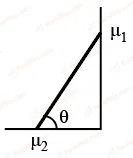
In the figure, a ladder of mass m is shown leaning against a wall. It is in static equilibrium making an angle θ\theta with the horizontal floor. The coefficient of friction between the wall and the ladder is μ1\mu_1 and that between the floor and the ladder is μ2\mu_2. The normal reaction of the wall on the ladder is N1N_1 and that of the floor is N2N_2. If the ladder is about to slip, then

Figure for JEE Advanced 2014 Physics question on Equilibrium of rigid bodies and toppling
  1. A

    μ1=0μ2≠0\mu_1 = 0 \mu_2 \neq 0 and N2tan⁡θ=mg2N_2 \tan \theta = \frac{mg}{2}

  2. B

    μ1≠0μ2=0\mu_1 \neq 0 \mu_2 = 0 and N1tan⁡θ=mg2N_1 \tan \theta = \frac{mg}{2}

  3. C

    μ1≠0μ2≠0\mu_1 \neq 0 \mu_2 \neq 0 and N2=mg1+μ1μ2N_2 = \frac{mg}{1 + \mu_1 \mu_2}

  4. D

    μ1=0μ2≠0\mu_1 = 0 \mu_2 \neq 0 and N1tan⁡θ=mg2N_1 \tan \theta = \frac{mg}{2}

Q9Combinations of lenses and mirrors

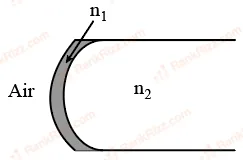
A transparent thin film of uniform thickness and refractive index n1=1.4n_1 = 1.4 is coated on the convex spherical surface of radius Rat one end of a long solid glass cylinder of refractive index n2=1.5,n_2 = 1.5, as shown in the figure. Rays of light parallel to the axis of the cylinder traversing through the film from air to glass get focused at distance f1f_1 from the film, while rays of light traversing from glass to air get focused at distance f2f_2 from the film. Then

Figure for JEE Advanced 2014 Physics question on Combinations of lenses and mirrors
  1. A

    ∣f1∣=3R|f_1| = 3R

  2. B

    ∣f1∣=2.8R|f_1| = 2.8R

  3. C

    ∣f2∣=2R|f_2| = 2R

  4. D

    ∣f2∣=1.4R|f_2| = 1.4R

Q10Wheatstone bridge

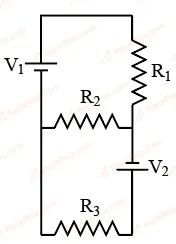
Two ideal batteries of  emfV1emfV_1 and V2V_2 and three resistances R1,R2R_1, R_2 and R3R_3 are connected as shown in the figure. The current in resistance R2R_2 would be zero if

Figure for JEE Advanced 2014 Physics question on Wheatstone bridge
  1. A

    V1=V2V_1 = V_2 and R1=R2=R3R_1 = R_2 = R_3

  2. B

    V1=V2V_1 = V_2 and R1=2R2=R3R_1 = 2R_2 = R_3

  3. C

    V1=2V2V_1 = 2V_2 and 2R1=2R2=R32R_1 = 2R_2 = R_3

  4. D

    2V1=V22V_1 = V_2 and 2R1=R2=R32R_1 = R_2 = R_3

Q11Relative velocity in two dimensions

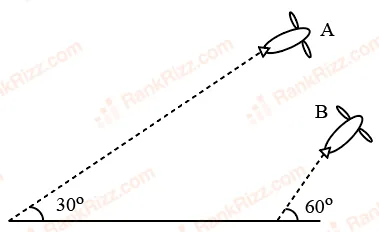
Airplanes A and B are flying with constant velocity in the same vertical plane at angles 30∘30^\circ and 60∘60^\circ with respect to the horizontal respectively as shown in figure. The speed of A is 1003ms−1100 \sqrt 3 ms^{−1}. At time t = 0 s, an observer in A finds B at a distance of 500 m. This observer sees B moving with a constant velocity perpendicular to the line of motion of A. If at t=t0t = t_0, A just escapes being hit by B, t0t_0 in seconds is

Figure for JEE Advanced 2014 Physics question on Relative velocity in two dimensions
Q12Vernier calipers: least count and zero error

During Searle’s experiment, zero of the Vernier scale lies between 3.20×10⁻²m3.20 \times 10^{−2} m and 3.25×10⁻²m3.25 \times 10^{-2} m of the main scale. The 20th20^{th} division of the Vernier scale exactly coincides with one of the main scale divisions. When an additional load of 2 kg is applied to the wire, the zero of the Vernier scale still lies between 3.20×10⁻²m3.20 \times 10^{-2} m and 3.25×10⁻²m3.25 \times 10^{-2} m of the main scale but now the 45th45^{th} division of Vernier scale coincides with one of the main scale divisions. The length of the thin metallic wire is 2 m and its cross-sectional area is 8×10⁻⁷m28 \times 10^{-7} m^2. The least count of the Vernier scale is 1.0×10⁻⁵m1.0 \times 10^{-5} m. The maximum percentage error in the Young’s modulus of the wire is

Q13Equilibrium of rigid bodies and toppling

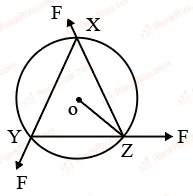
A uniform circular disc of mass 1.5 kg and radius 0.5 m is initially at rest on a horizontal frictionless surface. Three forces of equal magnitude F = 0.5 N are applied simultaneously along the three sides of an equilateral triangle XYZ with its vertices on the perimeter of the disc (see figure). One second after applying the forces, the angular speed of the disc in rads−1rads^{-1} is

Figure for JEE Advanced 2014 Physics question on Equilibrium of rigid bodies and toppling
Q14Motion of charged particles in a magnetic field

Two parallel wires in the plane of the paper are distance X0X_0 apart. A point charge is moving with speed u between the wires in the same plane at a distance X1X_1 from one of the wires. When the wires carry current of magnitude I in the same direction, the radius of curvature of the path of the point charge is R1R_1. In contrast, if the currents I in the two wires have directions opposite to each other, the radius of curvature of the path is R2R_2. If X0X1=3,\frac{X_0}{X_1} = 3, the value of R1R2\frac{R_1}{R_2} is

Q15Dimensional analysis: deriving and checking relations

To find the distance d over which a signal can be seen clearly in foggy conditions, a railways engineer uses dimensional analysis and assumes that the distance depends on the mass density ρ\rho of the fog, intensity (power/area) SS of the light from the signal and its frequency f. The engineer finds that disproportional to S1nS^{\frac {1}{n}}. The value of n is

Q16Galvanometer conversion to ammeter and voltmeter

A galvanometer gives full scale deflection with 0.006 A current. By connecting it to a 4990Ω4990 Ω resistance, it can be converted into a voltmeter of range 0 - 30 V. If connected to a 2n249Ω\frac{2n}{249}Ω resistance, it becomes an ammeter of range 0 - 1.5 A. The value of n is

Q17Potential energy, conservative forces and energy curves

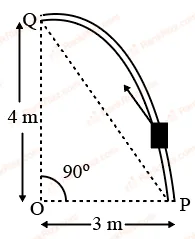
Consider an elliptically shaped rail PQ in the vertical plane with OP = 3 m and OQ = 4 m. A block of mass 1 kg is pulled along the rail from P to Q with a force of 18 N, which is always parallel to line PQ (see the figure given). Assuming no frictional losses, the kinetic energy of the block when it reaches Q is (n×10)(n \times 10) Joules. The value of n is (take acceleration due to gravity = 10 ms−2ms^{-2})

Figure for JEE Advanced 2014 Physics question on Potential energy, conservative forces and energy curves
Q18Relative motion in one dimension

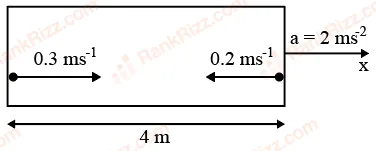
A rocket is moving in a gravity free space with a constant acceleration of 2ms−22 ms^{-2} along +x direction (see figure). The length of a chamber inside the rocket is 4 m. A ball is thrown from the left end of the chamber in +x direction with a speed of 0.3ms−10.3 ms^{-1} relative to the rocket. At the same time, another ball is thrown in -x direction with a speed of 0.2ms−10.2 ms^{-1} from its right end relative to the rocket. The time in seconds when the two balls hit each other is

Figure for JEE Advanced 2014 Physics question on Relative motion in one dimension
Q19Angular momentum of particles and rigid bodies

A horizontal circular platform of radius 0.5 m and mass 0.45 kg is free to rotate about its axis. Two massless spring toy-guns, each carrying a steel ball of mass 0.05 kg are attached to the platform at a distance 0.25 m from the centre on its either sides along its diameter (see figure). Each gun simultaneously fires the balls horizontally and perpendicular to the diameter in opposite directions. After leaving the platform, the balls have horizontal speed of 9ms−19 ms^{-1} with respect to the ground. The rotational speed of the platform in rads−1rads^{-1} after the balls leave the platform is

Figure for JEE Advanced 2014 Physics question on Angular momentum of particles and rigid bodies
Q20Carnot engine and Carnot cycle

A thermodynamic system is taken from an initial state i with internal energy Ui=100JU_i = 100 J to the final state f along two different paths iaf and ibf, as schematically shown in the figure. The work done by the system along the paths af, ib and bf are Waf=200J,Wib=50JW_{af} = 200 J, W_{ib} = 50 J and Wbf=100JW_{bf} = 100 J respectively. The heat supplied to the system along the path iaf, ib and bf are Qiaf,QibQ_{iaf}, Q_{ib} and QbfQ_{bf} respectively. If the internal energy of the system in the state b is Ub=200JU_b = 200 J and Qiaf=500JQ_{iaf} = 500 J, the ratio QbfQib\frac {Q_{bf}} {Q_{ib}} is

Figure for JEE Advanced 2014 Physics question on Carnot engine and Carnot cycle
NEXT IN THIS PAPER →Chemistry, Q21 onwards