RankRizz

JEE Advanced 2013 Paper 2 Question Paper

All 60 questions of JEE Advanced 2013 Paper 2, in the order they were asked, one subject to a page. Pick an answer on any question to check it against the key. Free to read, nothing to download.

Questions

60

Physics · Chemistry · Maths

Answer key

60

questions with a checked key

Price

Free

no sign-up

Physics

Q1Errors in measurement and significant figures

Using the expression 2dsin⁡θ=λ2d \sin \theta = \lambda, one calculates the values of d by measuring the corresponding angles θ\theta in the range 0 to 90∘90^\circ. The wavelength λ\lambda is exactly known and the error in θ\theta is constant for all values of θ\theta. As θ\theta increases from 0∘0^\circ,

  1. A

    the absolute error in d remains constant.

  2. B

    the absolute error in d increases.

  3. C

    the fractional error in d remains constant.

  4. D

    the fractional error in d decreases.
Q2Relation between field and potential, equipotential surfaces

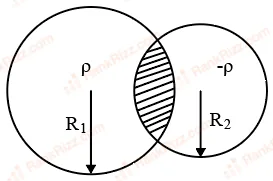
Two non-conducting spheres of radii R1R_1 and R2R_2 and carrying uniform volume charge densities ρ\rho and ρ\rho respectively, are placed such that they partially overlap, as shown in the figure. At all points in the overlapping region,

Figure for JEE Advanced 2013 Physics question on Relation between field and potential, equipotential surfaces
  1. A

    the electrostatic field is zero.

  2. B

    the electrostatic potential is constant.

  3. C

    the electrostatic field is constant in magnitude.

  4. D

    the electrostatic field has same direction.

Q3Calorimetry and specific heat capacity

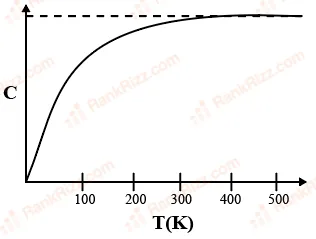
The figure below shows the variation of specific heat capacity (C) of a solid as a function of temperature (T). The temperature is increased continuously from 0 to 500 K at a constant rate. Ignoring any volume change, the following statement(s)is (are) correct to a reasonable approximation.

Figure for JEE Advanced 2013 Physics question on Calorimetry and specific heat capacity
  1. A

    the rate at which heat is absorbed in the range 0-100 K varies linearly with temperature T.

  2. B

    heat absorbed in increasing the temperature from 0-100 K is less than the heat required for increasing the temperature from 400-500 K.

  3. C

    there is no changein the rate of heat absorption in the range 400-500 K.

  4. D

    the rate of heat absorption increases in the range 200-300 K.

Q4Hydrogen spectrum and spectral series

The radius of the orbit of an electron in a Hydrogen-like atom is 4.5 a0a_0, where a0a_0 is the bohr radius. Its orbital angular momentum is 3h2π\frac{3h}{2 \pi}. It is given that h is Planck constant and R is Rydberg constant. The possible wavelength(s), when the atom de-excites, is (are)

  1. A

    932R\frac{9}{32 R}

  2. B

    916R\frac{9}{16 R}

  3. C

    95R\frac{9}{5 R}

  4. D

    43R\frac{4}{3 R}

Q5Escape speed

Two bodies, each of mass M, are kept fixed with a separation 2L. A particle of mass m is projected from the midpoint of the line joining their centres, perpendicular to the line. The gravitational constant is G. The correct statement(s) is (are)

  1. A

    The minimum initial velocity of the mass m to escape the gravitational field of the two bodiesis 4GML4 \sqrt{\frac{GM}{L}}

  2. B

    The minimum initial velocity of the mass m to escape the gravitational field of the two bodiesis 2GML2 \sqrt{\frac{GM}{L}}

  3. C

    The minimum initial velocity of the mass m to escape the gravitational field of the two bodiesis 2GML\sqrt{\frac{2GM}{L}}

  4. D

    The energy of the mass m remains constant.

Q6Spring-block oscillations

A particle of mass mis attached to one end of a mass-less spring of force constant k, lying on a frictionless horizontal plane. The other end of the spring is fixed. The particle starts moving horizontally from its equilibrium position at time t = 0 with an initial velocity u0u_0. When the speed of the particle is 0.5 u0u_0,it collides elastically with a rigid wail. After this collision,

  1. A

    the speed of the particle when it returns to its equilibrium position is u0u_0.

  2. B

    the time at which the particle passes through the equilibrium position for the first time is t=πmkt = \pi \sqrt{\frac{m}{k}}.

  3. C

    the time at which the maximum compression of the spring occurs is t=4π3mkt = \frac{4 \pi}{3} \sqrt{\frac{m}{k}}.

  4. D

    the time at which the particle passes through the equilibrium position for the second time is t=5π3mkt = \frac{5 \pi}{3} \sqrt{\frac{m}{k}}.

Q7Ampere's circuital law: cylinders, solenoids and toroids

A steady current I flows along an infinitely long hollow cylindrical conductor of radius R. This cylinder is placed coaxially inside an infinite solenoid of radius 2R. The solenoid has n turns per unit length and carries a steady current I. Consider a point P at a distance r from the common axis. The correct statement(s) is (are)

  1. A

    In the region 0 < r < R, the magnetic field is non-zero.

  2. B

    In the region R < r < 2R, the magneticfield is along the common axis.

  3. C

    In the region R < r < 2R, the magnetic field is tangential to the circle of radiusr, centered on the axis.

  4. D

    In the region r > 2R, the magnetic field is non-zero.

Q8Doppler effect in sound

Two vehicles, each moving with speed u on the samehorizontal straight road, are approaching each other. Wind blows along the road with velocity w. One of these vehicles blows a whistle of frequency f1f_1. An observerin the other vehicle hears the frequency of the whistle to be f2f_2. The speed of soundin still air is V. The correct statement(s) is (are)

  1. A

    If the wind blows from the observerto the source, f2>f1f_2 > f_1.

  2. B

    If the wind blows from the source to the observer, f2>f1f_2 > f_1.

  3. C

    If the wind blows from observerto the source, f2<f1f_2 < f_1.

  4. D

    If the wind blows from the source to the observer, f2<f1f_2 < f_1.

Q9Magnetic flux, Faraday's law and Lenz's law

The magnitude of the induced electric field in the orbit at any instant of time during the time interval of the magnetic field change is

  1. A

    BR4\frac{BR}{4}

  2. B

    BR2\frac{BR}{2}

  3. C

    BRBR

  4. D

    2BR2 BR

Q10Magnetic dipole moment of current loops and torque on loops

The change in the magnetic dipole moment associated with the orbit, at the end of the time interval of the magnetic field change, is

  1. A

    −γBQR2- \gamma BQR^2

  2. B

    −γBQR22-\gamma \frac{BQR^2}{2}

  3. C

    γBQR22\gamma \frac{BQR^2}{2}

  4. D

    γBQR2\gamma BQR^2

Q11Nuclear fission, fusion and Q-value

The correct statement is

  1. A

    The nucleus 36Li^6_3Li can emit an alpha particle.

  2. B

    The nucleus 84210Po^{210}_{84}Po can emit a proton.

  3. C

    Deuteron and alpha particle can undergo complete fusion.

  4. D

    The nuclei 3070Zn^{70}_{30}Zn and 3482Se^{82}_{34}Se can undergo complete fusion

Q12Radioactivity: decay law, half-life and decay modes

The kinetic energy (in keV) of the alpha particle, when the nucleus 84210Po^{210}_{84}Po at rest undergoes alpha decay, is

  1. A

    5319

  2. B

    5422

  3. C

    5707

  4. D

    5818

Q13Potential energy, conservative forces and energy curves

The speed of the block whenit reachesthe point Q is

  1. A

    5 ms−1ms^{-1}

  2. B

    10 ms−1ms^{-1}

  3. C

    10 3ms−1\sqrt{3} ms^{-1}

  4. D

    20 ms−1ms^{-1}

Q14Potential energy, conservative forces and energy curves

The magnitude of the normal reaction that acts on the block at the point Q is

  1. A

    7.5 N

  2. B

    8.6 N

  3. C

    11.5 N

  4. D

    22.5 N

Q15Electric power and heating effect of current

If the direct transmission method with a cable of resistance 0.4Ωkm−10.4Ωkm^{-1} is used, the power dissipation (in %) during transmission is

  1. A

    20

  2. B

    30

  3. C

    40

  4. D

    50

Q16AC generator and transformer

In the method using the transformers, assume that the ratio of the numberof turns in the primary to that in the secondary in the step-up transformeris 1 : 10. If the power to the consumers has to be supplied at 200 V, the ratio of the numberof turns in the primary to that in the secondary in the step-down transformer is

  1. A

    200 : 1

  2. B

    150 : 1

  3. C

    100 : 1

  4. D

    50 : 1

Q17Dimensional analysis: deriving and checking relations

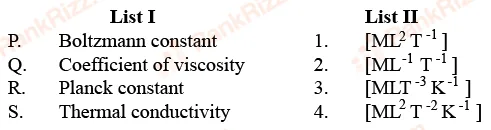
Match List I with List II and select the correct answer using the codes given below the lists :

Figure for JEE Advanced 2013 Physics question on Dimensional analysis: deriving and checking relations
  1. A

    P-3, Q-1, R-2, S-4

  2. B

    P-3, Q-2, R-1, S-4

  3. C

    P-4, Q-2, R-1, S-3

  4. D

    P-4, Q-1, R-2, S-3

Q18Prism: deviation and dispersion

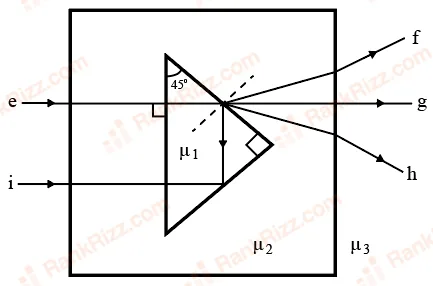
A right angled prism of refractive index μ1\mu_{1} is placed in a rectangular block of refractive index μ2\mu_{2}, which is surrounded by a medium of refractive index μ3\mu_{3}, as Shown in the figure. A ray of light ‘e’ enters the rectangular block at normal incidence. Depending upon the relationships between μ1,μ2\mu_{1},\mu_{2} and μ3\mu_{3}, it takes one of the four possible paths ‘ef’, ‘eg’, ‘eh’ or ‘ei’.

Figure for JEE Advanced 2013 Physics question on Prism: deviation and dispersion


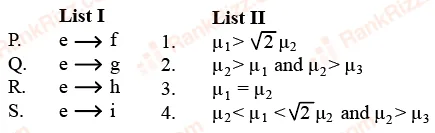
Match the paths in List I with conditions of refractive indices in List II and select the correct answer using the codes given below the lists:

Figure for JEE Advanced 2013 Physics question on Prism: deviation and dispersion
  1. A

    P-2, Q-2, R-1, S-4

  2. B

    P-1, Q-2, R-4, S-3

  3. C

    P-4, Q-1, R-2, S-3

  4. D

    P-2, Q-3, R-4, S-1

Q19Radioactivity: decay law, half-life and decay modes

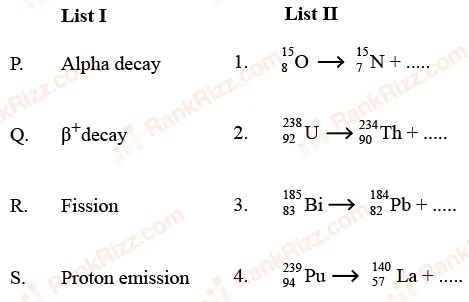
Match List I of the nuclear processes with List II containing parent nucleus and one of the end products of each process and then select the correct answer using the codes given below the lists :

Figure for JEE Advanced 2013 Physics question on Radioactivity: decay law, half-life and decay modes
  1. A

    P-4, Q-2, R-1, S-3

  2. B

    P-1, Q-3, R-2, S-4

  3. C

    P-2, Q-1, R-4, S-3

  4. D

    P-4, Q-3, R-2, S-1

Q20Multi-step processes and gas-piston-spring systems

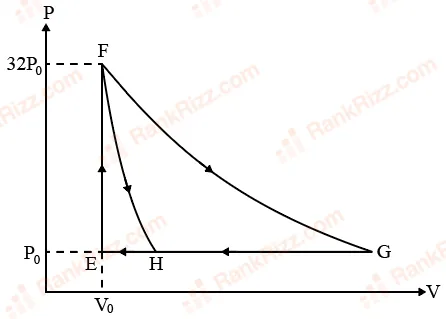
One mole of a monatomic ideal gas is taken along two cyclic processes E→F→G→EE\rightarrow F\rightarrow G \rightarrow E and E→F→H→EE\rightarrow F\rightarrow H \rightarrow E as shown in the PV diagram. The processes involved are purely isochoric, isobaric, isothermal or adiabatic.

Figure for JEE Advanced 2013 Physics question on Multi-step processes and gas-piston-spring systems


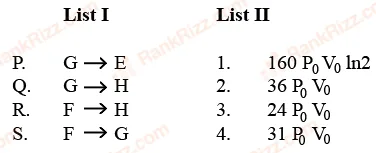
Match the paths in List I with the magnitudes of the work done in List II and select the correct answer using the codes given below the lists.

Figure for JEE Advanced 2013 Physics question on Multi-step processes and gas-piston-spring systems
  1. A

    P-4, Q-3, R-2, S-1

  2. B

    P-4, Q-3, R-1, S-2

  3. C

    P-3, Q-1, R-2, S-4

  4. D

    P-1, Q-3, R-2, S-4

NEXT IN THIS PAPER →Chemistry, Q21 onwards