RankRizz

JEE Advanced 2013 Paper 1 Question Paper

All 60 questions of JEE Advanced 2013 Paper 1, in the order they were asked, one subject to a page. Pick an answer on any question to check it against the key. Free to read, nothing to download.

Questions

60

Physics · Chemistry · Maths

Answer key

60

questions with a checked key

Price

Free

no sign-up

Physics

Q1Vernier calipers: least count and zero error

The diameter of a cylinder is measured using a Vernier callipers with no zero error.It is found that the zero of the Vernier scale lies between 5.10 cm and 5.15 cm of the main scale. The Vernier scale has 50 divisions equivalent to 2.45 cm. The 24th24^{th} division of the Vernier scale exactly coincides with one of the main scale divisions. The diameter of the cylinderis

  1. A

    5.112 cm

  2. B

    5.124 cm

  3. C

    5.136 cm

  4. D

    5.148 cm

Q2Reflection and plane mirrors

A ray oflight travelling in the direction 12(i^+3j^)\frac{1}{2} \left(\widehat{i} + \sqrt 3 \widehat{j}\right) is incident on a plane mirror. After reflection, it travels along the direction 12(i^−3j^)\frac{1}{2} \left(\widehat{i} - \sqrt 3 \widehat{j}\right). The angle of incidence is

  1. A

    30∘30^\circ

  2. B

    45∘45^\circ

  3. C

    60∘60^\circ

  4. D

    75∘75^\circ

Q3Young's double slit experiment: fringe width and intensity

In the Young’s double slit experiment using a monochromatic light of wavelength λ\lambda, the path difference (in terms of an integer n) corresponding to any point having half the peak intensity is

  1. A

    (2n+1)λ2\left(2n + 1\right)\frac{\lambda}{2}

  2. B

    (2n+1)λ4\left(2n + 1\right)\frac{\lambda}{4}

  3. C

    (2n+1)λ8\left(2n + 1\right)\frac{\lambda}{8}

  4. D

    (2n+1)λ16\left(2n + 1\right)\frac{\lambda}{16}

Q4Ideal gas equation and gas laws

Two non-reactive monoatomic ideal gases have their atomic masses in the ratio 2 : 3. The ratio of their partial pressures, when enclosed in a vessel kept at a constant temperature, is 4 : 3. The ratio of their densities is

  1. A

    1 : 4

  2. B

    1 : 2

  3. C

    6 : 9

  4. D

    8 : 9

Q5Thermal radiation: Stefan's law, Wien's law and Kirchhoff's law

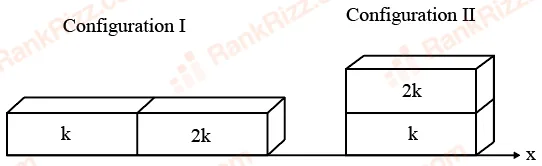
Two rectangular blocks, having identical dimensions, can be arranged either in configuration I or in configuration II as shown in the figure. One of the blocks has thermal conductivity K and the other 2K. The temperature difference between the ends along the x-axis is the same in both the configurations. It takes 9 s to transport a certain amount of heat from the hot end to the cold end in the configuration I. The time to transport the same amount of heat in the configuration II is

Figure for JEE Advanced 2013 Physics question on Thermal radiation: Stefan's law, Wien's law and Kirchhoff's law
  1. A

    2.0 s

  2. B

    3.0 s

  3. C

    4.5 s

  4. D

    6.0 s

Q6Properties of EM waves: fields, energy, intensity and momentum

A pulse of light of duration 100 ns is absorbed completely by a small object initially at rest. Power of the pulse is 30 mW and the speedoflight is 3×10⁸ms−13 \times 10^8 ms^{-1}. The final momentum of the object is

  1. A

    0.3×10⁻¹⁷kgms−10.3 \times 10^{-17} kg ms^{-1}

  2. B

    1.0×10⁻¹⁷kgms−11.0 \times 10^{-17} kg ms^{-1}

  3. C

    3.0×10⁻¹⁷kgms−13.0 \times 10^{-17} kg ms^{-1}

  4. D

    9.0×10⁻¹⁷kgms−19.0 \times 10^{-17} kg ms^{-1}

Q7Motion of centre of mass, momentum conservation and explosions

A particle of mass m is projected from the ground with an initial speed u0u_0, at an angle α\alpha with the horizontal. At the highest point of its trajectory, it makes a completely inelastic collision with another identical particle, which was thrown vertically upward from the ground with the same initial speed u0.u_0. The angle that the composite system makes with the horizontal immediately after the collision is

  1. A

    π4\frac{\pi}{4}

  2. B

    π4+α\frac{\pi}{4} + \alpha

  3. C

    π2−α\frac{\pi}{2} - \alpha

  4. D

    π2\frac{\pi}{2}

Q8Work done by constant and variable forces

The work done on a particle of mass m by a force, K[x(x2+y2)32i^+y(x2+y2)32j^]K \left[\frac {x}{\left(x^2 + y^2\right)^{\frac{3}{2}}}\widehat{i} + \frac {y}{\left(x^2 + y^2\right)^{\frac{3}{2}}}\widehat{j} \right] (K being a constant of appropriate dimensions), when the particle is taken from the point (a, 0) to the point (0, a) along a circular path of radius a about the origin in the x-y plane is

  1. A

    2Kπa\frac{2K \pi}{a}

  2. B

    Kπa\frac{K \pi}{a}

  3. C

    Kπ2a\frac{K \pi}{2a}

  4. D

    0

Q9Bulk modulus and compressibility

One end of a horizontal thick copper wire of length 2L and radius 2R is welded to an end of another horizontal thin copper wire of length L and radius R. When the arrangement is stretched by applying forces at two ends,the ratio of the elongation in the thin wire to that in the thick wire is

  1. A

    0.25

  2. B

    0.50

  3. C

    2.00

  4. D

    4.00

Q10Combinations of lenses and mirrors

The image of an object, formed by a plano-convex lens at a distance of 8 m behind the lens, is real and is one-third the size of the object. The wavelength oflight inside the lens is 23\frac{2}{3} times the wavelength in free space. The radius of the curved surface of the lens is

  1. A

    1 m

  2. B

    2 m

  3. C

    3 m

  4. D

    6 m

Q11Progressive waves: wave equation, phase and intensity

A horizontal stretched string, fixed at two ends, is vibrating in its fifth harmonic according to the equation, y(x,t)=(0.01m)sin⁡[(62.8m−1)x]cos⁡[(628s−1)t].y(x, t) = (0.01 m) \sin [(62.8 m^{-1}) x] \cos [(628 s^{-1})t]. Assuming π=3.14\pi = 3.14, the correct statement(s) is (are)

  1. A

    The number of nodes is 5.

  2. B

    The length of the string is 0.25 m.

  3. C

    The maximum displacement of the midpoint of the string, from its equilibrium position is 0.01 m.

  4. D

    The fundamental frequency is 100 Hz.

Q12Fluid pressure, Pascal's law and accelerated/rotating liquids

A solid sphere of radius R and density ρ\rho is attached to one end of a mass-less spring of force constant k. The other end of the spring is connected to another solid sphere of radius R and density 3ρ3 \rho. The complete arrangement is placed in a liquid of density 2ρ2 \rho and is allowed to reach equilibrium. The correct statement(s) is (are)

  1. A

    the net elongation of the spring is 4πR3ρg3k\frac{4 \pi R^3 \rho g}{3k}

  2. B

    the net elongation of the spring is 8πR3ρg3k\frac{8 \pi R^3 \rho g}{3k}

  3. C

    the light sphere is partially submerged.

  4. D

    the light sphere is completely submerged.

Q13Motion of charged particles in a magnetic field

A particle of mass M and positive charge Q, moving with a constant velocity u→1=4i^ms−1\overrightarrow{u}_1 = 4\widehat{i} ms^{-1}, enters a region of uniform static magnetic field normal to the x-y plane. The region of the magnetic field extends from x = 0 to x = L for all values of y. After passing through this region, the particle emerges on the other side after 10 milliseconds with a velocity u→2=2(3i^+j^)ms−1\overrightarrow{u}_2 = 2\left(\sqrt 3 \widehat{i} + \widehat{j}\right) ms^{-1}. The correct statement(s) is (are)

  1. A

    The direction of the magnetic field is —z direction.

  2. B

    The direction of the magnetic field is +z direction.

  3. C

    The magnitude of the magnetic field 50πM3Q\frac{50 \pi M}{3Q} units.

  4. D

    The magnitude of the magnetic field is 100πM3Q\frac{100 \pi M}{3Q} units.

Q14Electric flux and Gauss's law

Two non-conducting solid spheres of radii R and 2R, having uniform volume charge densities ρ1\rho_1 and ρ2\rho_2 respectively, touch each other. The net electric field at a distance 2R from the centre of the smaller sphere, along the line joining the centres of the spheres, is zero. The ratio ρ1ρ2\frac{\rho_1}{\rho_2} can be

  1. A

    -4

  2. B

    −3225-\frac{32}{25}

  3. C

    3225\frac{32}{25}

  4. D

    4

Q15Capacitors in DC circuits (steady state)

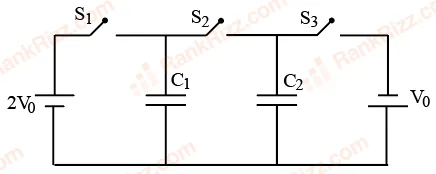
In the circuit shown in the figure, there are two parallel plate capacitors each of capacitance C. The switch S1S_1 is pressedfirst to fully charge the capacitor C1C_1 and then released. The switch S2S_2 is then pressed to charge the capacitor C2C_2. After some time, S2S_2 is released and then S3S_3 is pressed. After sometime,

Figure for JEE Advanced 2013 Physics question on Capacitors in DC circuits (steady state)
  1. A

    the charge on the upperplate of C1C_1 is 2CV02CV_0.

  2. B

    the charge on the upperplate of C1C_1 is CV0CV_0

  3. C

    the charge on the upperplate of C2C_2is 0.

  4. D

    the charge on the upper plate of C2C_2 is CV0CV_0.

Q16Photoelectric effect and Einstein's equation

The work functions of Silver and Sodium are 4.6 and 2.3 eV, respectively. The ratio of the slope of the stopping potential versus frequencyplot for Silver to that of Sodium is

Q17Radioactivity: decay law, half-life and decay modes

A freshly prepared sample of a radioisotope of half-life 1386 s has activity 10310^3 disintegrations per second. Given that ln 2 = 0.693, the fraction of the initial number of nuclei (expressed in nearest integer percentage) that will decay in the first 80 s after preparation of the sample is

Q18Power

A particle of mass 0.2 kg is moving in one dimension under a force that delivers a constant power 0.5 W to the particle. If the initial speed (in ms−1)ms^{-1}) of the particle is zero, the speed (in ms−1)ms^{-1}) after 5 s is

Q19Angular momentum of particles and rigid bodies

A uniform circular disc of mass 50 kg and radius 0.4 m is rotating with an angular velocity of 10 rad s−1s^{-1} aboutits own axis, which is vertical. Two uniform circular rings, each of mass 6.25 kg and radius 0.2 m, are gently placed symmetrically on the disc in such a manner that they are touching each other along the axis of the disc and are horizontal. Assume that the friction is large enough such that the rings are at rest relative to the disc and the system rotates about the original axis. The new angular velocity (in rad s−1s^{-1}) of the system is

Q20Potential energy, conservative forces and energy curves

A bob of mass m, suspended by string of length l1l_1, is given a minimum velocity required to completea full circle in the vertical plane. At the highestpoint,it collides elastically with another bob of mass m suspendedbya string of length l2l_2, which is initially at rest. Both the strings are mass-less and inextensible. If the second bob, after collision acquires the minimum speed required to complete a full circle in the vertical plane, the ratio l1l2\frac{l_1}{l_2} is

NEXT IN THIS PAPER →Chemistry, Q21 onwards