Q1Magnetic dipole moment of current loops and torque on loops
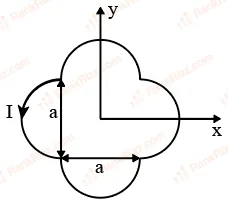
A loop carrying current I lies in the x-y plane as shown in the figure. the unit vector is coming out of the plane of the paper. the magnetic moment of the current loop is :
- A
- B
- C
- D
All 60 questions of JEE Advanced 2012 Paper 2, in the order they were asked, one subject to a page. Pick an answer on any question to check it against the key. Free to read, nothing to download.
Questions
60
Physics · Chemistry · Maths
Answer key
60
questions with a checked key
Price
Free
no sign-up
A loop carrying current I lies in the x-y plane as shown in the figure. the unit vector is coming out of the plane of the paper. the magnetic moment of the current loop is :
A thin uniform cylindrical shell, closed at both ends, is partially filled with water. It is floating vertically in water in half-submerged state. If is the relative density of the material of the shell with respect to water, then the correct statement is that the shell is
more than half filled if is less than 0.5
more than half filled if is less than 1.0
half filled if is less than 0.5
less than half filled if is less than 0.5
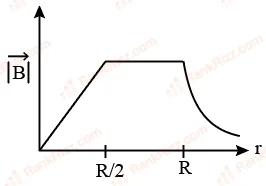
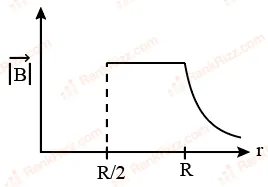
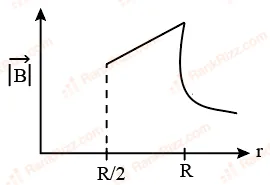
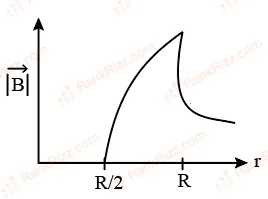
An infinitely long hollow conducting cylinder with inner radius R/2 and outer radius R carries a uniform current density along is length. Themagnitude of themagnetic field, as a function of the radial distance r from the axis is best represented by :
Consider a disc rotating in the horizontal plane with a constant angular speed about its centre O. The disc has a shaded region on one side of the diameter and an unshaded region on the other side as shown in the figure. When the disc is in the orientation as shown, two pebbles P and Q are simultaneously projected at an angle towards R. The velocity of projection is in the y-z plane and is same for both pebbles with respect to the disc. Assume that (i) they land back on the disc before the disc completed rotation. (ii) their range is less than half disc radius, and (iii) remains constant throughout . Then
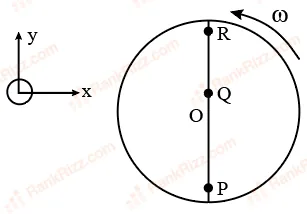
P lands in the shaded region and Q in the unshaded region
P lands in the unshaded region and Q in the shaded region
Both P and Q land in the unshaded region
Both P and Q land in the shaded region
A student is performing the experiment of Resonance Column. The diameter of the column tube is 4cm . The distance frequency of the tuning for k is 512 Hz. The air temperature is in which the speed of sound is 336 m/s. The zero of the meter scale coincides with the top and of the Resonance column. When first resonance occurs, the reading of the water level in the column is
14.0
15.2
16.4
17.6
In the given circuit, a charge of +80 is given to the upper plate of the capacitor. Then in the steady state, the charge on the upper plate of the capacitor is :
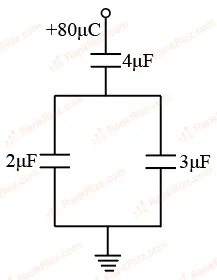
+32
+40
+48
+80
Two identical discs of same radius R are rotating about their axes in opposite directions with the same constant angular speed . The disc are in the same horizontal plane. At time t = 0 , the points P and Q are facing each other as shown in the figure. The relative speed between the two points P and Q is . as function of times best represented by
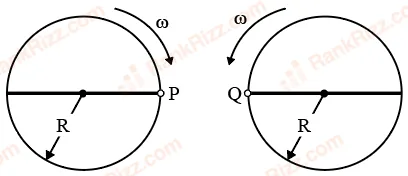
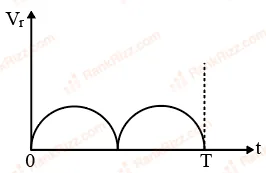
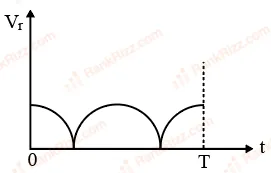
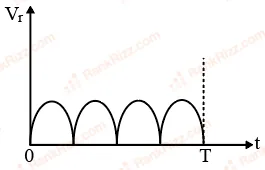
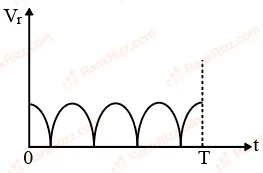
Two moles of ideal helium gas are in a rubber balloon at .The balloon is fully expandable and can be assumed to require no energy in its expansion. The temperature of the gas in the balloon is slowly changed to .The amount of heat required in raising the temperature is nearly (take R = 8.31 J/mol.K)
62 J
104 J
124 J
208 J
What is the maximum energy of the anti-neutrino ?
Zero
Much less than eV
Nearly eV
Much larger than eV
If the anti-neutrino had amass of 3 eV/c (where c is the speed of light) instead of zeromass, what should be the range of the kinetic energy, K, of the electron ?
eV
3.0 eV eV
3.0 eV eV
eV
Choose the correct statement.
The speed of light in the meta-material is
The speed of light in the meta-material is
The speed of light in the meta-material is v = c.
The wavelength of the light in the meta-material is given by , where is the wavelength of the light in air
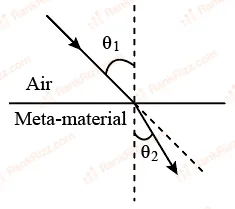
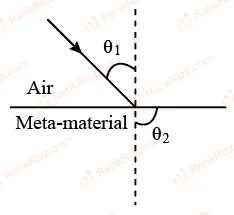
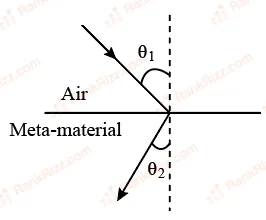
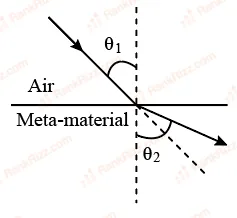
For light incident from air on a meta-material, the appropriate ray diagram is :
Which of the following statement regarding the angular speed about the istantaneous axis (passing through the centre of mass) is correct?
It is for both the cases
It is for case (a); and for case (b).
It is for case (a); and for case (b).
It is for both the cases
Which of the following statements about the instantaneous axis (passing through the centre of mass) is correct?
It is vertical for both the cases (a) and (b).
It is verticle for case (a); and is at to the x-z plane and lies in the plane of the disc for case (b)
It is horizontal ofr case (a); and is at to the x - z plane and is normal to the plane of the disc for case (b).
It is vertical of case (a); and is at to the x - z plane and is normal to the plane of the disc for case (b).
Two solid cylinders P andQ of same mass and same radius start rolling down a fixed inclined plane form the same height at the same time. Cylinder P has most of its mass concentrated near its surface, while Q has most of its mass concentrated near the axis. Which statement (s) is (are) correct?
Both cylinders P and Q reach the ground at the same time
Cylinder P has larger linear acceleration than cylinder Q.
Both cylinder Q reaches the ground with same translational kinetic energy.
Cylinder Q reaches the ground with larger angular speed.
A current carrying infinitely long wire is kept along the diameter of a circular wire loop,without touching it. The correct statement (s) is (are) :
the emf induced in the loop is zero if the current is constant.
The emf induced in the loop is finite if the current is constant.
The emf induced in the loop is zero if the current decreases at a steady rate.
The emf induced in the loop is finite if the current decreases at a steady rate.
In the given circuit, the AC source has rad/s. considering the inductor and capacitor to be ideal, the correct choice (s) is(are)
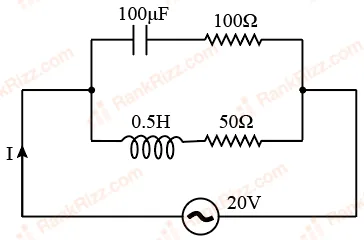
The current through the circuit, I is 0.3 A
The current through the circuit, I is .
The voltage across 100 Ω resistor V
The voltage across 50 Ω resistor = 10 V
Six point charges are kept at the vertices of a regular hexagon of side L and centre O, as shown in the figure. Given that , which of the following statement (s) is (are) correct?
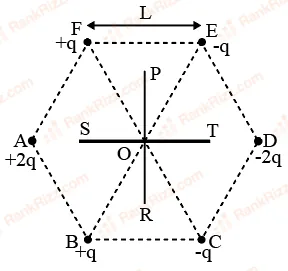
the elecric field at O is 6K along OD
The potential at O is zero
The potential at all points on the line PR is same
The potential at all points on the line ST is same.
Two spherical planets P andQ have the same unfirom density , masses and , an surface areas A and 4A, respectively. A spherical planet R also has unfirom density and its mass is . The escape velocities from the planets P, Q and R, are and respectively. Then
The figure shows a system consisting of (i) a ring of outer radius 3R rolling clockwise without slipping on a horizontal surface with angular speed and (ii) an inner disc of radius 2R rotating anti-clockwisewith angular speed . The ring and disc are separated b frictionaless ball bearings. The system is in the x-z plane. The
point P on the inner disc is at distance R from the origin, where OP makes an angle of with the horizontal. Then with respect to the horizontal surface,
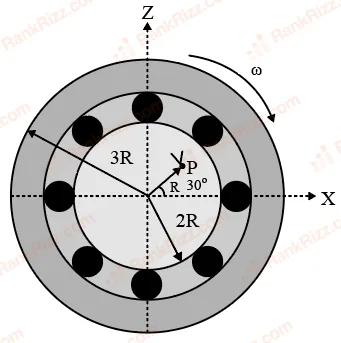
the point O has linear velocity .
the point P has a linear velocity
the point P has a linear velocity
the point P has a linear velocity