RankRizz

JEE Advanced 2012 Paper 1 Question Paper

All 60 questions of JEE Advanced 2012 Paper 1, in the order they were asked, one subject to a page. Pick an answer on any question to check it against the key. Free to read, nothing to download.

Questions

60

Physics · Chemistry · Maths

Answer key

60

questions with a checked key

Price

Free

no sign-up

Physics

Q1Angular momentum of particles and rigid bodies

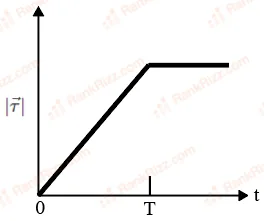
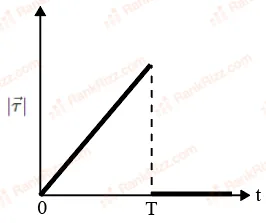
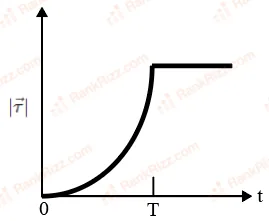
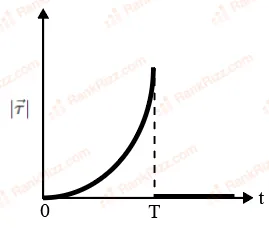
Athin uniform rod, pivoted at O,is rotating in the horizontal plane with constant angular speed ω\omega, as shownin the figure. At time t = 0, a small insect starts from O and moves with constant speedv with respect to the rod towardsthe other end. It reaches the end of the rod at t = T and stops. The angular speed of the system remains ω\omega throughout. The magnitude of the torque (∣τ→∣)(\mid \overrightarrow{\tau} \mid) on the system about O, as a function of time is best represented by which plot ?
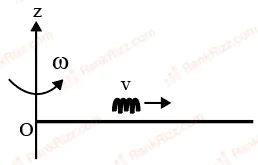
Figure for JEE Advanced 2012 Physics question on Angular momentum of particles and rigid bodies
  1. A
    Figure for JEE Advanced 2012 Physics question on Angular momentum of particles and rigid bodies
  2. B
    Figure for JEE Advanced 2012 Physics question on Angular momentum of particles and rigid bodies
  3. C
    Figure for JEE Advanced 2012 Physics question on Angular momentum of particles and rigid bodies
  4. D
    Figure for JEE Advanced 2012 Physics question on Angular momentum of particles and rigid bodies
Q2Thermal radiation: Stefan's law, Wien's law and Kirchhoff's law

Three very large plates of same area are kept parallel and close to each other. They are considered as ideal black surfaces and have very high thermal conductivity. Thefirst and
third plates are maintained at temperatures 27 and 37 respectively. The temperature of the middle (i.e. second) plate under steady state condition is

  1. A

    (652)14T\left(\frac{65}{2}\right)^{\frac{1}{4}}T

  2. B

    (974)14T\left(\frac{97}{4}\right)^{\frac{1}{4}}T

  3. C

    (972)14T\left(\frac{97}{2}\right)^{\frac{1}{4}}T

  4. D

    (97)14T\left({97}\right)^{\frac{1}{4}}T

Q3Relation between field and potential, equipotential surfaces

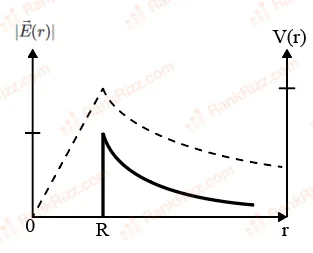
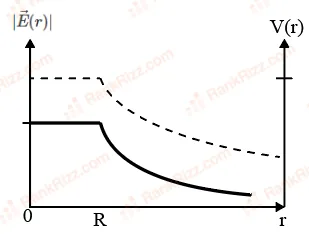
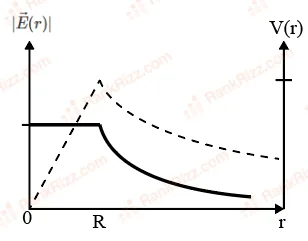
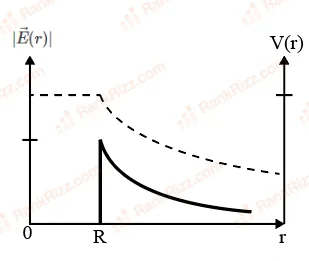
Consider a thin spherical shell of radius R with its centre at the origin, carrying uniform positive surface charge density. The variation of the magnitude of the electric field ∣E→(r)∣\mid \overrightarrow{E}(r) \mid and the electric potential V(r) with the distance r from the centre, is best represented by which graph?

  1. A
    Figure for JEE Advanced 2012 Physics question on Relation between field and potential, equipotential surfaces
  2. B
    Figure for JEE Advanced 2012 Physics question on Relation between field and potential, equipotential surfaces
  3. C
    Figure for JEE Advanced 2012 Physics question on Relation between field and potential, equipotential surfaces
  4. D
    Figure for JEE Advanced 2012 Physics question on Relation between field and potential, equipotential surfaces
Q4Errors in measurement and significant figures

In the determination of Young’s modulus (Y=4MLgπld2)\left(Y = \frac{4MLg}{\pi l d^2}\right) by using Searle’s method,a wire of length L=2 mand diameter d=0.5 mmis used. For a load M= 2.5 kg, an extension l = 0.25 mm in the length of the wire is observed. Quantities d and/ are measured using a screw gauge and a micrometer, respectively. They have the same pitch of 0.5 mm. The number ofdivisions on their circular scale is 100. The contributions to the maximum probable error of the Y measurement

  1. A

    due to the errors in the measurements of d and/ are the same.

  2. B

    due to the error in the measurementof d is twice that dueto the errorin the measurement of l.

  3. C

    due to the error in the measurementof / is twice that due to the error in the measurement of d.

  4. D

    due to the error in the measurementof d is four times that dueto the errorin the measurement of l.

Q5Spring-block oscillations

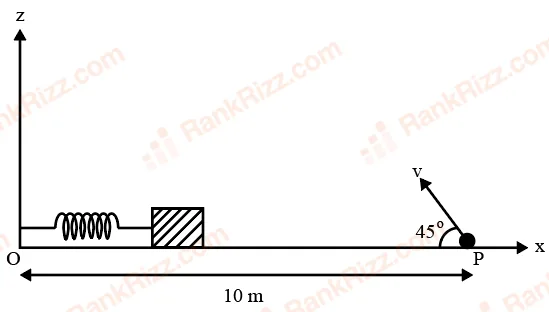
A small block is connected to one end of a massless spring of un-stretched length 4.9 m. The other end of the spring (See thefigure)is fixed. The system lies on a horizontal frictionless surface. The blockis stretched by 0.2 m and released from rest at t= 0. It then executes simple harmonic motion with angular frequency ω=π3\omega = \frac{\pi}{3} rad/s. Simultaneously at t = 0, a small pebble is projected with speed v from point P at an angle of 45∘45^\circ as shownin thefigure. Point P is at a horizontal distance of 10 m from O. If the pebble hits the block at + = 1s, the value of v is (take g = 10 m/s2m/s^2)

Figure for JEE Advanced 2012 Physics question on Spring-block oscillations
  1. A

    50\sqrt{50} m/s

  2. B

    51\sqrt{51} m/s

  3. C

    52\sqrt{52} m/s

  4. D

    53\sqrt{53} m/s

Q6Young's double slit experiment: fringe width and intensity

Young's double slit experimentis carried out by using green, red and bluelight, one color at a time. The fringe widths recorded are βG,βR,βB\beta_G, \beta_R, \beta_B, respectively. Then,

  1. A

    βG>βB>βR\beta_G > \beta_B > \beta_R

  2. B

    βB>βG>βR\beta_B > \beta_G > \beta_R

  3. C

    βR>βB>βG\beta_R > \beta_B > \beta_G

  4. D

    βR>βG>βB\beta_R > \beta_G > \beta_B

Q7Angular momentum of particles and rigid bodies

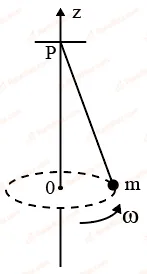
A small mass m is attached to a massless string whose other end is fixed at P as shown in the figure. The mass is undergoing circular motion in the x-y plane with centre at O and constant angular speed ω\omega If the angular momentum of the system, calculated about O and P are denoted by LO→\overrightarrow{L_O} and LP→\overrightarrow{L_P} respectively, then

Figure for JEE Advanced 2012 Physics question on Angular momentum of particles and rigid bodies
  1. A

    LO→\overrightarrow{L_O} and LP→\overrightarrow{L_P} do not vary with time

  2. B

    LO→\overrightarrow{L_O} varies with time while LP→\overrightarrow{L_P} remains constant.

  3. C

    LO→\overrightarrow{L_O} remains constant while LP→\overrightarrow{L_P} varies with time.

  4. D

    LO→\overrightarrow{L_O} and LP→\overrightarrow{L_P} both vary with time.

Q8Degrees of freedom, equipartition of energy and internal energy

A mixture of 2 moles of helium gas (atomic mass = 4 amu) and 1 mole of argon gas (atomic mass = 40 amu) is kept at 300 K in a container. The ratio of the rms speeds
(vrms(helium)vrms(argon))\left(\frac{v_{rms}(helium)}{v_{rms}(argon)}\right)

  1. A

    0.32

  2. B

    0.45

  3. C

    2.24

  4. D

    3.16

Q9Electric field of continuous charge distributions

Two large vertical and parallel metal plates having a separation of 1 cm are connected to a DC voltage source of potential difference X . A protonis released at rest midway between the two plates. It is found to move at 45∘45^\circ to the vertical JUSTafter release. Then X is nearly

  1. A

    1×10−51 \times 10^{-5} V

  2. B

    1×10−71 \times 10^{-7} V

  3. C

    1×10−91 \times 10^{-9} V

  4. D

    1×10−101 \times 10^{-10} V

Q10Combinations of lenses and mirrors

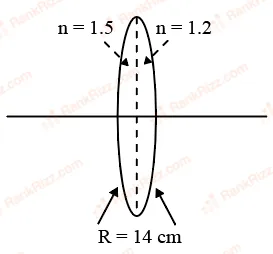
A bi-convex lens is formed with two thin plano-convex lenses as shown in the figure. Refractive index n of the first lens is 1.5 and that of the second lens is 1.2. Both the curved surfaces are of the same radius of curvature R = 14 cm. For this bi-convex lens, for an object distance of 40 cm, the image distance will be

Figure for JEE Advanced 2012 Physics question on Combinations of lenses and mirrors
  1. A

    -280.0 cm.

  2. B

    40.0 cm.

  3. C

    21.5 cm.

  4. D

    13.3 cm.

Q11Electric flux and Gauss's law

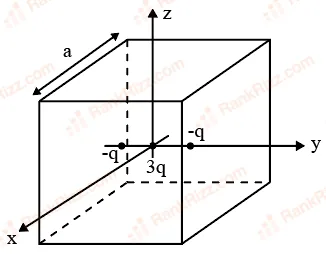
A cubical region of side a has its centre at the origin. It encloses three fixed point charges, -q at (0, -a/4,0), +3qg at (0, 0, 0) and -q at (0, +a/4, 0). Choose the correct option(s).

Figure for JEE Advanced 2012 Physics question on Electric flux and Gauss's law
  1. A

    The net electric flux crossing the plane x = +a/2 is equal to the net electric flux crossing the plane x = -a/2.

  2. B

    The netelectric flux crossing the plane y = +a/2 is more than the net electric flux crossing the plane y = -a/2.

  3. C

    The netelectric flux crossing the entire region is qε0\frac{q}{ε_0}.

  4. D

    The netelectric flux crossing the plane z = +a/2 is equalto the netelectric flux crossing the plane x = +a/2.

Q12Kirchhoff's laws and circuit analysis

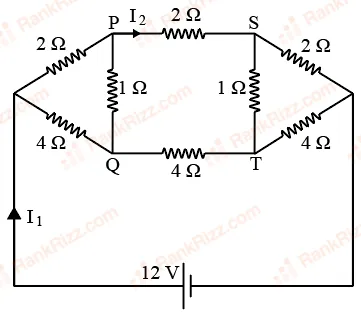
For the resistance network shown in the figure, choose the correct option(s)

Figure for JEE Advanced 2012 Physics question on Kirchhoff's laws and circuit analysis
  1. A

    The current through PQ is zero.

  2. B

    I1=3AI_1 = 3A

  3. C

    The potential at S is less than that at Q.

  4. D

    I2=2AI_2 = 2A

Q13Motion on inclined planes and wedges

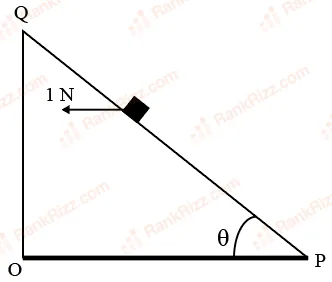
A small block of mass of 0.1 kg lies on fixed inclined plane PQ which makes an angle θ\theta with the horizontal. A horizontal force of 1 N acts on the block through its center of mass as shown in the figure. The block remains stationary if (take g = 10 m/s2m/s^2)

Figure for JEE Advanced 2012 Physics question on Motion on inclined planes and wedges
  1. A

    θ=45∘\theta = 45^\circ

  2. B

    θ>45∘\theta > 45^\circ and frictionalforce acts on the block towards P.

  3. C

    θ>45∘\theta > 45^\circ and frictional force acts on the block towards Q.

  4. D

    θ<45∘\theta < 45^\circ and frictional force acts on the block towards Q.

Q14Motion of charged particles in a magnetic field

Consider the motion of a positive point charge in a region where there are simultaneous uniform electric and magnetic fields E→=E0j^\overrightarrow{E} = E_0 \hat{j} and B→=B0j^\overrightarrow{B} = B_0 \hat{j}. At time t = 0, this charge has velocity v→\overrightarrow{v} in the x-y plane, making an angle θ\theta with the x-axis. Which of the following option(s) is (are) correct for time t > 0?

  1. A

    if θ=0∘\theta = 0^\circ, the charge moves in circular path in the x-z plane.

  2. B

    If θ=0∘\theta = 0^\circ, the charge undergoes helical motion with constant pitch along the y-axis.

  3. C

    If θ=10∘\theta = 10^\circ, the charge undergoes helical motion with its pitch increasing with time, along the y-axis.

  4. D

    If θ=90∘\theta = 90^\circ, the charge undergoes linear but accelerated motion along the y-axis.

Q15Superposition, interference and beats

A person blowsinto open-end of a long pipe. As a result, a high-pressure pulseof air travels down the pipe. Whenthis pulse reachesthe other endof the pipe,

  1. A

    a high-pressure pulsestarts traveling up the pipe, if the other end of the pipe is open.

  2. B

    a low-pressure pulsestarts traveling up the pipe, if the other end ofthe pipe is open.

  3. C

    alow-pressure pulsestarts traveling up the pipe, if the other end of the pipe is closed.

  4. D

    a high-pressure pulse starts traveling up the pipe, if the other end of the pipe is closed.

Q16Electric flux and Gauss's law

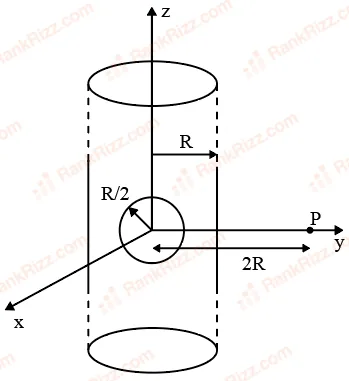
An infinitely long solid cylinder of radius R has a uniform volume charge density p. It has a spherical cavity of radius R/2 with its centre on the axis of the cylinder, as shown in the figure. The magnitude of the electric field at the point P, which is at a distance 2R from the axis of the cylinder, is given by the expression 23ρR16kε0\frac{23 \rho R}{16k ε_0}. The value of k is

Figure for JEE Advanced 2012 Physics question on Electric flux and Gauss's law
Q17Ampere's circuital law: cylinders, solenoids and toroids

A cylindrical cavity of diameter a exists inside a cylinder of diameter 2a as shown in the figure. Both the cylinder and the cavity are infinitely long. A uniform current density/ flows along the length. If the magnitude of the magnetic field at the point P is given by N12μ0aJ\frac{N}{12}\mu_0 aJ, then the value of N is

Figure for JEE Advanced 2012 Physics question on Ampere's circuital law: cylinders, solenoids and toroids
Q18Moment of inertia of standard bodies and composite systems

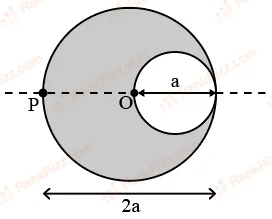
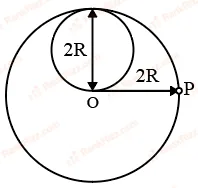
A lamina is made by removing a small disc of diameter 2R from a bigger disc of uniform mass density and radius 2R, as shown in the figure. The moment of inertia of this lamina about axes passing through O and is IOI_O and IPI_P, respectively. Both these axes are perpendicular to the plane of the lamina. The ratio IPIO\frac{I_P}{I_O} to the nearest integer is

Figure for JEE Advanced 2012 Physics question on Moment of inertia of standard bodies and composite systems
Q19Self inductance and energy stored in inductors

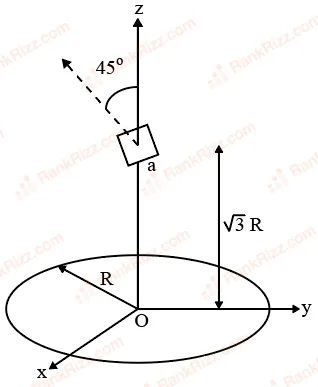
A circular wire loop of radius R is placed in the x-y plane centeredat the origin O. A square loop of side a (a << R) having twoturnsis placed with its center at z=3Rz = \sqrt{3}R along the axis of the circular wire loop, as shownin figure. The plane of the square loop makes an angle of 45∘45^\circ with respectto the z-axis. If the mutual inductance between the loops is given by μ0a22p2R\frac{\mu_0 a^2}{2^{\frac{p}{2}}R}, then the value of p is

Figure for JEE Advanced 2012 Physics question on Self inductance and energy stored in inductors
Q20de Broglie wavelength of matter waves

A proton is fired from very far away towards a nucleus with charge Q = 120 e, where e is the electronic charge. It makes a closest approach of 10 fm to the nucleus. The de Broglie wavelength (in units of fm) of the protonatits start is: (take the proton mass, mp=(53)×10−27m_p = \left(\frac{5}{3}\right) \times 10^{-27} kg; h/e=4.2×10−15h/e = 4.2 \times 10^{-15} J.s/C; 14πε0=9×10⁹\frac{1}{4 \pi ε_0} = 9 \times 10^9 m/f; 1 fm = 10−1510^{-15} m)

NEXT IN THIS PAPER →Chemistry, Q21 onwards