RankRizz

JEE Advanced 2008 Paper 2 Question Paper

All 66 questions of JEE Advanced 2008 Paper 2, in the order they were asked, one subject to a page. Pick an answer on any question to check it against the key. Free to read, nothing to download.

Questions

66

Physics · Chemistry · Maths

Answer key

57

questions with a checked key

Price

Free

no sign-up

Physics

Q1Relation between field and potential, equipotential surfaces

Consider a system of three charges q3,q3\frac{q}{3}, \frac{q}{3} and −2q3-\frac{2q}{3} placed at points A, B and C, respectively, as shown in the figure. Take O to be the centre of the circle of radius R and angle CAB=60∘CAB = 60^\circ
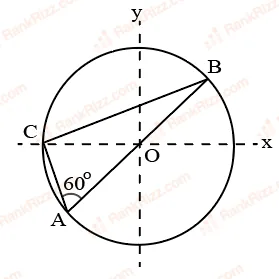
Figure for JEE Advanced 2008 Physics question on Relation between field and potential, equipotential surfaces
  1. A

    The electric field at point O is q8πε0R2\frac{q}{8 \pi \varepsilon_0 R^2} directed along the negative x-axis

  2. B

    The potential energy of the system is zero

  3. C

    The magnitude of the force between the charges at C and B is q254πε0R2\frac{q^2}{54 \pi \varepsilon_0 R^2}

  4. D

    The potential at point O is q12πε0R\frac{q}{12 \pi \varepsilon_0 R}

Q2Radioactivity: decay law, half-life and decay modes

A radioactive sample S1 having an activity of 5μCi5 \mu Ci has twice the number of nuclei as another sample S2 which has anactivity of 10μCi10 \mu Ci. The half lives of S1 and S2
can be

  1. A

    20 years and 5 years, respectively

  2. B

    20 years and 10 years, respectively

  3. C

    10 years each

  4. D

    5 years each

Q3Progressive waves: wave equation, phase and intensity

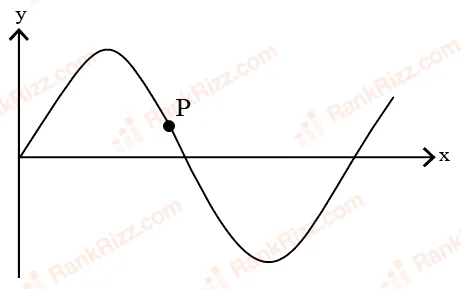
A transverse sinusoidal wave moves along a string in the positive x-direction at a speed of 10 cm/s. The wavelength of the waveis 0.5 m and its amplitude is 10 cm. At a particular time t, the snap-shot of the wave is shown in figure. The velocity of point P when its displacement is 5 cm is

Figure for JEE Advanced 2008 Physics question on Progressive waves: wave equation, phase and intensity
  1. A

    3π50j^\frac{\sqrt{3}\pi}{50}\hat{j} m/s

  2. B

    −3π50j^-\frac{\sqrt{3}\pi}{50}\hat{j} m/s

  3. C

    3π50i^\frac{\sqrt{3}\pi}{50}\hat{i} m/s

  4. D

    −3π50i^-\frac{\sqrt{3}\pi}{50}\hat{i} m/s

Q4Potential energy, conservative forces and energy curves

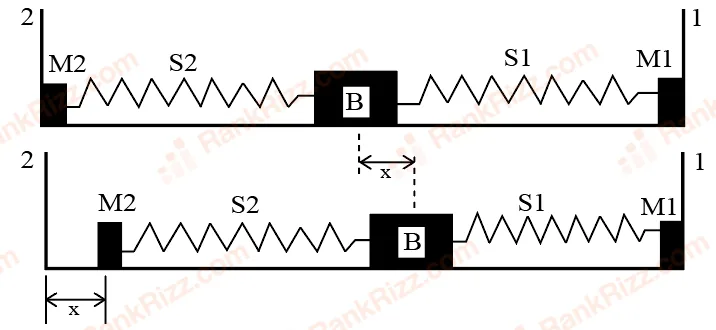
A block (B) is attached to two unstretched springs S1 and S2 with spring constants k and 4k, respectively (see figure I). The other ends are attached to identical supports M1 and M2 not attached to the walls. The springs and supports have negligible mass. There is no friction anywhere. The block B is displaced towards wall 1 by a small distance x (figure II) and released. The block returns and moves a maximum distance y towards wall 2. Displacements x and y are measured with respect to the equilibrium position of the block B. The ratio yx\frac{y}{x} is

Figure for JEE Advanced 2008 Physics question on Potential energy, conservative forces and energy curves
  1. A

    4

  2. B

    2

  3. C

    12\frac{1}{2}

  4. D

    14\frac{1}{4}

Q5Potential energy, conservative forces and energy curves

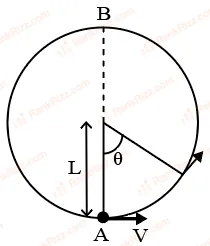
A bob of mass M is suspended by a massless string of length L. The horizontal velocity V at position A is just sufficient to make it reach the point B. The angle θ\theta at which the speed of the bob is half of that at A, satisfies 

Figure for JEE Advanced 2008 Physics question on Potential energy, conservative forces and energy curves
  1. A

    θ=π4\theta = \frac{\pi}{4}

  2. B

    π4<θ<π2\frac{\pi}{4} < \theta < \frac{\pi}{2}

  3. C

    π2<θ<3π4\frac{\pi}{2} < \theta < \frac{3 \pi}{4}

  4. D

    3π4<θ<π\frac{3 \pi}{4} < \theta < \pi

Q6Surface tension and surface energy

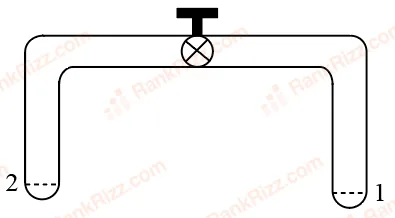
A glass tube of uniform internal radius (r) has a valve separating the two identical ends. Initially, the valve is in a tightly closed position. End 1 has a hemispherical soap bubble of radius r. End 2 has sub-hemispherical soap bubble as shown in figure. Just after opening the valve,

Figure for JEE Advanced 2008 Physics question on Surface tension and surface energy
  1. A

    air from end 1 flows towards end 2. No change in the volumeof the soap bubbles

  2. B

    air from end 1 flows towards end 2. Volumeof the soap bubble at end 1 decreases

  3. C

    no change occurs

  4. D

    air from end 2 flows towards end 1. Volume of the soap bubble at end 1 increases

Q7Superposition, interference and beats

A vibrating string of certain length l under a tension T resonates with a mode corresponding to the first overtone (third harmonic) of an air column of length 75 cm inside a tube closed at one end. The string also generates 4 beats per second when excited along with a tuning fork of frequency n. Now when the tension ofthe string is slightly increased the numberof beats reduces to 2 per second. Assuming the velocity of soundin air to be 340 m/s, the frequency n of the tuning fork in Hz is

  1. A

    344

  2. B

    336

  3. C

    117.3

  4. D

    109.3

Q8Capacitors with dielectrics

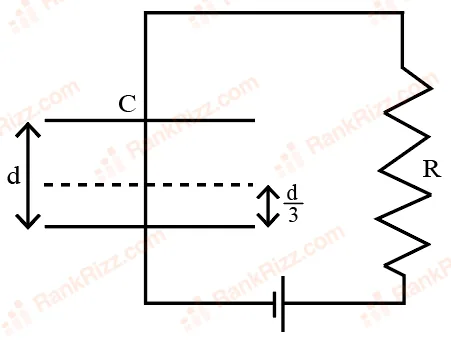
A parallel plate capacitor C with plates of unit area and separation is filled with a liquid of dielectric constant K = 2. The level of liquid is d3\frac{d}{3} initially. Suppose the liquid level decreases at a constant speed V, the time constant as a function of time t is

Figure for JEE Advanced 2008 Physics question on Capacitors with dielectrics
  1. A

    6ε0R5d+3Vt\frac{6 \varepsilon_0 R}{5d + 3V t}

  2. B

    (15d+9Vt)ε0R2d2−3dVt−9V2t2\frac{(15 d + 9V t) \varepsilon_0 R}{2d^2 - 3dV t - 9V^2t^2}

  3. C

    6ε0R5d−3Vt\frac{6 \varepsilon_0 R}{5d - 3V t}

  4. D

    (15d−9Vt)ε0R2d2+3dVt−9V2t2\frac{(15 d - 9V t) \varepsilon_0 R}{2d^2 + 3dV t - 9V^2t^2}

Q9Prism: deviation and dispersion

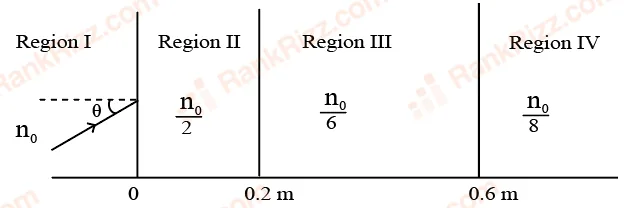
A light beam is traveling from Region I to Region IV (Refer Figure). The refractive index in Regions I, II, III and IV are n0,n02,n06n_0, \frac{n_0}{2}, \frac{n_0}{6} and n08\frac{n_0}{8}, respectively. The angle of incidence θ\theta for which the beam just misses entering Region IV is 

Figure for JEE Advanced 2008 Physics question on Prism: deviation and dispersion
  1. A

    sin⁡−1(34)\sin^{-1}\left(\frac{3}{4}\right)

  2. B

    sin⁡−1(18)\sin^{-1}\left(\frac{1}{8}\right)

  3. C

    sin⁡−1(14)\sin^{-1}\left(\frac{1}{4}\right)

  4. D

    sin⁡−1(13)\sin^{-1}\left(\frac{1}{3}\right)

Q10Relative motion in one dimension

STATEMENT-1
For an observer looking out through the window of a fast moving train, the nearby objects appear to movein the opposite direction to the train, while the distant objects appearto be stationary.
and
STATEMENT-2
If the observer and the object are moving at velocities V1→\overrightarrow{V_1} and V2→\overrightarrow{V_2} respectively with reference to a laboratory frame, the velocity of the object with respect to the observer is V2→−V1→\overrightarrow{V_2} - \overrightarrow{V_1}.

  1. A

    STATEMENT-1 is True, STATEMENT-2 is True; STATEMENT-2 is a correct explanation for STATEMENT-1

  2. B

    STATEMENT-1 is True, STATEMENT-2 is True; STATEMENT-2 is NOT a correct explanation for STATEMENT-1

  3. C

    STATEMENT-1 is True, STATEMENT-2 is False

  4. D

    STATEMENT-1 is False, STATEMENT-2 is True

Q11Static and kinetic friction

STATEMENT-1
It is easier to pull a heavy object than to pushit on a level ground.
and
STATEMENT-2
The magnitude of frictional force depends on the nature of the two surfaces in contact.

  1. A

    STATEMENT-1 is True, STATEMENT-2 is True; STATEMENT-2 is a correct explanation for STATEMENT-1

  2. B

    STATEMENT-1 is True, STATEMENT-2 is True; STATEMENT-2 is NOT a correct explanation for STATEMENT-1

  3. C

    STATEMENT-1 is True, STATEMENT-2 is False

  4. D

    STATEMENT-1 is False, STATEMENT-2 is True

Q12Relation between field and potential, equipotential surfaces

STATEMENT-1
For practical purposes, the earth is used as a reference at zero potential in electrical circuits.
and
STATEMENT-2
The electrical potential of a sphere of radius R with charge Q uniformly distributed on the surface is given by Q4πε0R\frac{Q}{4 \pi \varepsilon_0 R}.

  1. A

    STATEMENT-1 is True, STATEMENT-2 is True; STATEMENT-2 is a correct explanation for STATEMENT-1

  2. B

    STATEMENT-1 is True, STATEMENT-2 is True; STATEMENT-2 is NOT a correct explanation for STATEMENT-1

  3. C

    STATEMENT-1 is True, STATEMENT-2 is False

  4. D

    STATEMENT-1 is False, STATEMENT-2 is True

Q13Moving coil galvanometer

STATEMENT-1
The sensitivity of a moving coil galvanometer is increased by placing a suitable magnetic material as a core inside the coil.
and
STATEMENT-2
Soft iron has a high magnetic permeability and cannot be easily magnetized or demagnetized.

  1. A

    STATEMENT-1 is True, STATEMENT-2 is True; STATEMENT-2 is a correct explanation for STATEMENT-1

  2. B

    STATEMENT-1 is True, STATEMENT-2 is True; STATEMENT-2 is NOT a correct explanation for STATEMENT-1

  3. C

    STATEMENT-1 is True, STATEMENT-2 is False

  4. D

    STATEMENT-1 is False, STATEMENT-2 is True

Q14Electric field of continuous charge distributions

The electric field at r = R is

  1. A

    independent of a

  2. B

    directly proportional to a

  3. C

    directly proportional to a2a^2

  4. D

    inversely proportional to a

Q15Electric charge and Coulomb's law

For a = 0, the value of d (maximum value of ρ\rho as shown in the figure) is

  1. A

    3Ze4πR3\frac{3Ze}{4 \pi R^3}

  2. B

    3ZeπR3\frac{3Ze}{\pi R^3}

  3. C

    4Ze3πR3\frac{4Ze}{3 \pi R^3}

  4. D

    Ze3πR3\frac{Ze}{3 \pi R^3}

Q16Electric field of continuous charge distributions

The electric field within the nucleus is generally observed to be linearly dependent on r. This implies

  1. A

    a = 0

  2. B

    a=R2a = \frac{R}{2}

  3. C

    a = R

  4. D

    a=2R3a = \frac{2R}{3}

Q17Rolling with friction, slipping and impulsive forces

The net external force acting on the disk whenits centre of mass is at displacement x with respect to its equilibrium position is

  1. A

    -kx

  2. B

    -2kx

  3. C

    −2kx3-\frac{2kx}{3}

  4. D

    −4kx3-\frac{4kx}{3}

Q18Rolling with friction, slipping and impulsive forces

The centre of mass of the disk undergoes simple harmonic motion with angular frequency ω\omega equal to

  1. A

    kM\sqrt{\frac{k}{M}}

  2. B

    2kM\sqrt{\frac{2k}{M}}

  3. C

    2k3M\sqrt{\frac{2k}{3M}}

  4. D

    4k3M\sqrt{\frac{4k}{3M}}

Q19Rolling with friction, slipping and impulsive forces

The maximum value of V0V_0 for which the disk will roll without slipping is

  1. A

    μgMk\mu g \sqrt{\frac{M}{k}}

  2. B

    μgM2k\mu g \sqrt{\frac{M}{2k}}

  3. C

    μg3Mk\mu g \sqrt{\frac{3M}{k}}

  4. D

    μg5M2k\mu g \sqrt{\frac{5M}{2k}}

Q20Spring-block oscillations

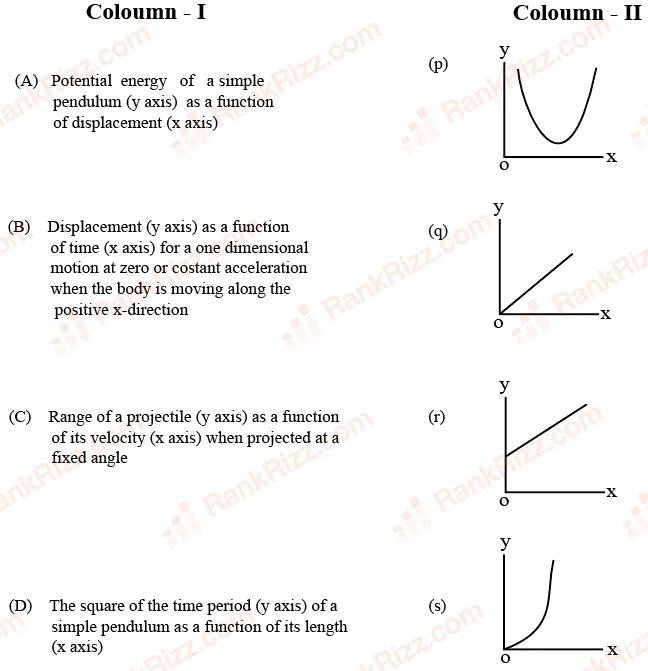
Column I gives a list of possible set of parameters measured in some experiments. The variations of the parameters in the form of graphs are shown in Column II. Match the set of parameters given in Column I with the graphs given in Column II. Indicate your answer by darkening the appropriate bubbles of the 4×44 \times 4 matrix given in the ORS.

Figure for JEE Advanced 2008 Physics question on Spring-block oscillations
Q21Combinations of lenses and mirrors

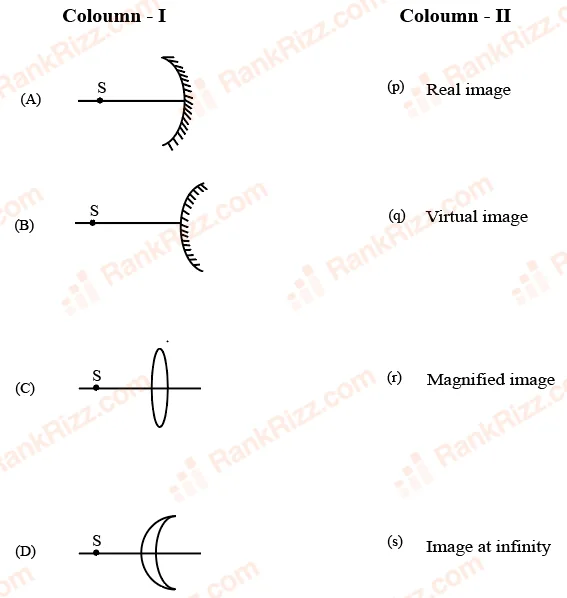
An optical component and an object S placed along its optic axis are given in Column I. The distance between the object and the component can be varied. The properties of images are given in Column II. Match all the properties of images from Column II with the appropriate components given in Column I. Indicate your answer by darkening the appropriate bubbles of the 4×44 \times 4 matrix given in the ORS.

Figure for JEE Advanced 2008 Physics question on Combinations of lenses and mirrors
Q22Multi-step processes and gas-piston-spring systems

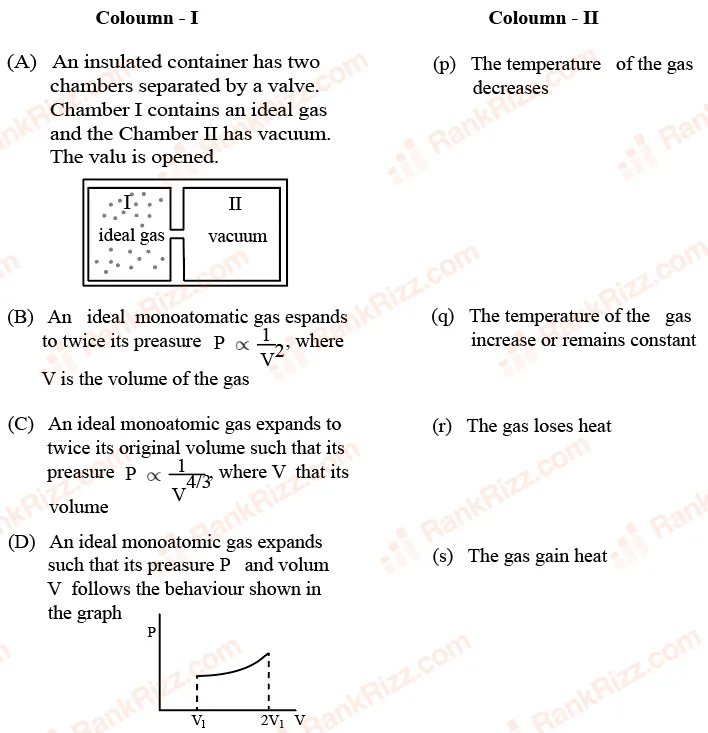
Column I contains a list of processes involving expansion of an ideal gas. Match this with Column II describing the thermodynamic change during this process. Indicate your answer by darkening the appropriate bubbles of the 4 x 4 matrix given in the ORS.

Figure for JEE Advanced 2008 Physics question on Multi-step processes and gas-piston-spring systems
NEXT IN THIS PAPER →Chemistry, Q23 onwards