RankRizz

Superposition, interference and beats — JEE Main Previous Year Questions

Superposition, interference and beats has been asked 41 times in JEE Main, in 15 different years between 2005 and 2026, and in all of the last five exam years (2022–2026), 17 questions in all. That is 24% of Waves, one of its three most-asked topics. Last asked in JEE Main 28 Jan 2026, Shift 2. 24 are multiple choice and 17 numerical-value; 9 easy and 29 medium by our difficulty labels. All of them are below, newest first, free to read.

Questions

41

Years asked

15

Since

2005

Of the chapter

24%

Every Superposition, interference and beats question

21–40 OF 41 · NEWEST FIRST

JEE MAIN 2021 · 26 FEB S2Superposition, interference and beats

A tuning fork AA of unknown frequency produces 5 beats s−1^{-1} with a fork of known frequency 340 Hz. When fork AA is filed, the beat frequency decreases to 2 beats s−1^{-1}. What is the frequency of fork AA?

  1. A

    335 Hz

  2. B

    338 Hz

  3. C

    345 Hz

  4. D

    342 Hz

JEE MAIN 2021 · 25 FEB S1Superposition, interference and beats

A student is performing the experiment of the resonance column. The diameter of the column tube is 6 cm. The frequency of the tuning fork is 504 Hz. Speed of the sound at the given temperature is 336 m s−1^{-1}. The zero of the meter scale coincides with the top end of the resonance column tube. The reading of the water level in the column when the first resonance occurs is:

  1. A

    14.8 cm

  2. B

    18.4 cm

  3. C

    16.6 cm

  4. D

    13 cm

JEE MAIN 2020 · 05 SEP S1Superposition, interference and beats

In a resonance tube experiment when the tube is filled with water up to a height of 17.0 cm17.0\,\text{cm}, from bottom, it resonates with a given tuning fork. When the water level is raised the next resonance with the same tuning fork occurs at a height of 24.5 cm24.5\,\text{cm}. If the velocity of sound in air is 330 m s−1330\,\text{m s}^{-1}, the tuning fork frequency is:

  1. A

    2200 Hz2200\,\text{Hz}

  2. B

    550 Hz550\,\text{Hz}

  3. C

    1100 Hz1100\,\text{Hz}

  4. D

    3300 Hz3300\,\text{Hz}

JEE MAIN 2020 · 02 SEP S2Superposition, interference and beats

A wire of density 9×10−39 \times 10^{-3} kg cm−3^{-3} is stretched between two clamps 1 m apart. The resulting strain in the wire is 4.9×10−44.9 \times 10^{-4}. The lowest frequency of the transverse vibrations in the wire (Young's modulus of wire Y=9×10¹⁰Y = 9 \times 10^{10} Nm−2^{-2}), (to the nearest integer) is ___________.

JEE MAIN 2020 · 09 JAN S2Superposition, interference and beats

A wire of length LL and mass per unit length 6.0×10−36.0 \times 10^{-3} kg m−1^{-1} is put under tension of 540 N. Two consecutive frequencies that it resonates at are: 420 Hz and 490 Hz. Then LL in meters is:

  1. A

    2.1 m

  2. B

    1.1 m

  3. C

    8.1 m

  4. D

    5.1 m

JEE MAIN 2020 · 08 JAN S1Superposition, interference and beats

A one metre long (both ends open) organ pipe is kept in a gas that has double the density of air at STP. Assuming the speed of sound in air at STP is 300 m/s, the frequency difference between the fundamental and second harmonic of this pipe is __________ Hz.

JEE MAIN 2019 · 12 APR S2Superposition, interference and beats

A tuning fork of frequency 480 Hz is used in an experiment for measuring speed of sound (v) in air by resonance tube method. Resonance is observed to occur at two successive lengths of the air column, l1_1 = 30 cm and l2_2 = 70 cm. Then, v is equal to:

  1. A

    384 m s−1^{-1}

  2. B

    332 m s−1^{-1}

  3. C

    338 m s−1^{-1}

  4. D

    379 m s−1^{-1}

JEE MAIN 2019 · 09 APR S1Superposition, interference and beats

A string is clamped at both the ends and it is vibrating in its 4th harmonic. The equation of the stationary wave is y=0.3sin⁡(0.157x)cos⁡(200πt)y = 0.3 \sin(0.157x) \cos(200\pi t). The length of the string is: (All quantities are in SI units.)

  1. A

    20 m

  2. B

    60 m

  3. C

    40 m

  4. D

    80 m

JEE MAIN 2019 · 09 APR S2Superposition, interference and beats

A string 2.0 m long and fixed at its ends is driven by a 240 Hz vibrator. The string vibrates in its third harmonic mode. The speed of the wave and its fundamental frequency is:

  1. A

    320 m s−1^{-1}, 120 Hz

  2. B

    320 m s−1^{-1}, 80 Hz

  3. C

    180 m s−1^{-1}, 80 Hz

  4. D

    180 m s−1^{-1}, 120 Hz

JEE MAIN 2019 · 08 APR S1Superposition, interference and beats

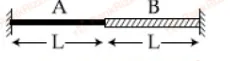
A wire of length 2L, is made by joining two wires A and B of same length but different radii r and 2r and made of the same material. It is vibrating at a frequency such that the joint of the two wires forms a node. If the number of antinodes in wire A is p and that in B is q then ratio p:q is:

Figure for JEE Main 2019 Physics question on Superposition, interference and beats
  1. A

    3 : 5

  2. B

    4 : 9

  3. C

    1 : 4

  4. D

    1 : 2

JEE MAIN 2019 · 12 JAN S2Superposition, interference and beats

A resonance tube is old and has a jagged end. It is still used in the laboratory to determine the velocity of sound in air. A tuning fork of frequency 512 Hz produces first resonance when the tube is filled with water to a mark 11 cm below a reference mark, near the open end of the tube. The experiment is repeated with another fork of frequency 256 Hz which produces first resonance when water reaches a mark 27 cm below the reference mark. The velocity of sound in air, obtained in the experiment, is close to

  1. A

    335 m s−1^{-1}

  2. B

    341 m s−1^{-1}

  3. C

    322 m s−1^{-1}

  4. D

    328 m s−1^{-1}

JEE MAIN 2019 · 10 JAN S2Superposition, interference and beats

A closed organ pipe has a fundamental frequency of 1.5 kHz. The number of overtones that can be distinctly heard by a person with this organ pipe will be (Assume that the highest frequency a person can hear is 20,000 Hz).

  1. A

    7

  2. B

    4

  3. C

    6

  4. D

    5

JEE MAIN 2018 · 16 APR ONLINESuperposition, interference and beats

Two sitar strings, A and B playing the note 'Dha' are slightly out of tune and produce beats of frequency 5 Hz. The tension of the string B is slightly increased and the beat frequency is found to decrease by 3 Hz. If the frequency of A is 425 Hz. The original frequency of B is:

  1. A

    428 Hz

  2. B

    430 Hz

  3. C

    422 Hz

  4. D

    420 Hz

JEE MAIN 2018 · 15 APR S2Superposition, interference and beats

5 beats/second are heard when a turning fork is sounded with a sonometer wire under tension, when the length of the sonometer wire is either 0.95 m or 1 m. The frequency of the fork will be:

  1. A

    195 Hz

  2. B

    251 Hz

  3. C

    150 Hz

  4. D

    300 Hz

JEE MAIN 2016 · 03 APR OFFLINESuperposition, interference and beats

A pipe open at both ends has a fundamental frequency ff in air. The pipe is dipped vertically in water so that half of it is in water. The fundamental frequency of the air column is now:

  1. A

    2ff

  2. B

    ff

  3. C

    f2\frac{f}{2}

  4. D

    3f4\frac{3f}{4}

JEE MAIN 2014 · 19 APR ONLINESuperposition, interference and beats

The total length of a sonometer wire fixed between two bridges is 110 cm. Now, two more bridges are placed to divide the length of the wire in the ratio 6 : 3 : 2. If the tension in the wire is 400 N and the mass per unit length of the wire is 0.01 kg m−1^{-1}, then the minimum common frequency with which all the three parts can vibrate, is:

  1. A

    1000 Hz

  2. B

    1100 Hz

  3. C

    100 Hz

  4. D

    110 Hz

JEE MAIN 2014 · 06 APR OFFLINESuperposition, interference and beats

A pipe of length 85 cm is closed from one end. Find the number of possible natural oscillations of air column in the pipe whose frequencies lie below 1250 Hz. The velocity of sound in air is 340 m/s.

  1. A

    12

  2. B

    8

  3. C

    6

  4. D

    4

JEE MAIN 2013 · 23 APR ONLINESuperposition, interference and beats

A sonometer wire of length 114 cm is fixed at both the ends. Where should the two bridges be placed so as to divide the wire into three segments whose fundamental frequencies are in the ratio 1 : 3 : 4?

  1. A

    At 36 cm and 84 cm from one end

  2. B

    At 24 cm and 72 cm from one end

  3. C

    At 48 cm and 96 cm from one end

  4. D

    At 72 cm and 96 cm from one end

JEE MAIN 2012Superposition, interference and beats

Following are expressions for four plane simple harmonic waves (i) y1=Acos⁡2π(n1t+xλ1)y_1 = A \cos 2\pi \left(n_1 t + \dfrac{x}{\lambda_1}\right) (ii) y2=Acos⁡2π(n1t+xλ1+0.5)y_2 = A \cos 2\pi \left(n_1 t + \dfrac{x}{\lambda_1} + 0.5\right) (iii) y3=Acos⁡2π(n2t+xλ2)y_3 = A \cos 2\pi \left(n_2 t + \dfrac{x}{\lambda_2}\right) (iv) y4=Acos⁡2π(n2t−xλ2)y_4 = A \cos 2\pi \left(n_2 t - \dfrac{x}{\lambda_2}\right). The pairs of waves which will produce destructive interference and stationary waves respectively in a medium, are

  1. A

    (iii, iv), (i, ii)

  2. B

    (i, iii), (ii, iv)

  3. C

    (i, iv), (ii, iii)

  4. D

    (i, ii), (iii, iv)

JEE MAIN 2009Superposition, interference and beats

Three sound waves of equal amplitudes have frequencies (v−1),v,(v+1)(v - 1), v, (v + 1). They superpose to give beats. The number of beats produced per second will be

  1. A

    44

  2. B

    33

  3. C

    22

  4. D

    11