JEE MAIN 2024 · 29 JAN S2Motion of charged particles in a magnetic field
A charge of C is moving with a velocity of along the positive -axis under a magnetic field of strength T. The force acting on the charge is N. The value of is ______.
Motion of charged particles in a magnetic field has been asked 69 times in JEE Main, in 15 different years between 2005 and 2026, and in all of the last five exam years (2022–2026), 37 questions in all. That is 28% of Moving Charges & Magnetism, one of its three most-asked topics. Last asked in JEE Main 08 Apr 2026, Shift 2. 55 are multiple choice and 14 numerical-value; 29 easy, 33 medium and 1 hard by our difficulty labels. All of them are below, newest first, free to read.
Questions
69
Years asked
15
Since
2005
Of the chapter
28%
21–40 OF 69 · NEWEST FIRST
A charge of C is moving with a velocity of along the positive -axis under a magnetic field of strength T. The force acting on the charge is N. The value of is ______.
A proton moving with a constant velocity passes through a region of space without any change in its velocity. If and represent the electric and magnetic fields respectively, then the region of space may have :
(A) ; (B) ; (C) ; (D) . Choose the most appropriate answer from the options given below :
(A), (B) and (C) only
(A), (C) and (D) only
(A), (B) and (D) only
(B), (C) and (D) only
An electron is moving along the positive x-axis. If uniform magnetic field is applied parallel to the negative z-axis, then
A. The electron will experience magnetic force along positive y-axis
B. The electron will experience magnetic force along negative y-axis
C. The electron will not experience any force in magnetic field
D. The electron will continue to move along the positive x-axis
E. The electron will move along circular path in magnetic field
Choose the correct answer from the option given below:
A and E only
C and D only
B and E only
B and D only
A charge particle moving in magnetic field B, has the components of velocity along B as well as perpendicular to B. The path of the charge particle will be
helical path with the axis perpendicular to the direction of magnetic field B
helical path with the axis along magnetic field B
circular path
straight along the direction of magnetic field B
A proton with a kinetic energy of 2.0 eV moves into a region of uniform magnetic field of magnitude T. The angle between the direction of magnetic field and velocity of proton is 60°. The pitch of the helical path taken by the proton is ______ cm. (Take, mass of proton = kg and charge on proton = C).
A charge particle of 2 C accelerated by a potential difference of 100 V enters a region of uniform magnetic field of magnitude 4 mT at right angle to the direction of field. The charge particle completes semicircle of radius 3 cm inside magnetic field. The mass of the charge particle is _____ kg.
A cyclotron is used to accelerate protons. If the operating magnetic field is 1.0 T and the radius of the cyclotron 'dees' is 60 cm, the kinetic energy of the accelerated protons in MeV will be: [use kg, C]
12
18
16
32
A charge particle is moving in a uniform magnetic field . If it has an acceleration of , then the value of will be
A velocity selector consists of electric field and magnetic field with . The value required for an electron of energy moving along the positive x-axis to pass undeflected is (Given, mass of electron )
Two charged particles, having same kinetic energy, are allowed to pass through a uniform magnetic field perpendicular to the direction of motion. If the ratio of radii of their circular paths is and their respective masses ratio is . Then, the ratio of their charges will be
A charge particle moves along circular path in a uniform magnetic field in a cyclotron. The kinetic energy of the charge particle increases to 4 times its initial value. What will be the ratio of new radius to the original radius of circular path of the charge particle?
1 : 1
1 : 2
2 : 1
1 : 4
Given below are two statements:
Statement I: The electric force changes the speed of the charged particle and hence changes its kinetic energy; whereas the magnetic force does not change the kinetic energy of the charged particle.
Statement II: The electric force accelerates the positively charged particle perpendicular to the direction of electric field. The magnetic force accelerates the moving charged particle along the direction of magnetic field.
In the light of the above statements, choose the most appropriate answer from the options below:
Both Statement I and Statement II are correct.
Both Statement I and Statement II are incorrect.
Statement I is correct but Statement II is incorrect.
Statement I is incorrect but Statement II is correct.
A singly ionized magnesium atom ion is accelerated to kinetic energy keV, and is projected perpendicularly into a magnetic field of the magnitude T. The radius of path formed will be ______ cm.
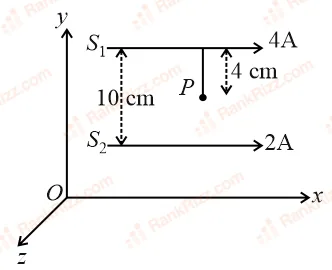
Two long parallel conductors and are separated by a distance cm and carrying currents of A and A respectively. The conductors are placed along -axis in plane. There is a point located between the conductors (as shown in figure).
A charge particle of coulomb is passing through the point with velocity m s.
The force acting on the charge particle is N. The value of is
A deuteron and a proton moving with equal kinetic energy enter into a uniform magnetic field at right angle to the field. If and are the radii of their circular paths respectively, then the ratio will be where is ______
A proton and an alpha particle of the same velocity enter in a uniform magnetic field which is acting perpendicular to their direction of motion. The ratio of the radii of the circular paths described by the alpha particle and proton is
A proton, a deuteron and an -particle with same kinetic energy enter into a uniform magnetic field at right angle to magnetic field. The ratio of the radii of their respective circular paths is :
None of these
Two ions of masses 4 amu and 16 amu have charges +2e and +3e respectively. These ions pass through the region of the constant perpendicular magnetic field. The kinetic energy of both ions is the same. Then:
lighter ion will be deflected less than heavier ion
lighter ion will be deflected more than heavier ion
both ions will be deflected equally
no ion will be deflected
If the maximum value of accelerating potential provided by a radio frequency oscillator is 12 kV. The number of revolution made by a proton in a cyclotron to achieve one sixth the speed of light is:
[ kg, C, Speed of light = m s]
Two ions having same mass have charges in the ratio 1 : 2. They are projected normally in a uniform magnetic field with their speeds in the ratio 2 : 3. The ratio of the radii of their circular trajectories is,
1 : 4
4 : 3
3 : 1
2 : 3