Stress, strain, Hooke's law and Young's modulus — JEE Main Previous Year Questions
Stress, strain, Hooke's law and Young's modulus has been asked 70 times in JEE Main, in 14 different years between 2006 and 2026, and in all of the last five exam years (2022–2026), 46 questions in all. That is 56% of Mechanical Properties of Solids, its most-asked topic. Last asked in JEE Main 06 Apr 2026, Shift 2. 45 are multiple choice and 25 numerical-value; 33 easy and 33 medium by our difficulty labels. All of them are below, newest first, free to read.
Every Stress, strain, Hooke's law and Young's modulus question
41–60 OF 70 · NEWEST FIRST
JEE MAIN 2022 · 27 JUL S2Stress, strain, Hooke's law and Young's modulus
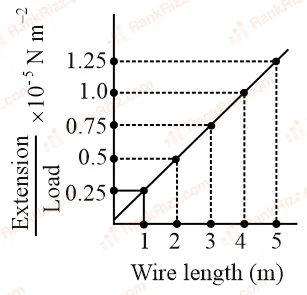
In an experiment to determine the Young's modulus, steel wires of five different lengths (1, 2, 3, 4 and 5 m) but of same cross-section area (2mm2) were taken and the curves between extension and load were obtained. The slope (extension/load) of the curves were plotted with the wire length and the following graph was obtained. If the Young's modulus of the given steel wire is x×1011Nm−2, then the value of x is _____
JEE MAIN 2022 · 26 JUL S2Stress, strain, Hooke's law and Young's modulus
The area of cross section of the rope used to lift a load by a crane is 2.5×10⁻⁴ m2. The maximum lifting capacity of the crane is 10 metric tons. To increase the lifting capacity of the crane to 25 metric tons, the required area of cross section of the rope should be (take g=10 m s−2)
JEE MAIN 2022 · 26 JUL S2Stress, strain, Hooke's law and Young's modulus
A uniform heavy rod of mass 20 kg, cross sectional area 0.4 m2 and length 20 m is hanging from a fixed support. Neglecting the lateral contraction, the elongation in the rod due to its own weight is x×10−9 m. The value of x is ______. (Given: Young's modulus Y=2×10¹¹ N m−2 and g=10 m s−2)
JEE MAIN 2022 · 25 JUL S1Stress, strain, Hooke's law and Young's modulus
A wire of length L and radius r is clamped rigidly at one end. When the other end of the wire is pulled by a force F, its length increases by 5 cm. Another wire of the same material of length 4L and radius 4r is pulled by a force 4F under same conditions. The increase in length of this wire is ______ cm.
JEE MAIN 2022 · 29 JUN S1Stress, strain, Hooke's law and Young's modulus
A wire of length L is hanging from a fixed support. The length changes to L1 and L2 when masses 1 kg and 2 kg are suspended respectively from its free end. Then the value of L is equal to
JEE MAIN 2022 · 26 JUN S1Stress, strain, Hooke's law and Young's modulus
The elongation of a wire on the surface of the earth is 10−4 m. The same wire of same dimensions is elongated by 6×10⁻⁵ m on another planet. The acceleration due to gravity on the planet will be ______ m s−2. (Take acceleration due to gravity on the surface of earth =10 m s−2)
JEE MAIN 2021 · 31 AUG S1Stress, strain, Hooke's law and Young's modulus
A uniform heavy rod of weight 10 kg m s−2, cross-sectional area 100 cm2 and length 20 cm is hanging from a fixed support. Young modulus of the material of the rod is 2×10¹¹ N m−2. Neglecting the lateral contraction, find the elongation of rod due to its own weight:
JEE MAIN 2021 · 31 AUG S2Stress, strain, Hooke's law and Young's modulus
Four identical hollow cylindrical columns of mild steel support a big structure of mass 50×103 kg. The inner and outer radii of each column are 50 cm and 100 cm respectively. Assuming uniform local distribution, calculate the compression strain of each column. [use Y=2.0×10¹¹ Pa, g=9.8 m s−2]
JEE MAIN 2021 · 27 AUG S2Stress, strain, Hooke's law and Young's modulus
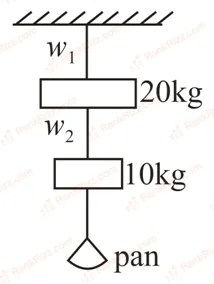
Wires W1 and W2 are made of same material having the breaking stress of 1.25×10⁹ N m−2. W1 and W2 have cross-sectional area of 8×10⁻⁷ m2 and 4×10⁻⁷ m2, respectively. Masses of 20 kg and 10 kg hang from them as shown in the figure. The maximum mass that can be placed in the pan without breaking the wires is _________ kg (Use g = 10 m s−2)
JEE MAIN 2021 · 26 AUG S2Stress, strain, Hooke's law and Young's modulus
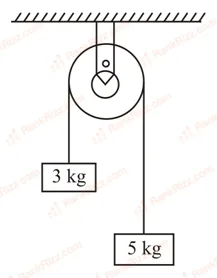
Two blocks of masses 3 kg and 5 kg are connected by a metal wire going over a smooth pulley. The breaking stress of the metal is π24×102 N m−2. What is the minimum radius of the wire?
JEE MAIN 2021 · 25 JUL S1Stress, strain, Hooke's law and Young's modulus
Two wires of same length and radius are joined end to end and loaded. The Young's moduli of the materials of the two wires are Y1 and Y2. The combination behaves as a single wire then its Young's modulus is:
JEE MAIN 2021 · 20 JUL S1Stress, strain, Hooke's law and Young's modulus
The value of tension in a long thin metal wire has been changed from T1 to T2. The lengths of the metal wire at two different values of tension T1 and T2 are ℓ1 and ℓ2, respectively. The actual length of the metal wire is:
JEE MAIN 2021 · 24 FEB S2Stress, strain, Hooke's law and Young's modulus
A uniform metallic wire is elongated by 0.04 m when subjected to a linear force F. The elongation, if its length and diameter is doubled and subjected to the same force will be ______ cm.
JEE MAIN 2020 · 06 SEP S1Stress, strain, Hooke's law and Young's modulus
An object of mass m is suspended at the end of a massless wire of length L and area of cross-section, A. Young modulus of the material of the wire is Y. If the mass is pulled down slightly its frequency of oscillation along the vertical direction is:
JEE MAIN 2020 · 09 JAN S1Stress, strain, Hooke's law and Young's modulus
A body of mass m=10 kg is attached to one end of a wire of length 0.3 m. What is the maximum angular speed (in rad s−1) with which it can be rotated about its other end in a space station without breaking the wire? [Breaking stress of wire (σ)=4.8×10⁷ N m−2 and area of cross-section of the wire =10−2cm2]
JEE MAIN 2019 · 10 APR S2Stress, strain, Hooke's law and Young's modulus
The elastic limit of brass is 379 MPa. The minimum diameter of a brass rod if it is to support a 400 N load without exceeding its elastic limit will be
JEE MAIN 2019 · 10 APR S2Stress, strain, Hooke's law and Young's modulus
In an experiment, brass and steel wires of length 1 m each with areas of cross section 1 mm2 are used. The wires are connected in series and one end of the combined wire is connected to a rigid support and other end is subjected to elongation. The stress required to produce a net elongation of 0.2 mm is, [Given, the Young's Modulus for steel and brass are, respectively, 120×109 N/m2 and 60×109 N/m2]
JEE MAIN 2019 · 08 APR S1Stress, strain, Hooke's law and Young's modulus
A steel wire having a radius of 2.0 mm, carrying a load of 4 kg, is hanging from a ceiling. Given that g = 3.1π m s−2, what will be the tensile stress that would be developed in the wire?