JEE MAIN 2022 · 28 JUN S1Surface tension and surface energy
A water drop of diameter cm is broken into equal droplets. The surface tension of water is N m. In this process the gain in surface energy will be
- A
J
- B
J
- C
J
- D
J
Surface tension and surface energy has been asked 28 times in JEE Main, in 11 different years between 2011 and 2026, and in all of the last five exam years (2022–2026), 21 questions in all. That is 15% of Mechanical Properties of Fluids, one of its three most-asked topics. Last asked in JEE Main 05 Apr 2026, Shift 2. 21 are multiple choice and 7 numerical-value; 9 easy and 16 medium by our difficulty labels. All of them are below, newest first, free to read.
Questions
28
Years asked
11
Since
2011
Of the chapter
15%
21–28 OF 28 · NEWEST FIRST
A water drop of diameter cm is broken into equal droplets. The surface tension of water is N m. In this process the gain in surface energy will be
J
J
J
J
Two small drops of mercury each of radius coalesce to form a single large drop. The ratio of total surface energy before and after the change is:
A small spherical droplet of density is floating exactly half immersed in a liquid of density and surface tension . The radius of the droplet is (take note that the surface tension applies an upward force on the droplet):
A large number of liquid drops each of radius r coalesce to form a single drop of the radius R. The energy released in the process is converted into kinetic energy of the big drop so formed. The speed of the big drop is (given surface tension of the liquid T, density )
Assume that a drop of a liquid evaporates by a decrease in its surface energy so that its temperature remains unchanged. The minimum radius of the drop for this to be possible is. (The surface tension is T, the density of the liquid is and L is its latent heat of vaporisation.)
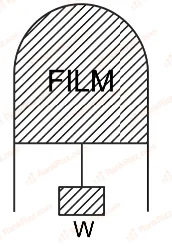
A thin liquid film formed between a U-shaped wire and a light slider supports a weight of N (see figure). The length of the slider is cm and its weight negligible. The surface tension of the liquid film is
A large number of droplets, each of radius coalesce to form a bigger drop of radius . An engineer designs a machine so that the energy released in this process is converted into the kinetic energy of the drop. Velocity of the drop is ( = surface tension, = density)
Work done in increasing the size of a soap bubble from a radius of to is nearly (Surface tension of soap solution ):
RELATED MECHANICAL PROPERTIES OF FLUIDS TOPICS