RankRizz

Stokes' law and terminal velocity — JEE Main Previous Year Questions

Stokes' law and terminal velocity has been asked 34 times in JEE Main, in 14 different years between 2004 and 2026, and in all of the last five exam years (2022–2026), 24 questions in all. That is 18% of Mechanical Properties of Fluids, its most-asked topic. Last asked in JEE Main 08 Apr 2026, Shift 2. 26 are multiple choice and 8 numerical-value; 11 easy and 19 medium by our difficulty labels. All of them are below, newest first, free to read.

Questions

34

Years asked

14

Since

2004

Of the chapter

18%

Every Stokes' law and terminal velocity question

21–34 OF 34 · NEWEST FIRST

JEE MAIN 2022 · 29 JUN S2Stokes' law and terminal velocity

A small spherical ball of radius 0.1 mm and density 10410^4 kg m−3^{-3} falls freely under gravity through a distance hh before entering a tank of water. If, after entering the water the velocity of ball does not change and it continue to fall with same constant velocity inside water, then the value of hh will be ______ m. (Given g=10g = 10 m s−2^{-2}, viscosity of water =1.0×10−5= 1.0 \times 10^{-5} N-s m−2^{-2}).

JEE MAIN 2022 · 28 JUN S2Stokes' law and terminal velocity

A water drop of radius 1μ1 \mum falls in a situation where the effect of buoyant force is negligible. Co-efficient of viscosity of air is 1.8×10−51.8 \times 10^{-5} N s m−2^{-2} and its density is negligible as compared to that of water 10610^6 g m−3^{-3}. Terminal velocity of the water drop is
(Take acceleration due to gravity =10= 10 m s−2^{-2})

  1. A

    145.4×10−6145.4 \times 10^{-6} m s−1^{-1}

  2. B

    123.4×10−6123.4 \times 10^{-6} m s−1^{-1}

  3. C

    118.0×10−6118.0 \times 10^{-6} m s−1^{-1}

  4. D

    132.6×10−6132.6 \times 10^{-6} m s−1^{-1}

JEE MAIN 2022 · 27 JUN S1Stokes' law and terminal velocity

The velocity of a small ball of mass mm and density d1d_1, when dropped in a container filled with glycerine, becomes constant after some time. If the density of glycerine is d2d_2, then the viscous force acting on the ball will be

  1. A

    mg(1−d1d2)mg\left(1 - \frac{d_1}{d_2}\right)

  2. B

    mg(1−d2d1)mg\left(1 - \frac{d_2}{d_1}\right)

  3. C

    mg(d1d2−1)mg\left(\frac{d_1}{d_2} - 1\right)

  4. D

    mg(d2d1−1)mg\left(\frac{d_2}{d_1} - 1\right)

JEE MAIN 2022 · 25 JUN S1Stokes' law and terminal velocity

The terminal velocity vtv_t of the spherical rain drop depends on the radius rr of the spherical rain drop as

  1. A

    rr

  2. B

    r2r^2

  3. C

    1r\frac{1}{r}

  4. D

    1r2\frac{1}{r^2}

JEE MAIN 2021 · 27 AUG S1Stokes' law and terminal velocity

In Millikan's oil drop experiment, what is viscous force acting on an uncharged drop of radius 2.0×10−52.0 \times 10^{-5} m and density 1.2×1031.2 \times 10^3 kg m−3^{-3}? Take viscosity of liquid = 1.8×10−51.8 \times 10^{-5} N s m−2^{-2}. (Neglect buoyancy due to air).

  1. A

    5.8×10−105.8 \times 10^{-10} N

  2. B

    3.9×10−103.9 \times 10^{-10} N

  3. C

    1.8×10−101.8 \times 10^{-10} N

  4. D

    3.8×10−113.8 \times 10^{-11} N

JEE MAIN 2021 · 27 JUL S2Stokes' law and terminal velocity

A raindrop with radius R = 0.2 mm falls from a cloud at a height h = 2000 m above the ground. Assume that the drop is spherical throughout its fall and the force of buoyancy may be neglected, then the terminal speed attained by the raindrop is: [Density of water fw=1000f_w = 1000 kg m−3^{-3} and Density of air fa=1.2f_a = 1.2 kg m−3^{-3}, g = 10 m/s2^2, Coefficient of viscosity of air = 1.8×10−51.8 \times 10^{-5} N s m−2^{-2}]

  1. A

    250.6 m s−1^{-1}

  2. B

    43.56 m s−1^{-1}

  3. C

    4.94 m s−1^{-1}

  4. D

    14.4 m s−1^{-1}

JEE MAIN 2020 · 05 SEP S2Stokes' law and terminal velocity

In an experiment to verify Stokes law, a small spherical ball of radius rr and density ρ\rho falls under gravity through a distance hh in air before entering a tank of water. If the terminal velocity of the ball inside water is same as its velocity just before entering the water surface, then the value of hh is proportional to: (ignore viscosity of air)

  1. A

    r4r^4

  2. B

    rr

  3. C

    r3r^3

  4. D

    r2r^2

JEE MAIN 2019 · 12 APR S2Stokes' law and terminal velocity

A solid sphere, of radius R acquires a terminal velocity v1v_1 when falling (due to gravity) through a viscous fluid having a coefficient of viscosity η\eta. The sphere is broken into 27 identical solid spheres. If each of these spheres acquires a terminal velocity, v2v_2, when falling through the same fluid, the ratio (v1v2)\left(\frac{v_1}{v_2}\right) equals:

  1. A

    19\frac{1}{9}

  2. B

    27

  3. C

    127\frac{1}{27}

  4. D

    9

JEE MAIN 2016 · 09 APR ONLINEStokes' law and terminal velocity

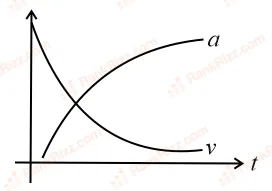
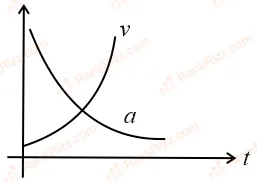
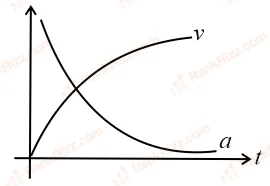
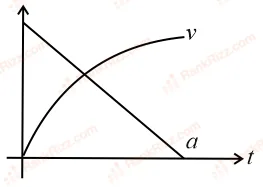
Which of the following option correctly describes the variation of the speed v and acceleration 'a' of a point mass falling vertically in a viscous medium that applies a force F=−kvF = -kv, where 'k' is a constant, on the body? (Graphs are schematic and not drawn to scale)

  1. A
    Figure for JEE Main 2016 Physics question on Stokes' law and terminal velocity
  2. B
    Figure for JEE Main 2016 Physics question on Stokes' law and terminal velocity
  3. C
    Figure for JEE Main 2016 Physics question on Stokes' law and terminal velocity
  4. D
    Figure for JEE Main 2016 Physics question on Stokes' law and terminal velocity
JEE MAIN 2013 · 25 APR ONLINEStokes' law and terminal velocity

In an experiment, a small steel ball falls through a liquid at a constant speed of 10 cm/s. If the steel ball is pulled upward with a force equal to twice its effective weight, how fast will it move upward?

  1. A

    5 cm/s

  2. B

    Zero

  3. C

    10 cm/s

  4. D

    20 cm/s

JEE MAIN 2012Stokes' law and terminal velocity

The terminal velocity of a small sphere of radius aa in a viscous liquid is proportional to

  1. A

    a2a^2

  2. B

    a3a^3

  3. C

    aa

  4. D

    a−1a^{-1}

JEE MAIN 2008Stokes' law and terminal velocity

A spherical solid ball of volume VV is made of a material of density ρ1\rho_1. It is falling through a liquid of density ρ2 (ρ2<ρ1)\rho_2\ (\rho_2 < \rho_1). Assume that the liquid applies a viscous force on the ball that is proportional to the square of its speed v, i.e., Fviscous=−kv2(k>0)F_{viscous} = -kv^2 (k > 0). The terminal speed of the ball is

  1. A

    Vg(ρ1−ρ2)k\sqrt{\frac{Vg(\rho_1 - \rho_2)}{k}}

  2. B

    Vgρ1k\frac{Vg\rho_1}{k}

  3. C

    Vgρ1k\sqrt{\frac{Vg\rho_1}{k}}

  4. D

    Vg(ρ1−ρ2)k\frac{Vg(\rho_1 - \rho_2)}{k}

JEE MAIN 2006Stokes' law and terminal velocity

If the terminal speed of a sphere of gold (density =19.5 kg/m3= 19.5\,kg/m^3) is 0.2 m/s0.2\,m/s in a viscous liquid (density =1.5 kg/m3= 1.5\,kg/m^3) of the same size in the same liquid.

  1. A

    0.2 m/s

  2. B

    0.4 m/s

  3. C

    0.133 m/s

  4. D

    0.1 m/s

JEE MAIN 2004Stokes' law and terminal velocity

Spherical balls of radius RR are falling in a viscous fluid of viscosity η\eta with a velocity vv. The retarding viscous force acting on the spherical ball is

  1. A

    directly proportional to RR but inversely proportional to vv.

  2. B

    directly proportional to both radius RR and velocity vv.

  3. C

    inversely proportional to both radius RR and velocity vv.

  4. D

    inversely proportional to RR but directly proportional to velocity vv.