RankRizz

Fluid pressure, Pascal's law and accelerated/rotating liquids — JEE Main Previous Year Questions

Fluid pressure, Pascal's law and accelerated/rotating liquids has been asked 24 times in JEE Main, in 10 different years between 2014 and 2026, and in all of the last five exam years (2022–2026), 13 questions in all. That is 12% of Mechanical Properties of Fluids, one of its three most-asked topics. Last asked in JEE Main 23 Jan 2026, Shift 2. 18 are multiple choice and 6 numerical-value; 11 easy and 13 medium by our difficulty labels. All of them are below, newest first, free to read.

Questions

24

Years asked

10

Since

2014

Of the chapter

12%

Every Fluid pressure, Pascal's law and accelerated/rotating liquids question

21–24 OF 24 · NEWEST FIRST

JEE MAIN 2018 · 15 APR S1Fluid pressure, Pascal's law and accelerated/rotating liquids

A thin uniform tube is bent into a circle of radius r in the vertical plane. Equal volumes of two immiscible liquids, whose densities are ρ1\rho_1 and ρ2\rho_2 (ρ1>ρ2\rho_1 > \rho_2) fill half the circle. The angle θ\theta between the radius vector passing through the common interface and the vertical is:

  1. A

    θ=tan⁡−1[π2(ρ1−ρ2ρ1+ρ2)]\theta = \tan^{-1}\left[\frac{\pi}{2}\left(\frac{\rho_1 - \rho_2}{\rho_1 + \rho_2}\right)\right]

  2. B

    θ=tan⁡−1π2(ρ1+ρ2ρ1−ρ2)\theta = \tan^{-1}\frac{\pi}{2}\left(\frac{\rho_1 + \rho_2}{\rho_1 - \rho_2}\right)

  3. C

    θ=tan⁡−1π(ρ1ρ2)\theta = \tan^{-1}\pi\left(\frac{\rho_1}{\rho_2}\right)

  4. D

    θ=tan⁡−1π2(ρ2ρ1)\theta = \tan^{-1}\frac{\pi}{2}\left(\frac{\rho_2}{\rho_1}\right)

JEE MAIN 2018 · 15 APR S2Fluid pressure, Pascal's law and accelerated/rotating liquids

When an air bubble of radius r rises from the bottom to the surface of a lake, its radius becomes 5r4\frac{5r}{4}. Taking the atmospheric pressure to be equal to 10 m height of water column, the depth of the lake would approximately be (ignore the surface tension and the effect of temperature):

  1. A

    10.5 m

  2. B

    8.7 m

  3. C

    11.2 m

  4. D

    9.5 m

JEE MAIN 2014 · 06 APR OFFLINEFluid pressure, Pascal's law and accelerated/rotating liquids

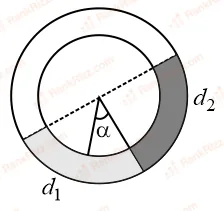
There is a circular tube in a vertical plane. Two liquids which do not mix and of densities d1d_1 and d2d_2 are filled in the tube. Each liquid subtends 90° angle at centre. Radius joining their interface makes an angle α\alpha with vertical. Ratio d1d2\frac{d_1}{d_2} is:

Figure for JEE Main 2014 Physics question on Fluid pressure, Pascal's law and accelerated/rotating liquids
  1. A

    1+sin⁡α1−sin⁡α\frac{1+\sin\alpha}{1-\sin\alpha}

  2. B

    1+cos⁡α1−cos⁡α\frac{1+\cos\alpha}{1-\cos\alpha}

  3. C

    1+tan⁡α1−tan⁡α\frac{1+\tan\alpha}{1-\tan\alpha}

  4. D

    1+sin⁡α1−cos⁡α\frac{1+\sin\alpha}{1-\cos\alpha}

JEE MAIN 2014 · 06 APR OFFLINEFluid pressure, Pascal's law and accelerated/rotating liquids

An open glass tube is immersed in mercury in such a way that a length of 8 cm extends above the mercury level. The open end of the tube is then closed and sealed and the tube is raised vertically up by additional 46 cm. What will be length of the air column above mercury in the tube now? (Atmospheric pressure = 76 cm of Hg)

  1. A

    16 cm

  2. B

    22 cm

  3. C

    38 cm

  4. D

    6 cm