JEE MAIN 2025 · 24 JAN S2Arithmetic progression
In an arithmetic progression, if and , then is equal to:
- A
525
- B
510
- C
515
- D
505
Arithmetic progression has been asked 95 times in JEE Main, in 18 different years between 2004 and 2026, and in all of the last five exam years (2022–2026), 52 questions in all. That is 28% of Sequences and Series, one of its three most-asked topics. Last asked in JEE Main 08 Apr 2026, Shift 2. 76 are multiple choice and 19 numerical-value; 15 easy, 71 medium and 3 hard by our difficulty labels. All of them are below, newest first, free to read.
Questions
95
Years asked
18
Since
2004
Of the chapter
28%
21–40 OF 95 · NEWEST FIRST
In an arithmetic progression, if and , then is equal to:
525
510
515
505
If the first term of an A.P. is 3 and the sum of its first four terms is equal to one-fifth of the sum of the next four terms, then the sum of the first 20 terms is equal to
−1080
−1020
−1200
−120
The roots of the quadratic equation are and terms of an arithmetic progression with common difference . If the sum of the first 11 terms of this arithmetic progression is 88 , then q - 2p is equal to
Suppose that the number of terms in an A.P is . If the sum of all odd terms of the A.P. is 40 , the sum of all even terms is 55 and the last term of the A.P. exceeds the first term by 27, then k is equal to :
6
5
8
4
An arithmetic progression is written in the following way:
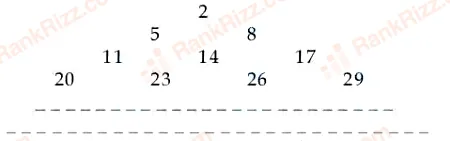
The sum of all the terms of the row is _____
A software company sets up number of computer systems to finish an assignment in 17 days. If 4 computer systems crashed on the start of the second day, 4 more computer systems crashed on the start of the third day and so on, then it took 8 more days to finish the assignment. The value of is equal to:
Let be in an arithmetic progression of positive terms. Let . If and , then is equal to ______
For , the least value of , for which are three consecutive terms of an A.P., is equal to :
8
4
10
16
Let and be two arithmetic progressions. Then the sum of the common terms in them is equal to:
Let denote the sum of the first n terms of an arithmetic progression. If and the ratio of the tenth and the fifth terms is 15 : 7, then is equal to:
800
890
790
690
Let denote the sum of first terms an arithmetic progression. If and , then is :
In an A.P., the sixth term . If the is the greatest, then the common difference of the A.P., is equal to
If are in an A.P. and are also in an A.P., then is equal to
The number of common terms in the progressions up to term and up to term is :
9
5
7
8
The 20th term from the end of the progression is :
-118
-110
-115
-100
Let respectively be the sum of 12 terms of 10 A.P.s whose first terms are and the common differences are respectively. Then is equal to
Let be in an arithmetic progression, with and their mean equal to 200. If , , then the mean of is
10100
10101.50
13382.5
10051.5
Let be an A.P. If the sum of its first four terms is 50 and the sum of its last four terms is 170, then the product of its middle two terms is _____.
The sum of the common terms of the following three arithmetic progressions.
and
, is equal to ______.
Let be in A.P. If and , then is equal to ______.