RankRizz

Sequences and Series — JEE Main Previous Year Questions

Every Sequences and Series question JEE Main has set from 2004–2026, grouped by the idea it tests rather than the order of the syllabus. 337 questions across 8 distinct ideas. Free to read, answer key on every one.

DATA UPDATED

Questions

337

Distinct ideas

8

Share of marks

7.1%

Difficulty

HARD

The ideas inside Sequences and Series

A chapter is not one subject — it is a handful of procedures the examiner reuses. These are the ones Sequences and Series questions actually test.

Every Sequences and Series question

61–80 OF 337 · NEWEST FIRST

JEE MAIN 2025 · 23 JAN S1Arithmetic progression

If the first term of an A.P. is 3 and the sum of its first four terms is equal to one-fifth of the sum of the next four terms, then the sum of the first 20 terms is equal to

  1. A

    −1080

  2. B

    −1020

  3. C

    −1200

  4. D

    −120

JEE MAIN 2025 · 23 JAN S2Arithmetic progression

The roots of the quadratic equation 3x2−px+q=03x^{2} - px + q = 0 are 10th10^{th} and 11th11^{th} terms of an arithmetic progression with common difference 32\frac{3}{2}. If the sum of the first 11 terms of this arithmetic progression is 88 , then q - 2p is equal to

JEE MAIN 2025 · 22 JAN S1Geometric progression and infinite GP

Let a1,a2,a3,...a_1,a_2,a_3,... be a G.P. of increasing positive terms. If a1a5=28a_1a_5 = 28 and a2+a4=29a_2+a_4 = 29, then a6a_6 is equal to:

  1. A

    628

  2. B

    812

  3. C

    526

  4. D

    784

JEE MAIN 2025 · 22 JAN S2Arithmetic progression

Suppose that the number of terms in an A.P is 2k,k∈N2k, k \in N. If the sum of all odd terms of the A.P. is 40 , the sum of all even terms is 55 and the last term of the A.P. exceeds the first term by 27, then k is equal to :

  1. A

    6

  2. B

    5

  3. C

    8

  4. D

    4

JEE MAIN 2024 · 09 APR S1Sums of natural numbers, squares and cubes

If the sum of the series 11⋅(1+d)+1(1+d)(1+2d)+…+1(1+9d)(1+10d)\frac{1}{1 \cdot (1+d)} + \frac{1}{(1+d)(1+2d)} + \ldots + \frac{1}{(1+9d)(1+10d)} is equal to 55, then 50d50d is equal to :

  1. A

    1010

  2. B

    55

  3. C

    1515

  4. D

    2020

JEE MAIN 2024 · 09 APR S2Geometric progression and infinite GP

Let a,ar,ar2,…a, ar, ar^2, \ldots be an infinite G.P. If ∑n=0∞arn=57\sum_{n=0}^{\infty} ar^n = 57 and ∑n=0∞a3r3n=9747\sum_{n=0}^{\infty} a^3 r^{3n} = 9747, then a+18ra + 18r is equal to

  1. A

    46

  2. B

    38

  3. C

    31

  4. D

    27

JEE MAIN 2024 · 09 APR S2Sums of natural numbers, squares and cubes

If (1α+1+1α+2+…+1α+1012)−(12⋅1+14⋅3+16⋅5+…+12024⋅2023)=12024\left(\frac{1}{\alpha+1} + \frac{1}{\alpha+2} + \ldots + \frac{1}{\alpha+1012}\right) - \left(\frac{1}{2 \cdot 1} + \frac{1}{4 \cdot 3} + \frac{1}{6 \cdot 5} + \ldots + \frac{1}{2024 \cdot 2023}\right) = \frac{1}{2024}, then α\alpha is equal to ________

JEE MAIN 2024 · 08 APR S1Sums of natural numbers, squares and cubes

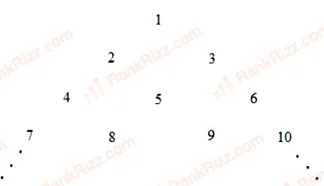
Let the positive integers be written in the form:

Figure for JEE Main 2024 Mathematics question on Sums of natural numbers, squares and cubes

If the kthk^{th} row contains exactly kk numbers for every natural number kk, then the row in which the number 5310 will be, is ________

JEE MAIN 2024 · 08 APR S2Geometric progression and infinite GP

In an increasing geometric progression of positive terms, the sum of the second and sixth terms is 703\frac{70}{3} and the product of the third and fifth terms is 49. Then the sum of the 4th4^{th}, 6th6^{th} and 8th8^{th} terms is equal to :

  1. A

    96

  2. B

    91

  3. C

    84

  4. D

    78

JEE MAIN 2024 · 08 APR S2Arithmetic progression


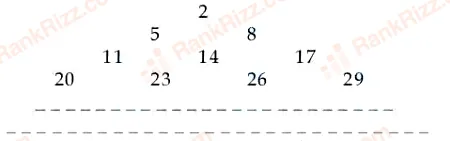
An arithmetic progression is written in the following way:

page12_img1


The sum of all the terms of the 10th10^{th} row is _____

JEE MAIN 2024 · 06 APR S1Sums of natural numbers, squares and cubes

Let the first term of a series be T1=6T_1 = 6 and its rthr^{th} term Tr=3Tr−1+6rT_r = 3T_{r-1} + 6^r, r=2,3,…,nr = 2, 3, \ldots, n. If the sum of the first nn terms of this series is 15(n2−12n+39)(4⋅6n−5⋅3n+1)\frac{1}{5}(n^2 - 12n + 39)(4 \cdot 6^n - 5 \cdot 3^n + 1), then nn is equal to ______

JEE MAIN 2024 · 06 APR S2Geometric progression and infinite GP

Let ABCABC be an equilateral triangle. A new triangle is formed by joining the middle points of all sides of the triangle ABCABC and the same process is repeated infinitely many times. If PP is the sum of perimeters and QQ is be the sum of areas of all the triangles formed in this process, then :

  1. A

    P2=63QP^2 = 6\sqrt{3}Q

  2. B

    P2=363QP^2 = 36\sqrt{3}Q

  3. C

    P=363Q2P = 36\sqrt{3}Q^2

  4. D

    P2=723QP^2 = 72\sqrt{3}Q

JEE MAIN 2024 · 06 APR S2Arithmetic progression

A software company sets up mm number of computer systems to finish an assignment in 17 days. If 4 computer systems crashed on the start of the second day, 4 more computer systems crashed on the start of the third day and so on, then it took 8 more days to finish the assignment. The value of mm is equal to:

  1. A

    150150

  2. B

    180180

  3. C

    160160

  4. D

    125125

JEE MAIN 2024 · 06 APR S2Sums of natural numbers, squares and cubes

If S(x)=(1+x)+2(1+x)2+3(1+x)3+⋯+60(1+x)60S(x) = (1+x) + 2(1+x)^2 + 3(1+x)^3 + \cdots + 60(1+x)^{60}, x≠0x \neq 0, and (60)2S(60)=a(b)b+b(60)^2 S(60) = a(b)^b + b, where a,b∈Na, b \in N, then (a+b)(a + b) equal to ___________

JEE MAIN 2024 · 05 APR S1Sums of natural numbers, squares and cubes

If 11+2+12+3+…+199+100=m\frac{1}{\sqrt{1}+\sqrt{2}} + \frac{1}{\sqrt{2}+\sqrt{3}} + \ldots + \frac{1}{\sqrt{99}+\sqrt{100}} = m and 11⋅2+12⋅3+…+199⋅100=n\frac{1}{1 \cdot 2} + \frac{1}{2 \cdot 3} + \ldots + \frac{1}{99 \cdot 100} = n, then the point (m,n)(m, n) lies on the line

  1. A

    11(x−1)−100(y−2)=011(x - 1) - 100(y - 2) = 0

  2. B

    11x−100y=011x - 100y = 0

  3. C

    11(x−2)−100(y−1)=011(x - 2) - 100(y - 1) = 0

  4. D

    11(x−1)−100y=011(x - 1) - 100y = 0

JEE MAIN 2024 · 05 APR S1Arithmetic progression

Let a1,a2,a3,…a_1, a_2, a_3, \ldots be in an arithmetic progression of positive terms. Let Ak=a12−a22+a32−a42+…+a2k−12−a2k2A_k = a_1^2 - a_2^2 + a_3^2 - a_4^2 + \ldots + a_{2k-1}^2 - a_{2k}^2. If A3=−153,A5=−435A_3 = -153, A_5 = -435 and a12+a22+a32=66a_1^2 + a_2^2 + a_3^2 = 66, then a17−A7a_{17} - A_7 is equal to ______

JEE MAIN 2024 · 05 APR S2Arithmetic progression

For x≥0x \geq 0, the least value of KK, for which 41+x+41−x,K2,16x+16−x4^{1+x} + 4^{1-x}, \frac{K}{2}, 16^x + 16^{-x} are three consecutive terms of an A.P., is equal to :

  1. A

    8

  2. B

    4

  3. C

    10

  4. D

    16

JEE MAIN 2024 · 05 APR S2Arithmetico-geometric progression

If 1+3−223+5−2618+93−112363+49−206180+…1 + \frac{\sqrt{3} - \sqrt{2}}{2\sqrt{3}} + \frac{5 - 2\sqrt{6}}{18} + \frac{9\sqrt{3} - 11\sqrt{2}}{36\sqrt{3}} + \frac{49 - 20\sqrt{6}}{180} + \ldots upto ∞=2+(ba+1)log⁡e(ab)\infty = 2 + \left(\sqrt{\frac{b}{a}} + 1\right)\log_e\left(\frac{a}{b}\right), where aa and bb are integers with gcd⁡(a,b)=1\gcd(a, b) = 1, then 11a+18b11a + 18b is equal to ______

JEE MAIN 2024 · 04 APR S1Geometric progression and infinite GP

Let the first three terms 2, p and q, with q ≠ 2, of a G.P. be respectively the 7th, 8th and 13th terms of an A.P. If the 5th5^{th} term of the G.P. is the nthn^{th} term of the A.P., then n is equal to:

  1. A

    163163

  2. B

    151151

  3. C

    177177

  4. D

    169169

JEE MAIN 2024 · 04 APR S2Sums of natural numbers, squares and cubes

The value of 1×22+2×32+…+100×(101)212×2+22×3+…+1002×101\frac{1 \times 2^2 + 2 \times 3^2 + \ldots + 100 \times (101)^2}{1^2 \times 2 + 2^2 \times 3 + \ldots + 100^2 \times 101} is

  1. A

    3231\frac{32}{31}

  2. B

    3130\frac{31}{30}

  3. C

    306305\frac{306}{305}

  4. D

    305301\frac{305}{301}